
Most people with an annular tear do not need surgery, and many improve with time and conservative care. If the pain has lasted despite that care and the tear is confirmed as the source, endoscopic spine surgery is an option in Florida that does not involve fusion.
I am Dr. Tony Mork, a board-certified orthopedic surgeon. I have practiced endoscopic spine surgery exclusively since 1998 and have performed more than 8,000 endoscopic spine procedures. My office in Naples, Florida, sees patients from Southwest Florida and beyond. Here is how I explain annular tears to someone sitting across from me.
TL;DR
- Start with time: Many back problems improve with time, activity changes, physical therapy, medication and injections.
- Diagnosis first: An exam and an MRI (magnetic resonance imaging) are needed to know for sure whether a tear is the source of your pain.
- Surgery goal: The aim is to remove the source of pain, not only manage it.
- Endoscopic surgery: Small incision, camera, outpatient, no hardware, no fusion. Results vary.
- Fusion: It is a last resort and can still be done later if needed.
What is an annular tear?
An annular tear is a crack or split in the tough outer wall of a spinal disc. The disc works like a liquid-filled cushion with a firm wall. When the wall splits, the cushion can no longer absorb load the way it should.
The outer wall is called the annulus. Its fibers contain nerve endings, so a tear can hurt even when no disc material has pushed out.
A 2020 peer-reviewed MRI review notes that these fissures are generally a chronic, degenerative process rather than one sudden injury. Many tears are also found in people with no pain, which is why the tear on your report must match your symptoms.
What does an annular tear feel like?
The pain is often deep, in the middle of the low back, and worse with sitting. Common ways it shows up in daily life:
- Sitting: A long workday or a drive becomes hard to tolerate.
- Bending: Putting on shoes or lifting a grandchild brings a sharp catch.
- Recurrence: Your back “goes out” repeatedly without a clear reason.
- Referred pain: Groin, tailbone or leg burning when hips and hernia checks came back normal.
- Exercise: Lifting or golf is limited by an injury that never healed.
These patterns can also come from other problems. I cannot diagnose you from a description, and neither can an article.
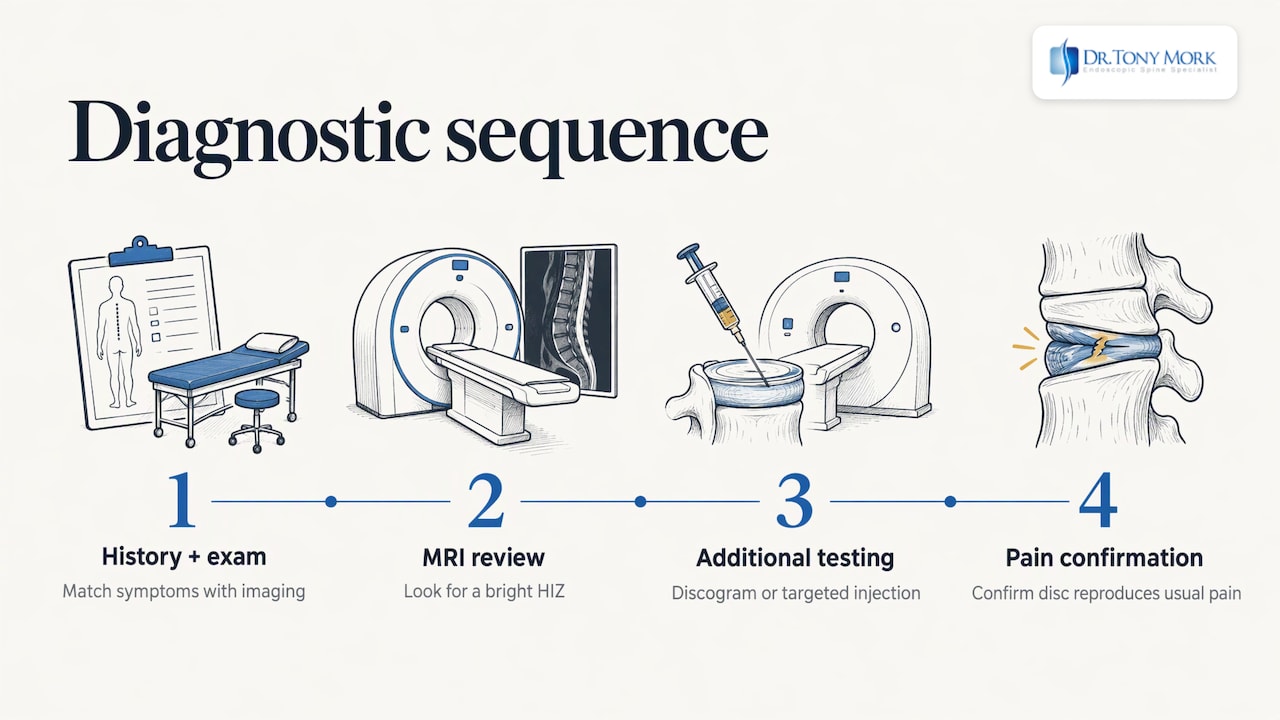
How do doctors confirm that a tear is causing the pain?
They match your history and exam with imaging. On MRI, a tear often appears as a bright line in the disc wall, sometimes called a high intensity zone (HIZ). The same review describes this signal on T2-weighted images, the MRI setting that shows fluid brightly.
Sometimes the MRI is not enough. A CT (computed tomography) discogram can help. Dye is placed in the disc under imaging, and your response to the pressure shows whether that disc reproduces your usual pain. A 2012 review of diagnostic testing describes discography as the test that directly evaluates the pain response, appropriate when nonoperative treatment has failed and nothing else explains the pain.
A targeted injection can serve the same purpose. A 2023 study in the Journal of Sexual Medicine used a step-by-step approach of history, noninvasive assessment and diagnostic injections before endoscopic surgery, in patients with tear-related pain that included genital symptoms.
Accurate diagnosis comes before surgery. Always.
If you want to know how my office reviews a case, see the spine surgery evaluation process.
What should I try before surgery?
Conservative care comes first, because time is on your side. Many back problems improve without an operation.
- Time and activity changes: Avoid what flares the pain, but keep moving. The spine was designed to move.
- Physical therapy: Guided exercise helps many people. If it makes your pain worse, tell your therapist and your doctor.
- Medication: Take it as prescribed. Never stop a medication without talking with the doctor who prescribed it.
- Injections: An epidural steroid injection (ESI) places anti-inflammatory medicine near the irritated nerve. Relief is sometimes short-lived.
For a herniated disc with nerve pain, the ISASS 2019 policy supports considering surgery after six weeks of unsuccessful nonsurgical care, or sooner for severe symptoms. That guideline addresses herniation with radiculopathy (nerve pain down the leg), not an isolated tear. The decision also rests on your history, exam and imaging that matches your symptoms.
When does surgery make sense for an annular tear?
Surgery makes sense when conservative care has not worked, your pain has been traced to a specific disc, and the pain limits your life. Three things need to line up:
- Symptoms: They fit the pattern of a painful disc.
- Imaging: The MRI or discogram points to the same level.
- Time: You have given conservative care a fair trial.
If you were told fusion is your only option, ask whether the source of pain has been clearly identified. The World Federation of Neurosurgical Societies recommendations state that lumbar fusion is not routine treatment for a first-time disc herniation. I consider fusion a last resort, and it can still be done later if needed. My page on alternatives to lumbar fusion explains the options.
What is endoscopic surgery for an annular tear?
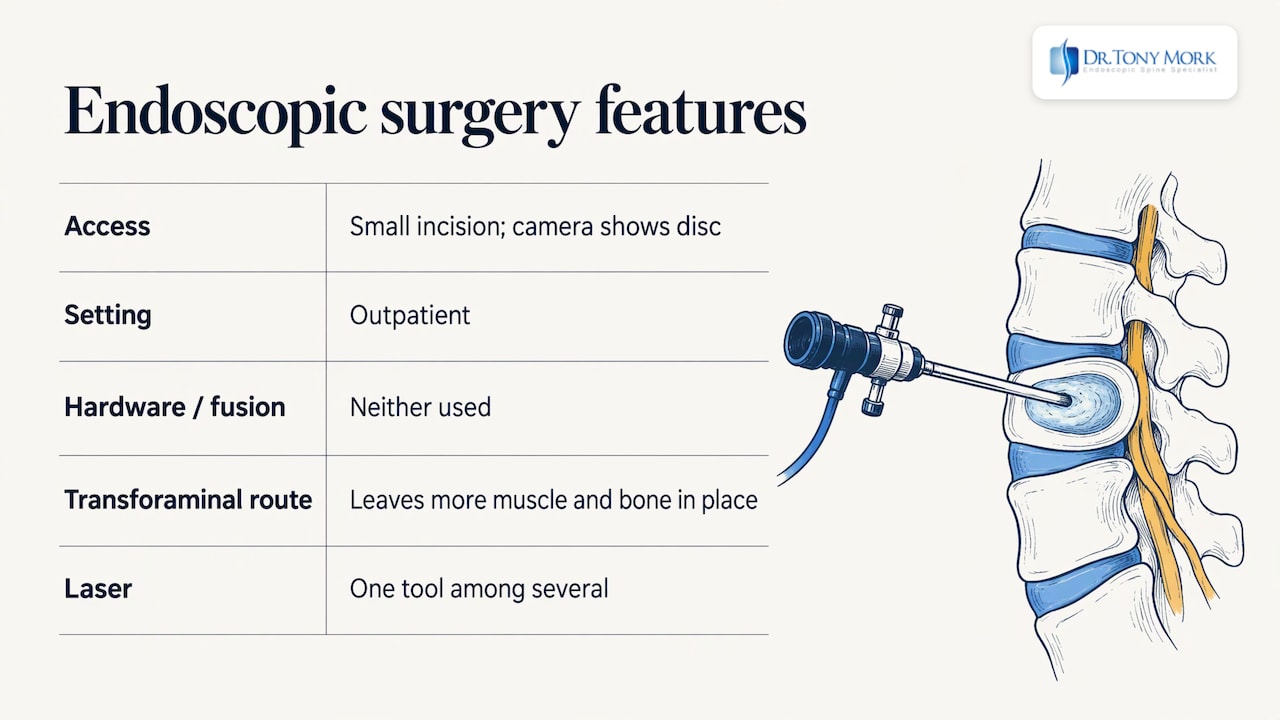
Endoscopic spine surgery uses a small incision and a camera. It is outpatient, with no hardware and no fusion. Through a narrow tube I can see the disc and the nerve on a screen and treat the painful area directly.
The goal is to remove the source of pain, not just manage it. For a tear, that can mean treating the torn wall and any disc material pressing on a nerve. A laser is one tool among several. It is never a cure by itself.
The term “minimally invasive” describes how much healthy tissue is disturbed, not only how small the incision is. Reaching the disc through the natural opening beside the spine, the transforaminal approach, leaves more muscle and bone in place. I describe it in lumbar transforaminal approach for disc herniation.
See also my pages on annular tear treatment and toxic annular tears.
What does the evidence say, and what are the limits?
Honest pros and cons matter. The ISASS policy says endoscopic discectomy offers a smaller incision and less soft-tissue damage, which may be associated with faster recovery. In a randomized trial it cites, the endoscopic group had fewer days of work disability (25 versus 49) than the microdiscectomy group.
The same policy lists the downsides. The approach has a learning curve and is technically challenging for many surgeons. The WFNS recommendations add that there is not enough evidence to favor one specific procedure over another, and that minimally invasive techniques show short-term advantages.
Other limits you should know:
- Recurrence: A larger defect in the disc wall after surgery is linked to a higher chance of the disc herniating again, according to the ISASS review of the research.
- Not every case: Some conditions, such as significant instability, call for a different plan.
- Results vary: I cannot promise a pain-free result or a set recovery time.
All surgery carries risks, including infection, bleeding, nerve irritation and a possible need for more treatment. We discuss them in detail before you decide.
What is recovery like?
Recovery often takes days to weeks to return to ordinary activities, and many patients report getting back to regular routines quickly. Results vary with your age, the condition and your job. Heavy lifting and sports come back in stages.
You go home the same day. My concierge practice gives you direct access to me and immediate post-operative support, so you are never guessing about a symptom alone.
Where can I get endoscopic spine surgery in Florida?
My Naples office serves Southwest Florida, and patients also travel to me from across the state and the country. My Irvine office is at 2102 Business Center Dr #127, Irvine, CA 92612. Read about my Naples office and endoscopic spine surgery in Florida.
I founded the Endoscopic Spine Academy and co-founded Microspine. Insurance may cover facility and anesthesia fees, but not the surgeon’s fee, and payment is required before surgery.
You do not have to be in Florida for the first step. I can evaluate your MRI or CT scan remotely, and you can set up a phone appointment with me. Learn about endoscopic spine surgery and the herniated disc treatment I offer.
What do I think about annular tears?
I see many people who have been told their MRI is normal, or that a tear is “just wear and tear,” while sitting through a workday has become a struggle. My view is simple. Find the source of the pain first. Then treat that source.
Because the spine was designed to move, I do not reach for fusion early. It stays a last resort, available later if it is needed. When a disc is the confirmed source, an endoscopic approach lets me work through a small incision with a camera, with no hardware and no fusion.
I have done this work exclusively since 1998, and my practice is built around direct access to the surgeon. Results vary, and some people will never need an operation. My job is to tell you which group you are in.
Dr. Tony Mork
FAQ
Can an annular tear heal on its own?
Some tears become less painful over time, and many back problems improve with time and conservative care. An exam and an MRI are needed to know what is happening in your case. If the pain persists, talk with your doctor about next steps.
Is annular tear surgery always a fusion?
No. Endoscopic surgery involves a small incision, a camera, no hardware and no fusion. Fusion is a last resort and can still be done later if needed.
How is a bulging disc different from an annular tear?
A bulging disc is a disc that extends beyond its normal edge. A tear is a split in the disc wall. They can occur together, which is why imaging and your symptoms must be read together. See my page on bulging disc treatment.
Do I have to live in Florida to see you?
No. I review MRI and CT scans remotely, and my offices are in Naples, Florida and Irvine, California. Many patients travel for endoscopic spine surgery.
If you have an MRI, upload it and I will review it personally and talk with you about your options. Request a consultation.
Recommended
- Annular Tear Surgery | Annular Tear Treatment Options
- Annular Tears & Annular Fissures | Everything You Need To Know
- Annular Tear Assessment
- Where can I get endoscopic spine surgery in Florida?
This article is for general education and is not medical advice. Please see a qualified doctor about your symptoms.