Revision spine surgery is another operation on the spine after a previous one, done when symptoms return or the first surgery did not fix the problem. You do not need it just because pain came back, and accurate diagnosis always comes before any decision to operate.
I am Dr. Tony Mork, a board-certified orthopedic surgeon. I have practiced endoscopic spine surgery exclusively since 1998 and have performed more than 8,000 endoscopic spine procedures. Many of the patients who come to my office have already had surgery and are still struggling to sit through a workday, drive, or sleep through the night. This article explains what is going on and what your options are.
TL;DR
- Definition: Revision surgery is a repeat operation on the spine, done to correct a specific problem that a prior surgery left behind or caused.
- First step: Finding the exact source of pain comes before any operation. An exam and an MRI (magnetic resonance imaging) are needed to know for sure.
- Not always surgery: Some causes of pain after surgery, such as scar tissue, are usually managed without another operation.
- Minimally invasive options: In selected patients, an endoscopic procedure (small incision, camera, outpatient, no hardware, no fusion) may address a recurrent problem. Results vary.
- Fusion: Fusion is a last resort, and it can still be done later if needed.
What does revision spine surgery actually mean?
It means a second (or third) operation at or near the site of an earlier spine surgery. The goal is to remove the source of pain, not just manage it.
People usually come to it in one of two ways. Either the first surgery did not address the true pain generator (the structure actually causing your pain), or a new problem developed afterward. Persistent pain after spine surgery is sometimes called failed back surgery syndrome. A 2019 consensus statement in a peer-reviewed journal defines it as back or leg pain lasting at least six months after the most recent spine surgery, after a thorough clinical and imaging assessment, when there is no clear surgical target and the treating team agrees more surgery is not appropriate.
That definition matters. It tells you that when there is a clear, fixable target, revision may be reasonable. When there is not, another operation is not the answer.
Why does pain come back after spine surgery?
There is rarely one reason. A 2024 review in Pain Practice groups the causes of ongoing pain after spine surgery into these categories:
- Wrong target: The procedure or the level treated did not match the real source of pain, for example a fusion done for pain that was coming from the sacroiliac joint (where the spine meets the pelvis).
- Technical problem: A piece of disc left behind, or a fusion that never fully healed (pseudoarthrosis).
- Mechanical change: The segment next to a fusion takes on extra stress and wears faster. This is called adjacent segment disease.
- Complications: Excess scar tissue around nerves, or irritation of a nerve root.
- Unknown: Some cases have no clear cause even after a full workup.
The same review reports that a disc can herniate again, with re-herniation (the same disc pushing out a second time) ranging from about 10% to over 25% at 2 years in the studies it describes. Those numbers come from that review, and individual risk varies.
The spine was designed to move. Every time a segment is fused, the segments above and below carry more of that motion. That is one reason I treat fusion as a last resort.
How do you find the cause before deciding on another operation?
You start with a careful history, a physical exam, and the right imaging. The 2024 Pain Practice review describes the workup as history, examination, X-rays, MRI with contrast dye, CT (computed tomography) to look at hardware and fusion, and CT myelography (a CT after dye is placed around the nerves) when metal implants block MRI or scar tissue around nerves is suspected.
The consensus statement matches the test to the question:
- Recurrent disc herniation: MRI.
- Instability (a segment that moves too much): CT or MRI plus bending X-rays.
- Balance of the whole spine: full standing X-rays.
- Fusion that did not heal: X-ray, CT, or nuclear imaging.
- New narrowing or infection: MRI and CT.
It also notes that problems such as low-grade infection, inflammation of the nerve coverings, or scar tissue usually do not call for reoperation and are managed without surgery. That is good news for many people.
If you have images from before and after your surgery, they are the most useful starting point. My office offers remote MRI and CT scan evaluation, so you can be reviewed from anywhere. Learn how the process works on my spine surgery evaluation process page.
Is revision surgery always the answer?
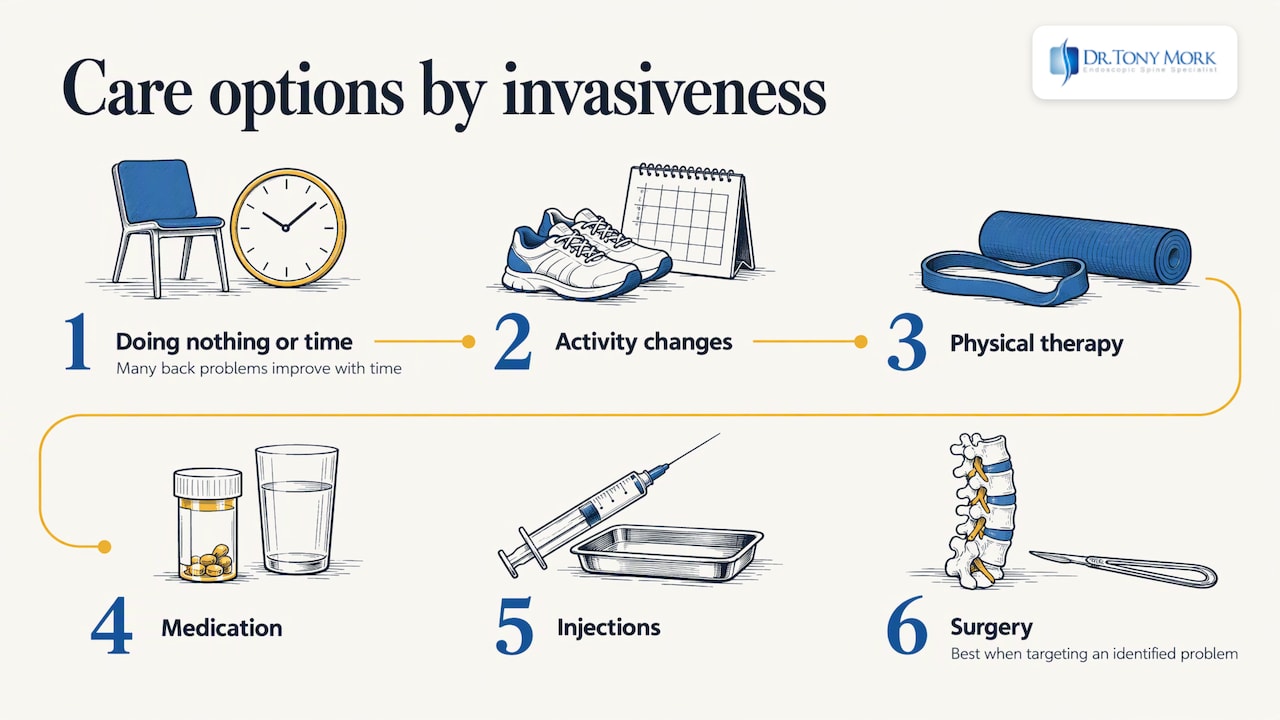
No. Conservative care comes first where it fits: time, activity changes, physical therapy, medication, and injections. Many back problems improve with time. Time is on your side more often than people expect.
Guidelines on informed consent from the American Society of Pain and Neuroscience, published in 2023, recommend that patients hear every alternative, including doing nothing, laid out from least to most invasive. That is how I talk with patients too.
Honest limits matter here. A 2024 review of chronic pain after spine surgery reports that revision surgery for this condition has a low success rate overall, and that among patients who had instrumented fusion as the repeat operation, only 35% reported pain reduction for about 15 months. Another 2024 review reports that operating only to remove scar tissue is effective in just 5% to 30% of patients.
Those figures are why diagnosis matters so much. Surgery works best when it targets a specific, identified problem, such as a recurrent herniation pressing on a nerve or a narrowed nerve opening. It works poorly as a general response to pain with no clear cause.
I never promise outcomes. Results vary.
What kinds of problems can revision surgery treat?
The common targets are specific structural problems that show up on imaging and match your symptoms:
- Recurrent herniated disc: A disc that pushes out again at a level treated before. See my page on recurrent herniated disc treatment without fusion.
- Foraminal stenosis: Narrowing of the opening where a nerve leaves the spine, like a waterway that has narrowed and slows the flow. Read about foraminal stenosis treatment.
- Retained disc fragment: A piece of disc left behind that keeps irritating a nerve.
- Hardware problems: Screws or rods that are causing pain.
- Adjacent segment problems: Wear at the level next to a prior fusion.
The pain from these problems often shows up in daily life: burning down the leg when you put on shoes, a deep ache after sitting through a workday, numbness while driving. If any of this sounds familiar, I cannot diagnose you from a description. An exam and an MRI are needed to know for sure.
My page on post-laminectomy syndrome treatment covers persistent pain after a prior decompression in more detail.
Can revision surgery be done with an endoscope instead of fusion?
In selected patients, yes. Endoscopic spine surgery means a small incision, a camera, outpatient care, no hardware, and no fusion. “Minimally invasive” refers to how much healthy tissue is disturbed, not only how small the incision is. Learn more on my endoscopic spine surgery page.
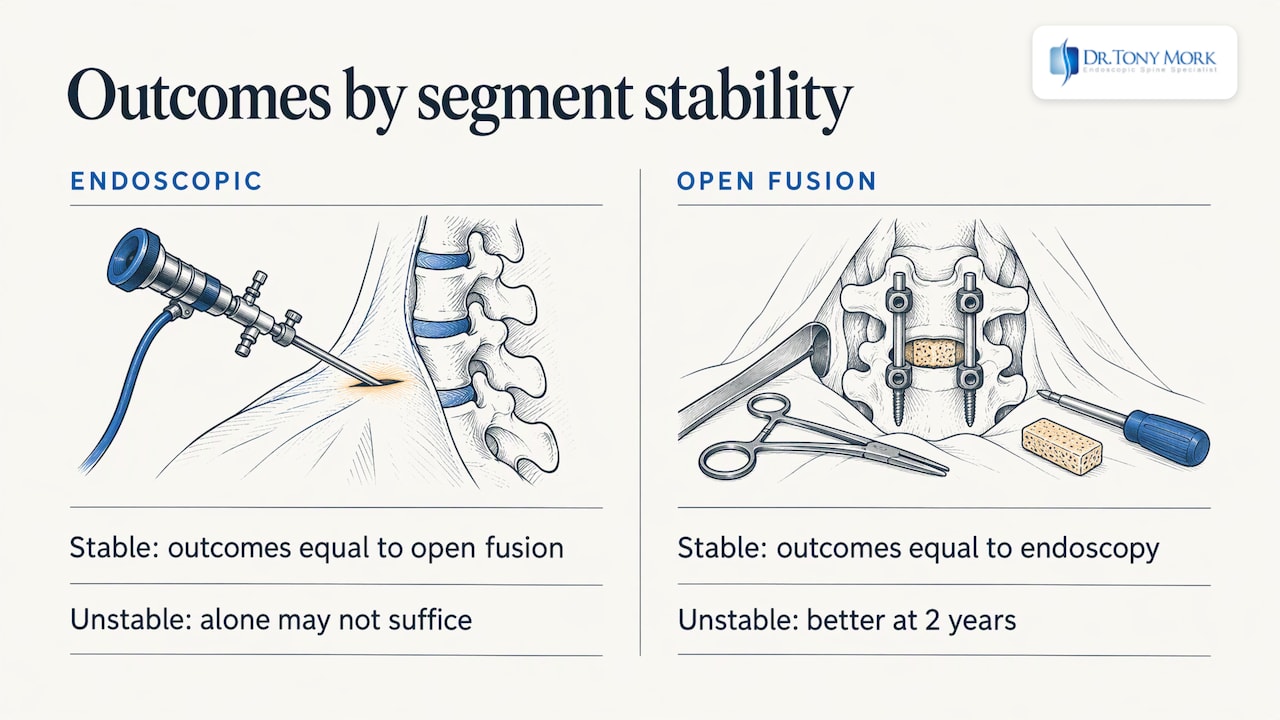
The evidence is still developing for revision work. A 2024 narrative review in the Journal of Spine Surgery reports early promising results for endoscopic foraminal decompression in previously fused segments and for hardware removal. It also says decompression at the adjacent segment is challenging and needs more study. For stable adjacent-segment disease, one study it describes found outcomes equal to an open revision fusion, while the open fusion did better at 2 years for unstable segments.
That last point is a real limit. If a segment is truly unstable, an endoscopic decompression alone may not be enough, and I will tell you so. The International Society for the Advancement of Spine Surgery’s 2019 guideline states that endoscopic discectomy allows direct visualization of the herniated disc with less tissue damage and faster recovery, with results similar to open discectomy, and that the transforaminal approach has a learning curve.
The laser is one tool in this work, never a cure by itself. For a closer look at an endoscopic disc removal, see my herniated disc treatment page.
What about spinal cord stimulation and injections?
These are options to discuss, and they sit on the spectrum of care. A 2025 narrative review notes that spinal cord stimulation was one of the first treatments studied for patients with pain after laminectomy, and that trials showed greater pain relief and better function than medical management alone at 6 and 24 months. It also says repeat epidural injections may be considered when they give at least 50% pain reduction.
If your epidural injections gave only short relief, that tells me something useful: the nerve is probably inflamed by something real, and finding that source is the next step. Do not stop any medication without talking to your doctor.
What is recovery like?
Recovery depends on what was done. After an endoscopic procedure, many patients go home the same day and return to light daily activity within days. Recovery often takes longer for full activity such as lifting, golf, or picking up a grandchild, and results vary. Open revision surgery, particularly with fusion, generally involves a longer recovery and often a hospital stay.
Every operation carries risks, including infection, bleeding, nerve injury, and the chance that pain does not improve. I will go through the risks that apply to you, in plain numbers, before you decide anything.
What does my practice offer?
My practice is a concierge practice, which means you have direct access to me and immediate post-operative support. I offer remote MRI and CT evaluation, phone consultations, and guidance on both surgical and non-surgical options. My goal is a procedure designed to avoid fusion whenever that is appropriate.
You can be seen in my Irvine office at 2102 Business Center Dr #127, Irvine, CA 92612, or at my Naples, Florida office. Patients also travel from other states. See Spine Surgeon Irvine, CA or Spine Surgeon Naples, FL. Insurance may cover facility and anesthesia fees, but not the surgeon’s fee.
I also founded the Endoscopic Spine Academy and co-founded Microspine. That experience shapes how I look at a failed surgery: I want to know exactly why it failed before suggesting anything new.
A word from my practice
Patients are often told that a second operation means a fusion. In my experience that is not the only path. The spine was designed to move, and I want to keep that motion whenever I safely can.
My approach is to find the true source of your pain first, then remove it with the least disturbance of healthy tissue. Fusion remains a last resort, and it can still be done later if it is truly needed.
I will tell you honestly when an endoscopic approach fits and when it does not.
Dr. Tony Mork
FAQ
What is the difference between revision surgery and failed back surgery syndrome?
Revision surgery is an operation. Failed back surgery syndrome is a description of ongoing pain after surgery, usually defined as lasting at least six months. Some people with that pain have a fixable target and a revision may help. Others do not, and other treatments are used.
How soon after surgery should I worry about new pain?
Some soreness is expected in the first weeks. Call your surgeon promptly for fever, wound drainage, new weakness, or loss of bladder or bowel control. Problems such as infection, hardware trouble, or a recurrent herniation within the first six months should be found and treated quickly, according to the 2019 consensus statement.
Does revision surgery always mean fusion?
No. Some revisions are decompressions, disc removals, or hardware removal. Fusion is a last resort, and my page on alternatives to spinal fusion explains the options.
Can I be evaluated if I live out of state?
Yes. I can review your MRI or CT scans remotely and talk with you about your options. Many out-of-state patients start this way before deciding whether to travel.
If you have an MRI or CT from before and after your surgery, upload it and request a consultation. I will review it personally and talk with you about your options.
Recommended
- When should I consider spine surgery?
- Can I have spine surgery without fusion in California?
- Can a recurrent herniated disc be treated without fusion?
- What is the treatment for post-laminectomy syndrome?
This article is for general education and is not medical advice. Please see a qualified doctor about your symptoms.