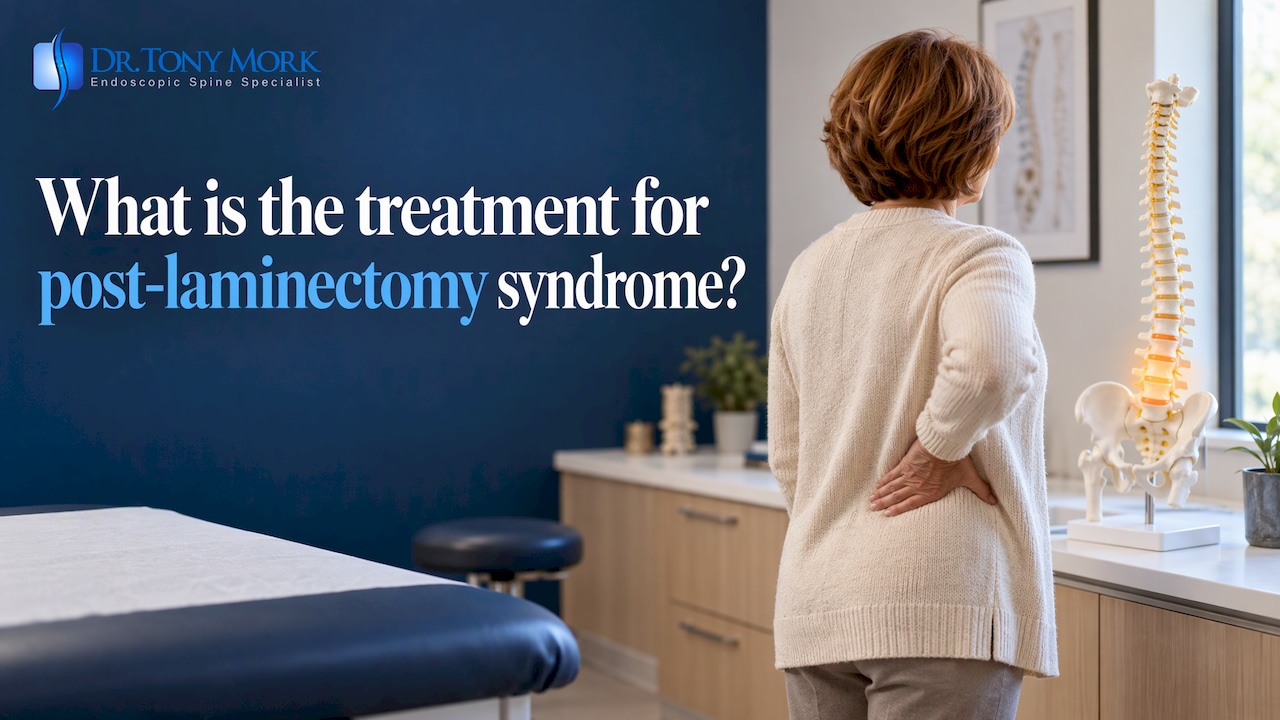
Treatment depends on what is causing your pain, so finding the cause comes first. Post-laminectomy syndrome, also called failed back surgery syndrome, means pain that continues or returns after a spine operation. It is often treated first with time, activity changes, physical therapy and medication, and sometimes with a second look at the spine to remove the source of pain.
I am Tony Mork, MD, a board-certified orthopedic surgeon. I have practiced endoscopic spine surgery exclusively since 1998. If your back or leg still hurts after a laminectomy, you are not alone, and you have more options than you may have been told.
TL;DR
- Diagnosis first: An exam and an MRI (magnetic resonance imaging) are needed to know for sure why you still hurt. Accurate diagnosis comes before any surgery.
- Conservative care first: Time, activity changes, physical therapy, medication and injections are the usual first steps when there are no warning signs.
- Different causes, different answers: Scar tissue, a new disc herniation, a nerve that is still pinched and a painful facet joint each need a different plan.
- Fusion is a last resort: It can still be done later if needed. Many second operations do not require it.
- Endoscopic revision may fit some patients: It uses a small incision and a camera, is outpatient, and uses no hardware. Results vary.
What is post-laminectomy syndrome?
It is a label for ongoing pain after a laminectomy, not a single diagnosis. A laminectomy (removing part of the bony roof of the spinal canal, called the lamina, to give the nerves more room) is done for conditions such as spinal stenosis. Spinal stenosis is a narrowing of the spinal canal or nerve openings.
Think of stenosis like a narrowing in a waterway. When the channel tightens, everything squeezed through it backs up. A laminectomy widens the channel. If you still have pain afterward, something other than that narrowing may be at work, or the narrowing was not fully relieved.
Patients describe it in daily terms:
- Sitting: Pain builds through a workday or a long drive.
- Sleeping: You cannot find a position that settles your back or leg.
- Bending: Putting on shoes or picking up a grandchild brings back the old burning or ache.
- Walking: Leg numbness or heaviness returns after a short distance.
Why does my back still hurt after a laminectomy?
There are several common reasons, and more than one can be present at once. Naming the right one matters, because the treatment changes with it.
- Scar tissue: The body heals with scar, and scar can sometimes tether or irritate a nerve.
- A new or recurrent disc herniation: A disc (the cushion between two vertebrae, the bones of the spine) can bulge or tear again at the same level or a nearby one.
- Leftover nerve compression: The nerve opening, called the foramen, may still be tight. Foraminal stenosis is narrowing of the opening where a nerve leaves the spine. A laminectomy does not always reach it. You can read more in my article on foraminal stenosis symptoms and causes.
- Facet joint pain: The facet joints are small joints at the back of the spine. They can become painful after open surgery changes how the spine carries load. I explain this in facet syndrome after open laminectomy.
- Disc pain: A disc with a tear in its outer wall can hurt on its own, even when the nerves are free. My page on how discogenic back pain is treated covers this.
- Instability: Sometimes a segment moves more than it should after bone and joint are removed.
The original surgery may have been appropriate and well done. Pain can still come from a second source that was never the target.
How do you find the cause of pain after surgery?
You start with a careful history and a physical exam, then imaging that matches your symptoms. I do not recommend a second operation until the source of pain is clear.
The workup often includes:
- History: When did the pain start? Did it ever improve after surgery, or did it never go away? Pain that returns after a good period feels different from pain that never left.
- Exam: Strength, reflexes, sensation and how you move.
- MRI: It shows discs, nerves, scar and narrowing. Sometimes contrast dye is used to tell scar from a new herniation.
- X-rays: Pictures taken bending forward and backward can show whether a segment is moving too much.
- CT (computed tomography) scan: It shows bone detail well.
- Lab tests: If you have fever or a wound that does not heal, blood tests help check for infection.
Metal hardware from earlier surgery can blur some MRI images. That is one reason a surgeon who reads these scans every day is useful.
Call your surgeon or seek urgent care right away if you have new leg weakness, trouble controlling your bladder or bowels, numbness in the groin or saddle area, or fever with new back pain. Those symptoms need prompt attention.
What can I try without another operation?
Many patients start here, and many back problems improve with time. If you have no warning signs, conservative care is the right first step.
- Time and activity: Short walks, changing positions often and avoiding the movements that flare you up.
- Physical therapy: A therapist who knows your surgical history can build strength and flexibility safely. Muscles that guard a painful spine often weaken, and targeted exercise helps them.
- Medication: Anti-inflammatory drugs help some types of pain. Nerve pain often responds to different medicines than muscle pain. Talk with your doctor before you change or stop anything you take.
- Injections: An epidural steroid injection (placing anti-inflammatory medicine near an irritated nerve) can calm a flare. Relief often lasts weeks to months and sometimes does not last at all.
The honest limit of these tools is that they manage pain. They do not remove its source. They are still worth trying when your symptoms allow it, and they help us learn which structure is hurting. If an injection to one spot gives clear relief, that tells us something useful.
I also see patients whose back pain got worse with therapy, or whose relief from injections never lasted. That pattern is a signal to look harder for the cause rather than repeat the same treatment.
When is spinal cord stimulation considered?
Spinal cord stimulation is an implanted device that sends mild electrical pulses to change how pain signals reach the brain. It is often offered when pain continues after other treatments and no clear surgical target is found.
Its strength is that it can reduce pain for some people. Its limit is that it does not remove the cause. It requires hardware, a procedure to place it, and follow-up care. Device-related problems such as lead movement or infection can occur, and research reviews report that they are not rare.
My approach is different. When imaging and exam point to a specific structure, I prefer to treat that structure. If no such target exists, pain management options are reasonable, and I will tell you so.
When is revision surgery the right choice?
Revision surgery makes sense when a clear, correctable source of pain matches your symptoms and conservative care has not given you enough relief. It is more urgent when weakness is progressing or bladder and bowel function change.
Common targets include:
- A recurrent herniation pressing on a nerve.
- A tight nerve opening that was never fully released.
- A painful facet joint that can be treated directly.
- A torn disc that is the pain generator.
I want to be direct about a fact that applies to the whole field: repeat open surgery on a spine that has already been operated on has a lower chance of success than a first operation, and scar makes it harder. That is a major reason I use a different route to the problem.
Can endoscopic spine surgery help after a failed laminectomy?
For some patients, yes. Endoscopic spine surgery is done through a small incision with a camera. It is outpatient, uses no hardware and involves no fusion. I use a tool called a laser at times, but a laser is one instrument among several. It is never a cure by itself.
“Minimally invasive” does not only describe incision size. It describes how much healthy tissue is disturbed. The endoscopic route lets me work through a narrow corridor, often to the side of the old surgical area, so I can reach a nerve or disc without dissecting through scar and muscle again. You can read the details in my guide to endoscopic spine surgery or on the page about endoscopic spine surgery.
Depending on your diagnosis, the procedure may be:
- Endoscopic discectomy: Removing disc material that presses on a nerve. See endoscopic discectomy.
- Endoscopic foraminal decompression: Opening the passage where the nerve exits. See foraminal decompression.
- Endoscopic decompression: Relieving central narrowing that remains. See endoscopic decompression for stenosis.
- Facet treatment: Addressing a painful joint. See facet joint syndrome endoscopic surgery.
Many patients report a shorter recovery than they had after open surgery. Recovery often takes days to weeks for daily activities, and results vary. I cannot promise a pain-free outcome or an exact timeline.
What are the limits of the endoscopic approach?
It is not right for everyone. A spine that is clearly unstable, or a deformity that needs realignment, may call for a different operation. Heavy scar can make any revision harder. And if your pain has no identifiable structural source, surgery will not help. That is why the evaluation comes first. I cover the trade-offs in the pros and cons of endoscopic spine surgery.
Does a second spine surgery mean fusion?
No. The spine was designed to move, and I try to keep that motion. Fusion permanently joins vertebrae. I see it as a last resort, and it can still be done later if it is truly needed. Choosing a motion-preserving operation now does not close that door.
If you have been told fusion is your only option, ask what specific problem it would fix. Then get a second evaluation of the cause. My overview of spinal fusion alternatives explains what else may be possible.
My goal is to remove the source of your pain, not to manage it indefinitely. Sometimes that source is a nerve still pinched by a bit of disc. Sometimes it is a joint. Finding it is the work.
What is cervical post-laminectomy syndrome?
It is the same idea in the neck: pain, arm symptoms or stiffness that continue after a cervical laminectomy. The neck carries nerves to the arms and hands, so symptoms often show up as arm pain, tingling or clumsy hands, not only neck pain.

The workup is similar, with extra attention to the spinal cord itself. Trouble with fine hand tasks, balance changes or progressive weakness need prompt evaluation by a spine surgeon. If you have lingering neck pain after surgery, send me your imaging and we will talk it through.
How do I think about pain after a laminectomy?
I have performed more than 8,000 endoscopic spine procedures, and I founded the Endoscopic Spine Academy and co-founded Microspine. Across those years, the patients who worry me least are the ones who arrive with a clear question: what is causing this pain?
Post-laminectomy syndrome is not a sentence. It is a signal that the first operation did not address everything. I do not want you to spend years on repeated treatments that quiet the pain for a while and then fade.
In my practice, I begin with your images and your story. I want to find the structure that hurts, and then treat that structure with the least disturbance to healthy tissue. My concierge practice means you speak with me directly, before surgery and afterward.
I do not promise results. I promise a careful look, an honest opinion, and a plan that treats fusion as a last resort.
Dr. Tony Mork
How can my office help if you still hurt after surgery?
I evaluate patients in person and remotely. If you have an MRI or CT scan, you can send it for my review, and I will go over what I see. I can also talk with you by phone about your options. The process is outlined in my spine surgery evaluation process.
My offices are in Irvine, California, at 2102 Business Center Dr #127, Irvine, CA 92612, and in Naples, Florida. Patients also travel from other states. Insurance may cover facility and anesthesia fees, but not the surgeon’s fee, and I will explain how payment works before you commit to anything. Start with my MRI evaluation and concierge spine services, or read about my offices in Irvine and Naples.
FAQ
How long does it take to recover from a laminectomy?
Recovery varies with the person and the operation. Many patients return to light daily activity within weeks, while full recovery often takes longer. Ongoing pain beyond the expected healing period is a reason to ask your surgeon for a new exam and imaging.
Is post-laminectomy syndrome the same as failed back surgery syndrome?
The terms are used for the same problem: pain that persists or returns after spine surgery. Neither name tells you the cause. An exam and an MRI are needed to know for sure what is behind your pain.
Can scar tissue be removed?
Scar tissue can be a source of pain, but it is not always the cause even when it shows on an MRI. Many people have scar with no symptoms. I look at whether scar matches your symptoms before treating it, and sometimes the real problem is a disc or nerve opening beside it.
Will I need a fusion if my laminectomy failed?
Not necessarily. Fusion is a last resort, and it can still be done later if needed. Depending on your diagnosis, a smaller endoscopic procedure that removes the source of pain without hardware may be an option. Results vary.
Is a laminectomy the same as a discectomy?
No. A laminectomy removes part of the bone over the spinal canal to make room. A discectomy removes disc material pressing on a nerve. Some patients need one, some need both, and some need neither. My page on lumbar radiculopathy treatment walks through options from home care to surgery.
If you have an MRI, upload it and I will review it personally and talk with you about your options. Time is on your side.
Recommended
- Facet Syndrome After Open Laminectomy
- Lumbar Radiculopathy Treatment: Options From Home Care to Surgery
- Lumbar Foraminal Stenosis Problems And Treatment Part 2
- Lumbar Foraminal Stenosis Problems And Treatment Part 1
This article is for general education and is not medical advice. Please see a qualified doctor about your symptoms.