
Pain that lasts for months with no answer usually has a source that has not been found yet. Sometimes it is hiding in a disc, a joint or a nerve that a standard MRI (magnetic resonance imaging, a scan that shows soft tissue) does not fully explain. I am Dr. Tony Mork, a board-certified orthopedic surgeon, and I have practiced endoscopic spine surgery exclusively since 1998. Accurate diagnosis always comes before any treatment, surgery included.
TL;DR
- Normal MRI, real pain: A scan can look normal or show findings that are not the cause. Your pain is still real and still worth tracing.
- Start with conservative care: Time, activity changes, physical therapy, medication and injections help many people. Many back problems improve with time.
- Diagnosis first: An exam and an MRI are needed to know for sure. The goal is to find and remove the source of pain, not only manage it.
- Fusion is a last resort: It can still be done later if needed. The spine was designed to move.
- If you have an MRI: I will review it personally and talk with you about your options.
How common is back pain that lasts and has no clear answer?
Very common. According to the American Family Physician review published in March 2024, chronic low back pain, meaning pain lasting 12 weeks or more, affects about 13% of U.S. adults. For many of them, the cause is never named.
That does not mean nothing is wrong. It usually means the usual tests did not point to one clear culprit. If you want more background, my page on how common back pain is and how long it lasts covers it in plain terms.
You may recognize yourself in one of these patterns:
- Sitting: A deep ache in the middle of your low back that builds through a workday or a long drive.
- Repeated flare-ups: Your back “goes out” every few months with no injury you can name.
- Referred symptoms: Groin, testicular or tailbone pain after your hips and a hernia check came back normal.
- Leg symptoms: Burning, numbness or sciatica (pain traveling down the leg) with no herniated disc on the scan.
- Opposite side: A herniated disc on one side and pain on the other.
I cannot diagnose you from a list. An exam and an MRI are needed to know for sure.
Why does my MRI look normal when I hurt every day?
Because an MRI is a picture of structure, and pain does not always come from structure you can see. A scan is taken while you lie flat. Your pain may happen when you sit, bend, lift a grandchild or swing a golf club.
The diagnostic criteria published in 2020 by the AAPT (Analgesic, Anesthetic, and Addiction Clinical Trial Translations, Innovations, Opportunities, and Networks) note that a normal MRI or CT (computed tomography, a detailed X-ray scan) is not uncommon in chronic low back pain. A 2025 review by Sima and Diwan makes a related point: MRI is performed lying down and cannot show the spine under load.
The reverse also happens. Many people have disc bulges or degeneration on a scan and feel fine. Researchers who wrote the American College of Physicians and American Pain Society guideline warned that many imaging findings correlate poorly with symptoms. So the question is never only “what does the scan show?” It is “which finding matches your pain?”
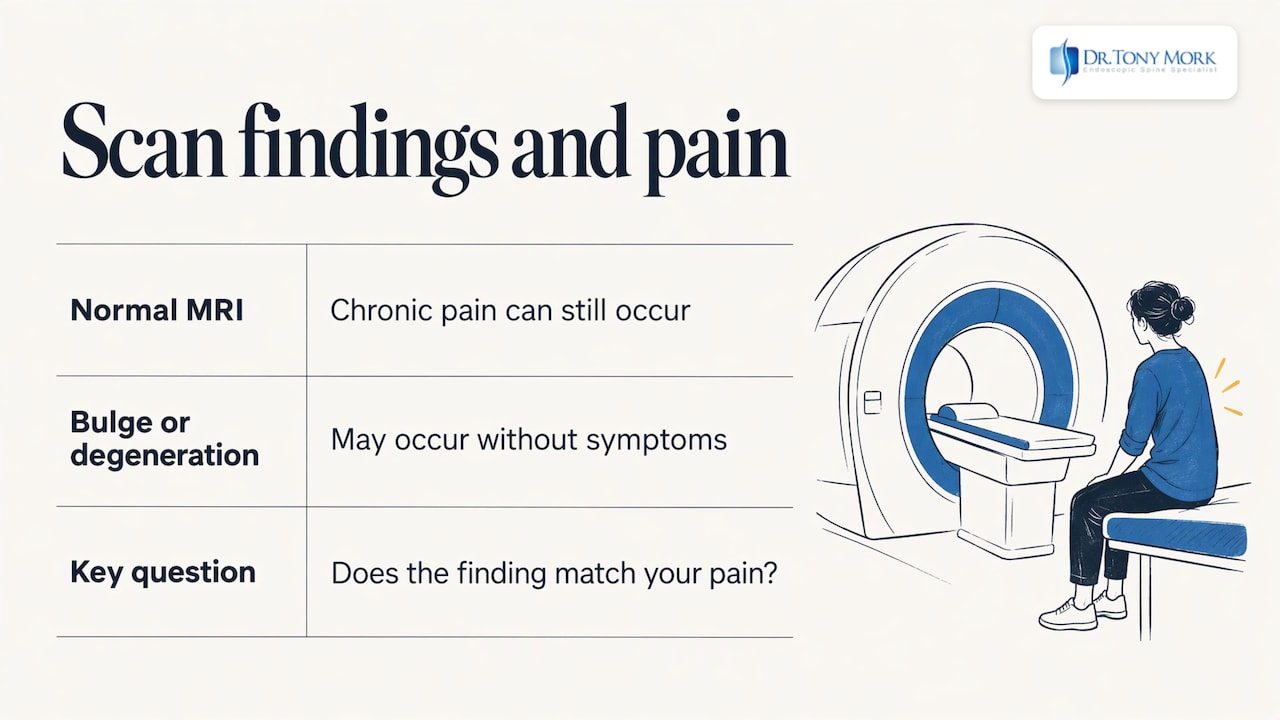
That matching is the work of a careful exam and a careful read of your images. If you have been told your MRI is normal, a second opinion on your spine MRI is a reasonable next step.
What can cause chronic back pain that nobody can explain?
Several things can, and they often overlap. Here are the sources I look for most:
- Annular tear: The disc has a tough outer wall. A tear in that wall can hurt even when the disc has not pushed out. My annular tear assessment page explains what I look for.
- Disc bulge or high intensity zone (HIZ): A bright spot in the back of the disc on MRI can signal an irritated, torn area. Not every bulge hurts, so the match with your symptoms matters. See my page on bulging disc treatment.
- Facet joints: These small joints at the back of the spine guide motion. When they are irritated, pain often worsens with standing, twisting or leaning back.
- Sacroiliac joint: This joint connects the spine to the pelvis. Its pain can look like disc pain. I explain the difference in facet joint versus sacroiliac pain.
- Foraminal stenosis: This is narrowing of the opening where a nerve leaves the spine. It can cause leg burning or numbness without a classic herniated disc. Read more on foraminal stenosis symptoms and causes.
- Earlier surgery: Pain that continues or returns after a previous operation has its own set of causes. I cover them in my page on post-laminectomy syndrome treatment.
A useful way to picture a disc is a liquid-filled cushion between two vertebrae (the bones of the spine). It absorbs shock and lets you bend. When the wall of that cushion is torn or stretched, it can hurt with ordinary movement, even if it still looks mostly intact on a scan.
For a wider overview, see my back pain causes page.
Could the pain be coming from somewhere other than my back?
Yes, and it is one reason I take a full history. Groin, testicular, hip and tailbone pain can come from the lower spine when the hips and a hernia check are normal. My page on groin pain from lower back problems walks through how that happens.
Stress, poor sleep and fear of movement can also amplify pain. A 2024 review by Farley and colleagues describes a cycle in which resting more eases pain briefly but makes the body less tolerant of movement. I do not say this to suggest the pain is in your head. Pain is real. Your nervous system is part of how every back pain is felt, and it deserves attention alongside the spine.
When does back pain need urgent medical attention?
Seek care right away, from an emergency department or your doctor, if back pain comes with any of these:
- Bladder or bowel changes: New loss of control or trouble passing urine.
- Numbness in the saddle area: The inner thighs, groin or buttocks.
- Progressive weakness: A leg or foot that is getting weaker, or a foot that drags.
- Fever or unexplained weight loss: Especially with a history of cancer.
- Significant injury: Back pain after a fall or a car accident.
These signs are the kind that doctors treat as red flags. Do not wait on them, and do not stop any medication on your own.
What should I try first for chronic back pain?
Conservative care comes first for most people. According to the American Family Physician 2024 review, most people with chronic low back pain will not need surgery, and non-drug approaches such as exercise, physical therapy, heat and counseling are first-line.
In my office, I think of the first steps this way:
- Time: Many back problems improve over weeks to months. Time is on your side.
- Activity changes: Staying active within comfort usually beats bed rest.
- Physical therapy: A good program builds the muscles that support your spine.
- Medication: Your own doctor guides this. Keep taking what you are prescribed.
- Injections: An epidural steroid injection (ESI, medicine placed near an irritated nerve) can calm pain for a while. The 2024 American Family Physician review says these are recommended for short-term relief of radiating nerve pain.
Some patients tell me therapy made them worse, or that injections or chiropractic care only helped for a short time. That is useful information. When a treatment keeps giving brief relief and the pain returns, it often means the true source has not been treated. It is a reason to look harder at the diagnosis, not a reason to give up.
How do I find the real source of my pain?
By matching your symptoms, your exam and your images, one piece at a time. Here is how I approach it:
- Listen first. Where does it hurt, what makes it worse, and what does it stop you from doing? Putting on shoes, sitting through a meeting, sleeping on your side.
- Examine. I check movement, strength, reflexes and which positions reproduce your pain.
- Read the images myself. I look at the MRI and, when useful, a CT scan, line by line. My page on whether a CT scan can find the cause of back pain explains when CT adds information.
- Match the finding to the pain. A tear or bulge matters when it sits where your symptoms point.
- Decide the next step. That may be more conservative care, a targeted test, or a procedure.
If you live far from my offices, I can review your MRI or CT scan remotely and speak with you by phone. Many out-of-state patients start this way.
Do I need spinal fusion if no one can find the cause?
No. Fusion joins two or more vertebrae into one solid piece with screws and rods. It has a place for true instability, but I see it as a last resort, and it can still be done later if needed.
The spine was designed to move. When one level is fused, the levels above and below take on more motion. So if you were told fusion is your only option, I would want to review your images and your story before you accept that. My press page on reconsidering spinal fusion surgery explains my thinking, and the Endoscopic Spine Academy, which I founded, reflects how seriously I take this approach.
What is endoscopic spine surgery, and when does it make sense?
Endoscopic spine surgery uses a small incision and a camera. It is done as outpatient surgery, with no hardware and no fusion. I have performed more than 8,000 endoscopic spine procedures, and I co-founded Microspine.
When I say “minimally invasive,” I mean how much healthy tissue is disturbed, not only how small the cut is. The goal is to reach the source of pain directly and leave muscle and bone as intact as possible. A laser may be one of the tools I use. It is a tool, never a cure by itself.
The goal is to remove the source of pain, not only manage it. That requires a source that has been identified. Depending on what is found, my treatments include:
- Disc herniation: Endoscopic discectomy, removing the part of the disc pressing on a nerve.
- Spinal stenosis: Endoscopic decompression, making room for the nerves.
- Foraminal stenosis: Endoscopic foraminal decompression, opening the exit tunnel for a nerve.
- Prior surgery: Treatment for pain that continues after an earlier operation.
Honest pros and cons matter. Many patients report a shorter recovery than with open surgery, and many return to daily activities within days. Recovery often takes longer for full activity, and results vary. Endoscopic surgery is not right for every spine, and some conditions, such as significant instability, call for a different approach. I lay out both sides in the pros and cons of endoscopic spine surgery and in my patient guide to endoscopic spine surgery.
What do I tell patients whose pain nobody can explain?
I tell them first that I believe them. Pain that keeps you from sitting through dinner or lifting a grandchild is real, whatever a report says.
Then I tell them the work is in the diagnosis. I read the images myself and match them to what you feel. When the match is clear, the aim is to remove the source of pain, not to manage it for years.
I start with conservative care when it fits, because many backs improve. I treat fusion as a last resort, and it can still be done later. If surgery is the right answer, a small incision, a camera and no hardware is what I have practiced since 1998.
Time is on your side. A clear answer is worth more than another guess.
Dr. Tony Mork
Where can I be seen, and how do I start?
I see patients at my Irvine office, 2102 Business Center Dr #127, Irvine, CA 92612, and at my Naples, Florida office, which serves Southwest Florida. Patients also travel from other states, and my practice is concierge, which means you have direct access to me and immediate support after surgery.
If you want my opinion on your spine, an MRI evaluation or a phone appointment is the place to begin. Learn more about endoscopic spine surgery or about minimally invasive spine surgery.

Insurance may cover facility and anesthesia fees, but not the surgeon’s fee. Payment is arranged before surgery, and my office will walk you through it.
FAQ
Can chronic back pain be real if my MRI is normal?
Yes. The 2020 AAPT criteria for chronic low back pain note that a normal MRI or CT is not uncommon. Pain can come from small tears, joints or nerve irritation that a scan does not fully capture. A careful exam is how I connect your symptoms to a source.
How long should I wait before seeing a spine specialist?
See someone right away if you have any red flag, such as weakness, bladder changes or saddle numbness. Otherwise, many people try conservative care first. If your pain lasts several months and keeps limiting your life, a specialist review is reasonable.
Will I need fusion if I have an annular tear or disc bulge?
Usually not. Many people with these findings improve with conservative care, and fusion is a last resort that can still be done later. Whether anything should be treated depends on whether the finding matches your pain.
Can you review my MRI if I live out of state?
Yes. I review MRI and CT scans remotely, and I can talk with you by phone about your options. Results vary, and a final plan can require an in-person exam.
If you have an MRI, upload it and I will review it personally and talk with you about your options.
Recommended
- Back Pain Causes
- Can a CT scan find the cause of my back pain?
- Five Conditions That Can Cause Back Pain
- How can I relieve facet joint pain?
This article is for general education and is not medical advice. Please see a qualified doctor about your symptoms.