
Most facet joint pain eases with time, smart activity changes, physical therapy and anti-inflammatory medication. When it does not, the next step is an accurate diagnosis, because a painful facet joint can look very much like a painful disc.
I am Dr. Tony Mork, a board-certified orthopedic surgeon. I have practiced endoscopic spine surgery exclusively since 1998, and I have performed more than 8,000 endoscopic spine procedures. Many of the patients I meet have been told their pain is “just arthritis” or “just a strain.” Let me walk you through what is really going on, and what you can do about it.
TL;DR
- What it is: Facet joints are the small joints at the back of the spine. When they become irritated or worn, they cause a deep ache that is often worse when you lean back or stand for a long time.
- First steps: Many back problems improve with time. Activity changes, physical therapy, heat or ice, and over-the-counter medication are where I usually begin.
- Diagnosis first: An exam and an MRI (magnetic resonance imaging) are needed to know for sure. Facet pain and disc pain overlap.
- If pain persists: There are options between injections and fusion. Fusion is a last resort and can still be done later if needed.
- Warning signs: Loss of bladder or bowel control, numbness in the groin area, or fast-worsening leg weakness need urgent care.
What is facet joint pain?
Facet joint pain is pain that comes from the small paired joints at the back of each vertebra (the bones that stack to form your spine). Doctors also call it facet syndrome, facet arthropathy or facet arthritis.
Think of each facet joint as a hinge. Every level of your spine has two of them, and they guide how far you can bend, lean back and twist. Each hinge is wrapped in a capsule and lined with cartilage, the smooth cushioning surface that lets bone glide on bone.
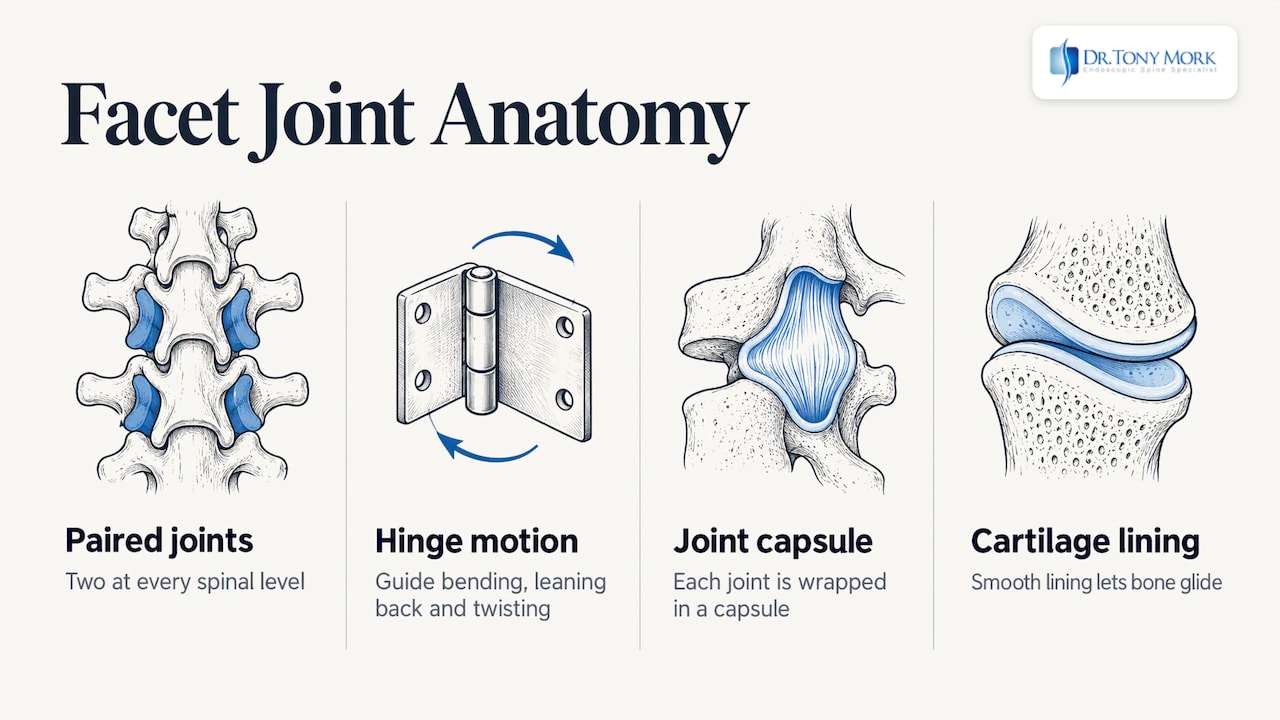
The spine was designed to move. When a hinge becomes inflamed, worn or stretched, ordinary motion starts to hurt. You may notice it when you stand at the kitchen counter, reach to a high shelf, or lean back to look up.
You can read more about this condition on my pages on facet syndrome and facet pain.
What are the symptoms of facet joint pain?
The classic sign is a deep, dull ache in the low back, often on one side, that gets worse when you lean backward or twist and eases when you sit or bend forward. Standing for long periods often makes it worse too.
According to the ACSM Clinical Sports Medicine Review on lumbar facet syndromes (2010), the hallmarks are low back pain without pain traveling down the leg, worse with standing, extension and rotation, and better with sitting or bending forward. In daily life, that can look like this:
- Standing: Washing dishes or waiting in a line becomes uncomfortable after a few minutes.
- Leaning back: Looking up to paint a ceiling or reaching overhead pinches the low back.
- Mornings: You feel stiff when you get up, then loosen as you move around.
- Twisting: Turning to back the car out of the driveway or following through on a golf swing brings a sharp catch.
- Referral: The ache can spread into the buttock or thigh. Pain that travels below the knee points more toward a pinched nerve.
Pain in the neck can come from the same joints. Neck facet pain often sits at the base of the skull or along the shoulder blade and flares when you turn your head to check a blind spot.
I cannot diagnose you from a list. An exam and an MRI are needed to know for sure.
How is facet pain different from disc pain?
The two can feel alike, but the pattern of movement often separates them. Facet pain tends to worsen when you lean back and ease when you sit. Disc pain tends to worsen when you sit, bend forward, cough or sneeze.
The World Federation of Neurosurgical Societies (WFNS) Spine Committee, in its 2023 recommendations on lower back pain, describes it this way: back pain that worsens with lumbar extension suggests the facet joints, while axial back pain (pain in the spine itself) that worsens with flexion, coughing or straining suggests the disc.
My patients often describe it in simple terms. If sitting through a workday or a long drive is the worst part, I think about the disc first. If standing and arching are the worst part, I think about the facets first.
Both problems can exist together. A disc that loses height shifts more load onto the facet joints behind it. That is one reason I do not treat a scan result in isolation.
For related reading, see my page on facet joint versus sacroiliac pain, and my page on bulging disc treatment.
What causes facet joint pain?
Facet joint pain comes from repeated strain, wear, or injury to the joints. According to the PM&R KnowledgeNow review from the American Academy of Physical Medicine and Rehabilitation (2025), facet-mediated pain results from repetitive and excessive mechanical strain, joint arthropathy (wear and degeneration of the joint), or stretching of the joint capsule.
The same source lists these common causes and risk factors:
- Age: The risk rises after about 45.
- Injury: A fall, a sports injury or a car accident can damage the joint or its capsule.
- Overuse: Repeated arching or twisting, as in golf, gymnastics or heavy lifting, adds up over years.
- Body weight: Carrying extra weight increases load on the lower spine.
- Poor lifting habits: Lifting with a rounded or twisted back strains the joints.
- Disc degeneration: As a disc thins, the facet joints take on more of the load.
Here is something many patients find reassuring. The PM&R KnowledgeNow review also notes that facet arthropathy is often found without any symptoms. A scan that shows arthritis does not prove the facets are the source of your pain. That is why diagnosis comes before surgery, every time.
How do I relieve facet joint pain at home?
Start with movement that does not provoke the pain, short rests, heat or ice, and over-the-counter medication if your own doctor says it is safe for you. Many back problems improve with time. Time is on your side.
Here is what I usually suggest patients try first:
- Heat or ice: Use whichever feels better for 15 to 20 minutes at a time. Some people like heat in the morning and ice after a long day.
- Gentle walking: Short, easy walks keep the joints moving without heavy impact.
- Posture changes: If standing hurts, shift your weight, rest one foot on a low step, or sit for a few minutes. If you drive often, adjust the seat so your hips and knees are comfortable.
- Sleep position: Try lying on your side with a pillow between your knees, or on your back with a pillow under your knees.
- Medication: Over-the-counter anti-inflammatory medicines help some people. Never stop a prescribed medication without talking to the doctor who prescribed it.
- Weight and sleep: According to 2020 consensus practice guidelines from a multispecialty working group, sleep habits, nutrition, weight loss and psychosocial factors are all part of a thorough conservative plan.
I do not claim that any herb or supplement heals the spine. The evidence is not there.
Which exercises help, and which should I avoid?
Low-impact exercise helps most people, and any exercise that increases your pain should stop. According to Medical News Today, citing the American College of Sports Medicine, people with lower back pain are advised to avoid high-impact activities such as running and to stop any exercise that causes pain. It lists walking, swimming, cycling, yoga, tai chi, stretching and strength training as better choices.
Because facet pain worsens with leaning back, I often tell patients to be careful with:
- Deep backbends: Yoga poses that arch the low back hard can provoke the joints.
- Heavy overhead lifts: Overhead presses push the low back into extension.
- Twisting under load: Fast rotation with a weight in your hands strains the capsule.
Gentle forward-leaning positions, such as a stationary bike or a slow knee-to-chest stretch, are often more comfortable. Core strength matters too, because strong trunk muscles share the load that would otherwise land on the joints.
My page on strengthening your lower back covers exercises in more detail. If golf is your sport, my article on low back pain in golfers explains why the swing is hard on these joints.
A physical therapist can tailor a program to you. Some patients tell me physical therapy made their pain worse. If that happens, tell your therapist and your doctor, because it can be a clue that something other than muscle weakness is driving the pain.
Do chiropractic care, injections and radiofrequency treatment help?
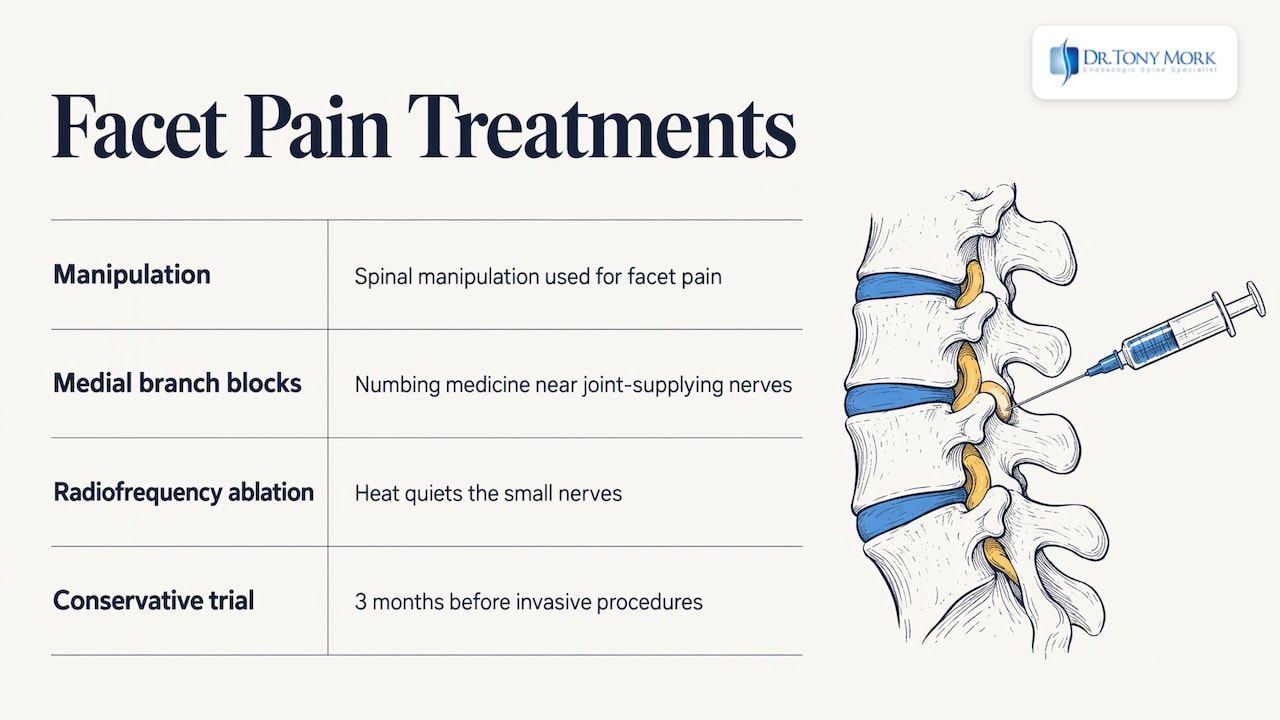
They help some patients for a time, and results vary. Spinal manipulation, medial branch blocks (small injections of numbing medicine near the nerves that supply the joint) and radiofrequency ablation (heat that quiets those small nerves) are all used for facet pain.
The North American Spine Society and a multispecialty working group recommended in 2020 a 3-month trial of conservative therapy before considering invasive procedures. I agree with starting with the least invasive options.
I also want you to know what the research says. A 2026 American Academy of Family Physicians summary of guidance on chronic spine pain reports that joint-targeted injections and radiofrequency ablation do not appear to improve pain compared with sham procedures, and the evidence is of low certainty. Individual patients may still feel better, and a procedure that gives only short-term relief is information in itself.
If you have had epidural steroid injections (ESI) or other injections that wore off within weeks, or if you see a chiropractor and the relief never lasts, that pattern tells me the true source of your pain may not have been found yet.
My goal is to remove the source of pain, not only manage it. Managing is a fine first step. Finding the source is the better destination.
How do doctors confirm that the facet joints are the problem?
The most reliable way is a careful history, a physical exam, imaging, and sometimes diagnostic blocks. According to StatPearls on the National Library of Medicine’s Bookshelf (updated March 2025), diagnostic medial branch blocks are considered the gold standard, and a single block carries a false-positive rate of 30% to 45%. Two blocks on separate occasions give a more reliable answer.
The ACSM review mentioned earlier also lists factors that correlate with facet pain:
- Age: Older patients are more likely to have facet pain.
- History: A previous history of low back pain is common.
- Pain pattern: The pain is greatest with leaning back.
- Leg symptoms: There is no pain down the leg.
- Muscle spasm: It is typically absent.
- Coughing: It does not worsen the pain.
A normal MRI does not rule out a painful spine. Neither does an abnormal one prove it. I look at your symptoms, your exam and your images together.
If you have images already, my office can review them remotely. You do not have to travel before we know whether you are a candidate for anything. For related diagnostic reading, see my article on diagnosing facet syndrome after transfacet decompression.
When should I worry that back pain is serious?
Seek urgent care if back pain comes with loss of bladder or bowel control, numbness around the groin or inner thighs, or leg weakness that is getting worse. Go to an emergency room right away. These can signal pressure on the nerves that needs prompt treatment.
Also see a doctor soon if your pain follows a significant fall or accident, comes with fever or unexplained weight loss, or wakes you from sleep and does not ease in any position. These are not signs of facet pain. They need their own evaluation.
Most back pain is not an emergency. Knowing the few signs that are is what lets you stay calm about the rest.
When should I consider surgery for facet pain?
Consider it when you have given conservative care a fair trial, your pain still limits your work, sleep or the activities you love, and a clear diagnosis points to a source that can be treated. Surgery is not the first step, and it is never the step before diagnosis.
Many patients arrive having been told fusion is their only option. In my view, fusion should be a last resort. It locks vertebrae together, and the spine was designed to move. It can still be done later if needed, so choosing a less invasive option first does not close any door.
Endoscopic spine surgery is different. It uses a small incision, a camera, and is done on an outpatient basis, with no hardware and no fusion. “Minimally invasive” refers to how much healthy tissue is disturbed, not only how small the incision is. A laser can be one of the tools I use, but it is never a cure by itself.
My office treats facet syndrome among other causes of back and neck pain. I want you to hear the limits as well:
- Pros: Smaller incision, less disturbance of healthy muscle, outpatient care, and many patients return to regular activities sooner than after open surgery.
- Cons: It is still surgery. Not every patient is a candidate, results vary, and some conditions respond better to other care.
- Fit: The right choice depends on your exact diagnosis, which is why I look at your images and exam first.
To learn more, see my guide to endoscopic spine surgery, the pros and cons of endoscopic spine surgery, and my page on how minimal minimally invasive surgery can be.
What do I think about facet joint pain?
The most common mistake I see is treating the label on the MRI instead of the person. A scan may show facet arthritis, a bulging disc, or an annular tear (a crack in the outer wall of the disc), and each of them can be present in someone with no pain at all.
I believe in a patient’s time, rest, therapy and honest conservative care first. When those have not worked, I believe the next step is to find the exact source of pain, and then remove it when that is possible, rather than managing it year after year.
I have practiced endoscopic spine surgery exclusively since 1998. I founded the Endoscopic Spine Academy and co-founded Microspine, and I have performed more than 8,000 endoscopic spine procedures. What I have learned is that patients do best when the diagnosis is right before anything else is done.
Fusion has its place, but it should be a last resort. Many patients can be helped without it, and I never promise a result. I promise a careful look at your case.
Dr. Tony Mork
How can my office help with facet pain?
My office offers a personal, concierge approach. You have direct access to me before and after treatment, and I review your case myself. I focus on endoscopic techniques designed to avoid spinal fusion.

If you already have an MRI or CT (computed tomography) scan, I can evaluate it remotely and talk through what it shows and what it does not. You can start on my main site with an MRI evaluation or a phone appointment.
If stenosis (narrowing of the spaces around the nerves) is part of your picture, see my pages on endoscopic decompression and endoscopic foraminal decompression. If a disc is involved, see endoscopic discectomy.
I see patients in my Irvine office at 2102 Business Center Dr #127, Irvine, CA 92612, and in my Naples, Florida office. Patients also travel from other states for endoscopic spine surgery. Insurance may cover some facility and anesthesia costs, but not the surgeon’s fee.
Frequently asked questions
Can facet joint pain go away on its own?
Often it improves with time, activity changes and physical therapy, and many back problems settle within weeks to months. Results vary, and pain that keeps returning deserves a proper diagnosis. An exam and an MRI are needed to know for sure.
Is walking good for facet joint pain?
For most people, easy walking is a comfortable low-impact activity, and the American College of Sports Medicine lists walking among the recommended choices for back pain. If walking or standing makes the pain worse, shorten the distance and rest. Stop any activity that increases the pain.
Does a normal MRI mean my facet joints are fine?
No. An MRI shows structure, not pain. Some people with a normal MRI still have pain, and some people with arthritic facets feel nothing. I combine your images with your history and exam before drawing any conclusion.
Will I need a fusion for facet joint pain?
Most people do not. I see fusion as a last resort, and it can still be done later if needed. Accurate diagnosis comes first, and many patients have options that preserve motion, including endoscopic surgery with no hardware.
If you have an MRI, upload it and I will review it personally and talk with you about your options. You can request a consultation here.
Recommended
- Facet Pain
- Facet Joint Vs Sacroiliac Pain | What’s the Difference?
- What Is Facet Joint Syndrome? | Symptoms, Causes & Treatment Options
- Facet Joint Syndrome Endoscopic Surgery
This article is for general education and is not medical advice. Please see a qualified doctor about your symptoms.