Yes, in many cases you should, especially if your pain is still limiting your day or someone has told you that surgery or a fusion is the only answer. A second look at your MRI (magnetic resonance imaging) can confirm what the first report said, or it can connect the images to your symptoms in a way the first report did not.
I am Dr. Tony Mork, a board-certified orthopedic surgeon. I have practiced endoscopic spine surgery exclusively since 1998, and I have performed more than 8,000 endoscopic spine procedures. Most of what follows is what I say to patients in my office when they bring me a scan and a stack of questions.
TL;DR
- Short answer: A second opinion is reasonable when pain persists, when the report does not explain your symptoms, or when surgery is on the table.
- What matters most: An MRI shows structure. An exam and an MRI together are needed to know for sure what is causing your pain.
- What to send: The actual images (not only the written report), the report itself, and a short history of your symptoms and treatments.
- What it does not mean: A second opinion does not commit you to surgery. Many back problems improve with time and conservative care.
- Fusion: I treat fusion as a last resort, and it can still be done later if it is ever needed.
What is a second opinion on a spine MRI?
A second opinion on a spine MRI is a fresh review of your images by another physician who looks at them alongside your symptoms and history. It is not a new scan. It uses the scan you already have.
There are two kinds, and people often mix them up. A radiology second opinion is a written re-read of the images by a radiologist, the physician who specializes in interpreting scans. A spine surgeon’s second opinion asks a different question: given these images and your daily life, what is causing your pain and what are your options?
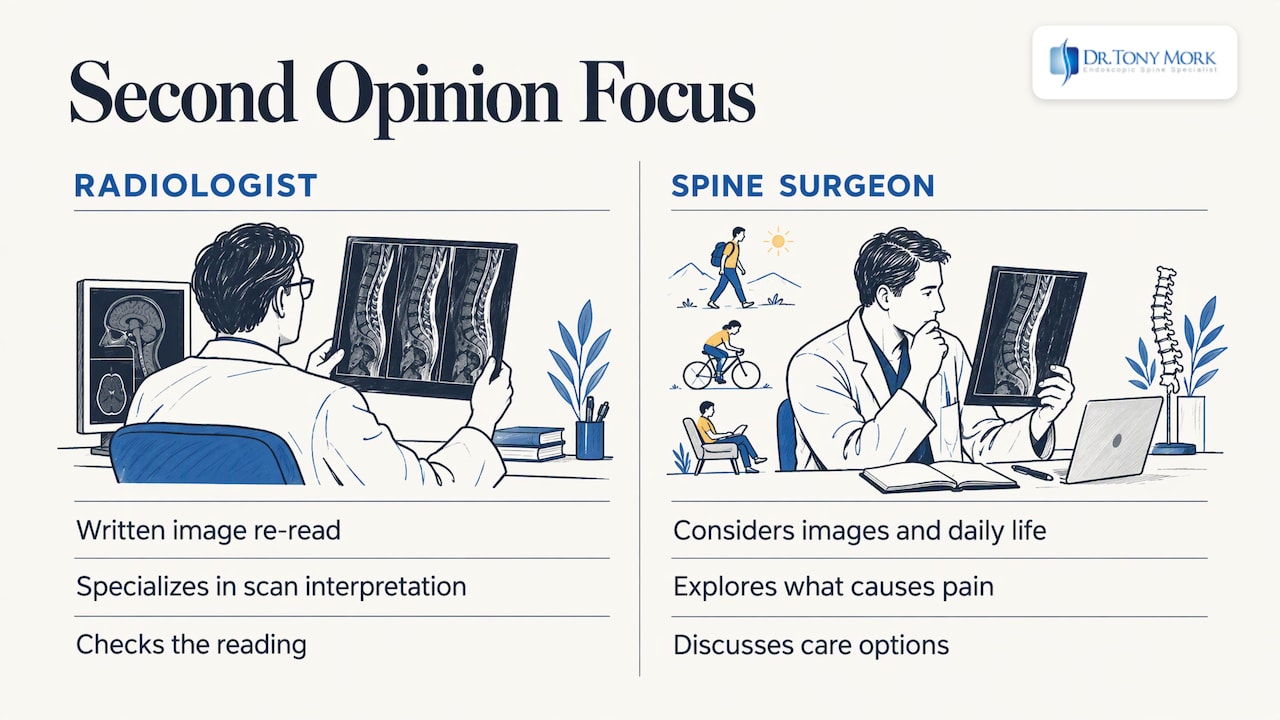
Both can be useful. The first checks the reading. The second connects the reading to you.
Why can two doctors see different things on the same MRI?
Because an MRI is a picture, and a picture has to be interpreted. The American College of Radiology notes in its adult spine MRI practice guideline that findings can mislead unless they are correlated with your clinical history, your examination, and other tests.
Here is the everyday comparison I use. A spinal disc is like a liquid-filled cushion between two vertebrae (the stacked bones of your spine). The cushion has a tough outer wall and a softer center. When the wall develops a crack or bulges, the MRI can show it. But a cushion can look worn on a scan and cause you no trouble at all, while a small change in the wall can cause a great deal of pain.
That is why the same image can lead to different conclusions. Common examples include:
- Disc bulge: The disc extends beyond its normal edge. Many people have one and feel nothing.
- Annular tear: A crack in the tough outer wall of the disc (the annulus). Some tears hurt and some do not.
- High intensity zone (HIZ): A bright spot in the disc wall on certain MRI images, sometimes linked with a painful tear.
- Herniation: Disc material pushes through the wall and may press on a nerve.
- Stenosis: Narrowing of the space for nerves, like a narrowing in a waterway that slows the flow. Foraminal stenosis is narrowing of the opening where a nerve leaves the spine.
If you want to read more about how I evaluate a painful disc wall, my page on annular tear assessment explains the process.
When is a second opinion worth getting?
It is worth getting whenever the answer you have does not match how you feel, and always before a major operation. Accurate diagnosis comes before surgery. If the diagnosis is uncertain, the plan will be too.
These situations are the ones I hear about most:
- Surgery was recommended: You were told you need a fusion or another operation, and you want to understand the other options.
- Your MRI was called normal, but you hurt: Sitting through a workday, driving, or putting on your shoes is still painful.
- The report and your pain do not match: For example, the disc problem is on one side and the pain is on the other.
- Treatment has not held: Physical therapy made things worse, or epidural steroid injections (ESIs, medicine placed near the nerves) helped for only a short time.
- You have seen several doctors: Three or more, and still no clear diagnosis.
- Pain continues after a prior spine surgery: You want to know what is still causing it.
A 2021 scoping review in the journal Surgical Neurology International looked at studies of second opinions in spine surgery. According to that review, a large share of second-opinion visits ended with a different recommendation than the first, and in most of those the different recommendation favored nonoperative care. I mention it because it shows something I see often: a second look can sometimes point toward less treatment, not more.
You also have the right to ask. The American Medical Association’s Code of Medical Ethics recognizes that patients may obtain a second opinion. You do not need permission, and a good physician will not take it personally.
What is the difference between an MRI review and a spine surgeon’s opinion?
An MRI review answers what the images show. A surgeon’s opinion answers what is causing your pain and what to do about it. Those are related questions, but not the same one.
| Radiology re-read | Spine surgeon’s review | |
|---|---|---|
| Who reviews | A radiologist | A spine surgeon |
| Main question | What do the images show? | What is the likely source of your pain, and what are your options? |
| Uses your symptoms | Often limited to a brief history | Central to the review |
| Output | A written report | A conversation about diagnosis and treatment choices |
| Treatment advice | Usually none | Surgical and non-surgical options |
Neither replaces an in-person exam. The imaging guidelines themselves state that responsibility for your care rests with the treating professionals, and that imaging does not dictate an individual treatment decision. I agree with that completely. My review of your scan is information to guide a conversation. It is not a verdict.
A bone density report works the same way. A number on a page can look alarming or reassuring, and context changes its meaning, as this explanation of how spine T-score results can mislead shows.
What do I tell patients about second opinions?
I want you to hear this from me directly. The spine was designed to move. When a treatment takes that motion away, I want to be sure it was truly necessary.
The goal of my work is to find and remove the source of your pain, not only to manage it. That starts with an accurate diagnosis, and that starts with someone taking the time to match your scan to your story. A normal-looking MRI does not mean your pain is imaginary. A scary-looking MRI does not mean you need an operation.
In my practice I use endoscopic spine surgery: a small incision, a camera, outpatient care, no hardware, and no fusion. Minimally invasive describes how much healthy tissue is disturbed, not only how small the incision is. A laser can be one tool during the procedure. It is never a cure by itself.
I founded the Endoscopic Spine Academy and co-founded Microspine because I believe more patients deserve a careful look at non-fusion options. My practice is a concierge practice, which means you can reach me directly, before and after any treatment.
Time is on your side. Take the time to get the diagnosis right.
Dr. Tony Mork
How do I get a remote review of my MRI?
You request your images, send them with your report and a short history, and the reviewer studies them and talks with you. You do not need to travel for this step, which matters if you live outside Southern California or Florida.
Here is the usual path:
- Request your images. Under HIPAA (the Health Insurance Portability and Accountability Act), you have a right to access your medical records, including images. The radiology facility will typically give you a CD or an electronic copy such as a link or flash drive. RadiologyInfo.org, a patient resource from radiology professional societies, explains that these copies can be useful when you seek a second opinion.
- Request the written report too. The report is the first reader’s interpretation. The images are the raw data. A reviewer wants both.
- Write down your story. Where it hurts, what makes it worse, what helps, and what you have already tried.
- Send everything securely. Use the upload method the reviewing office gives you, not regular email.
- Plan a conversation. The most useful reviews end with a talk, so you can ask questions and hear options in plain language.
Having prior images available can also reduce the need to repeat a scan, according to the American Medical Association’s patient guidance on requesting images. That saves you time and an extra trip to the imaging center.
What should I send for a spine MRI evaluation?
Send the images, the report, and your history. Without the images themselves, a reviewer is reading someone else’s summary.
A complete package includes:
- MRI images: The full study in DICOM format (the standard file type for medical images), not screenshots or photos of a monitor.
- MRI report: The radiologist’s written findings.
- Other imaging: X-rays or a CT (computed tomography) scan, if you have had them. A CT discogram, a test where dye is injected into a disc to see whether it reproduces your pain, belongs here too if one was done.
- Treatment history: Physical therapy, chiropractic care, medications, and injections, with rough dates and how each one affected you.
- Prior surgery records: If you have had an operation, the operative report is very helpful.
- Daily-life description: Can you sit through a movie, drive for an hour, sleep through the night, lift a grandchild, or play a round of golf?
That last item sounds small. It is not. How pain behaves in your day often tells me as much as the scan does.
If you want to see how my team and I structure the process, my spine surgery evaluation process page walks through it.
Does a second opinion mean I will need surgery?
No. Many back problems improve with time, and conservative care comes first where it fits. That includes activity changes, physical therapy, medication, and sometimes injections. If you are taking medication, keep taking it as prescribed and talk to your own doctor before changing anything.
Surgery becomes a topic when pain persists despite reasonable conservative care and the diagnosis is clear. Fusion, which permanently joins vertebrae together, is a last resort in my view, and it can still be done later if it is ever needed. If you want to see the alternatives I discuss, read about alternatives to spinal fusion and, for neck pain, cervical fusion alternatives.
When an operation is appropriate, I describe the options with honest pros and cons. For endoscopic spine surgery:
- Approach: A small incision and a camera that lets me see the problem directly. It is done as an outpatient procedure, with no hardware and no fusion.
- Tissue: The aim is to disturb as little healthy tissue as possible.
- Recovery: Many patients return to regular activities sooner than they would after fusion. Recovery often takes days to weeks, and results vary.
- Limits: It is not right for every spine problem. Some conditions, such as severe instability, may call for a different approach. Surgery of any kind carries risks, and no operation can promise a pain-free result.
For a fuller discussion, see the pros and cons of endoscopic spine surgery and my endoscopic spine surgery guide for patients.
Which conditions do I most often review on MRI?
Most of the scans I review show one of a handful of problems. Each has its own page with detail on symptoms and treatment:
- Disc herniation: Disc material pressing on a nerve, often causing sciatica (pain, burning, or numbness traveling down the leg). See my page on herniated disc treatment.
- Bulging disc: A disc that extends past its normal edge. Read about bulging disc treatment.
- Spinal stenosis: Narrowing around the nerves, which can make standing or walking uncomfortable. See endoscopic decompression for stenosis.
- Foraminal stenosis: A pinched nerve at the exit opening. See foraminal decompression and how foraminal stenosis is diagnosed.
- Facet syndrome: Pain from the small joints at the back of the spine. Read about facet joint syndrome surgery.
- Discogenic pain: Pain that comes from the disc itself. See how discogenic back pain is treated.
My endoscopic spine surgery page covers the technique in more detail.
Can my office review your MRI?
Yes. If you want a spine surgeon to look at your own images, my office offers MRI evaluation and one-on-one phone appointments, along with concierge spine services for patients who choose treatment with me. You can start on the MRI evaluation page.

I see patients at my Irvine office, 2102 Business Center Dr #127, Irvine, CA 92612, and at my Naples, Florida office. Patients also travel from other states, and because the review starts with your images, the first step can happen from home. Whether you are in Orange County, Southwest Florida, or farther away, the process is the same.
Frequently asked questions
How do I get a second opinion on an MRI?
Request a copy of your images and your written report from the facility that performed the scan. Send both, with a short history of your symptoms, to the physician you want to review them. Ask for a conversation afterward so you can ask questions.
Do I need a new MRI to get a second opinion?
Usually not. A reviewer can often work from your existing images if they are recent and of good quality. A new scan is sometimes suggested if your symptoms have changed or the first study was limited, but that decision depends on your exam and history.
Does insurance or Medicare pay for a second opinion on a radiology report?
Coverage depends on your plan and on who does the review. Call your insurer or Medicare before you book and ask whether a second opinion, or a review by a physician outside your network, is covered. Ask for the answer in writing if you can.
Can a second opinion tell me whether I need a fusion?
It can help you understand the question. An exam and an MRI are needed to know for sure what is causing your pain. A careful review often clarifies whether the pain generator is the disc, a joint, or a nerve, and whether a non-fusion option fits your situation.
What if my MRI looks normal but I still hurt?
A normal report does not mean there is no cause for your pain. Some sources of pain, such as small tears in the disc wall, are subtle or easy to overlook. A review that pairs the images with your symptoms and an exam can add useful information.
If you have an MRI, upload it and I will review it personally and talk with you about your options.
Recommended
- Alternatives to Spinal Fusion | Why You Should Consider Other Options
- Cervical Fusion Alternatives: Your Options for Neck Pain
- Lumbar Radiculopathy Treatment: Options From Home Care to Surgery
- Spine Surgery Evaluation Process
This article is for general education and is not medical advice. Please see a qualified doctor about your symptoms.