
Discogenic back pain is treated first with time, activity changes, physical therapy and medication, and many people improve. If pain from a damaged disc lasts despite that care, a precise diagnosis can open the door to minimally invasive options that remove the source of pain, often without a fusion.
I am Tony Mork, MD, a board-certified orthopedic surgeon. I have practiced endoscopic spine surgery exclusively since 1998 and have performed more than 8,000 endoscopic spine procedures. Here is how I walk patients through this problem in my office.
TL;DR
- Definition: Discogenic pain (pain that comes from the disc itself) often shows up as a deep, dull ache in the low back that gets worse when you sit, bend or drive.
- First step: Accurate diagnosis comes before any surgery. An exam and an MRI (magnetic resonance imaging) are needed to know for sure.
- Usual path: Conservative care comes first, because many back problems improve with time.
- Surgery: Fusion is a last resort that can still be done later. Endoscopic surgery uses a small incision and a camera, is outpatient, and uses no hardware.
- Results vary: No treatment can promise a pain-free result, and I will tell you the limits of each option.
What is discogenic back pain?
Discogenic back pain is pain that starts in a damaged or worn disc. A disc is the cushion between two vertebrae (the bones of your spine). It works like a radial tire filled with a soft, liquid-like center. The tough outer wall holds the pressure, and the center absorbs load.
When the wall develops a crack, called an annular tear (a tear in the disc’s outer layer), or the disc loses height and hydration, the disc can become a source of pain. Pain can come from the disc even when no nerve is pinched.
Patients describe it in daily terms:
- Sitting: A deep ache in the middle of the low back builds during a workday or a long drive.
- Bending: Putting on shoes or picking up a laundry basket brings a catch or a gnawing ache.
- Spread: The ache can reach the buttocks or the upper thighs, according to the North American Spine Society’s patient information on lumbar degenerative disc disease.
- Sleeping: Some people cannot find a comfortable position, or wake when they turn over.
- Flare-ups: Some people say their back “goes out” repeatedly with no clear cause.
These descriptions do not diagnose you. Many conditions cause back pain, which is why the exam matters.
How do I know if my disc is the source of my pain?
You know by combining your history, a physical exam and imaging, and sometimes a closer look at specific MRI findings. No single test settles it alone.
Accurate diagnosis comes before surgery. I want to know where the pain sits, what makes it worse and what has already been tried. Then I look at your images myself.
Three MRI findings often matter in discogenic pain:
- Disc degeneration: The disc looks dark and thin because it has lost water and height.
- Annular tear: A bright line or spot in the outer wall of the disc. You can read more about annular tears.
- High intensity zone (HIZ): A bright spot in the disc wall that can point to an irritated tear.
A 2023 review in eClinicalMedicine, published by The Lancet, used discography as the reference standard for discogenic pain and found that MRI findings such as these may help identify it.
Discography (a test where dye is injected into a disc, sometimes followed by a CT, computed tomography, scan) can help link an abnormal image to the pain you feel. It is invasive and carries risks, so I use it thoughtfully and not as a routine test.
A normal-looking MRI does not always mean there is no disc problem. Some patients arrive after seeing three or more doctors without an answer. A careful second look often helps. If you want that, my office offers MRI evaluation from anywhere.
What treatments should I try first?
Start with conservative care. Time, activity changes, physical therapy, medication and sometimes injections are the first steps, because many back problems improve with time. Time is on your side.
The options usually include:
- Activity changes: Break up long sitting, adjust your car seat and change how you lift. Complete bed rest is not the goal. The spine was designed to move.
- Physical therapy: Guided manual therapy and individualized exercises, such as an extension-based program, are described in a 2025 expert-panel algorithm for discogenic pain published by the National Library of Medicine’s PubMed Central. Some patients feel better with certain movements and worse with others. Tell your therapist if an exercise makes your pain worse.
- Medication: Over-the-counter anti-inflammatory medicines help some people. Talk with your own doctor about what is safe for you, and do not stop any prescribed medicine without that conversation.
- Posture and ergonomics: A workstation that lets you shift position often helps people who feel worse when they sit.
- Core strength: Gentle strengthening of the muscles that support the low back. My article on exercises that strengthen your lower back is a good place to start.
So what are the limits? Conservative care does not work for everyone. Some people find physical therapy makes the pain worse, or an epidural steroid injection (ESI, a medicine placed near the nerves) gives only short relief. Chiropractic patients sometimes tell me the relief never lasts. When that pattern repeats, the disc may be the real source and deserves a closer look.
Do PRP, stem cell and other injections work for disc pain?
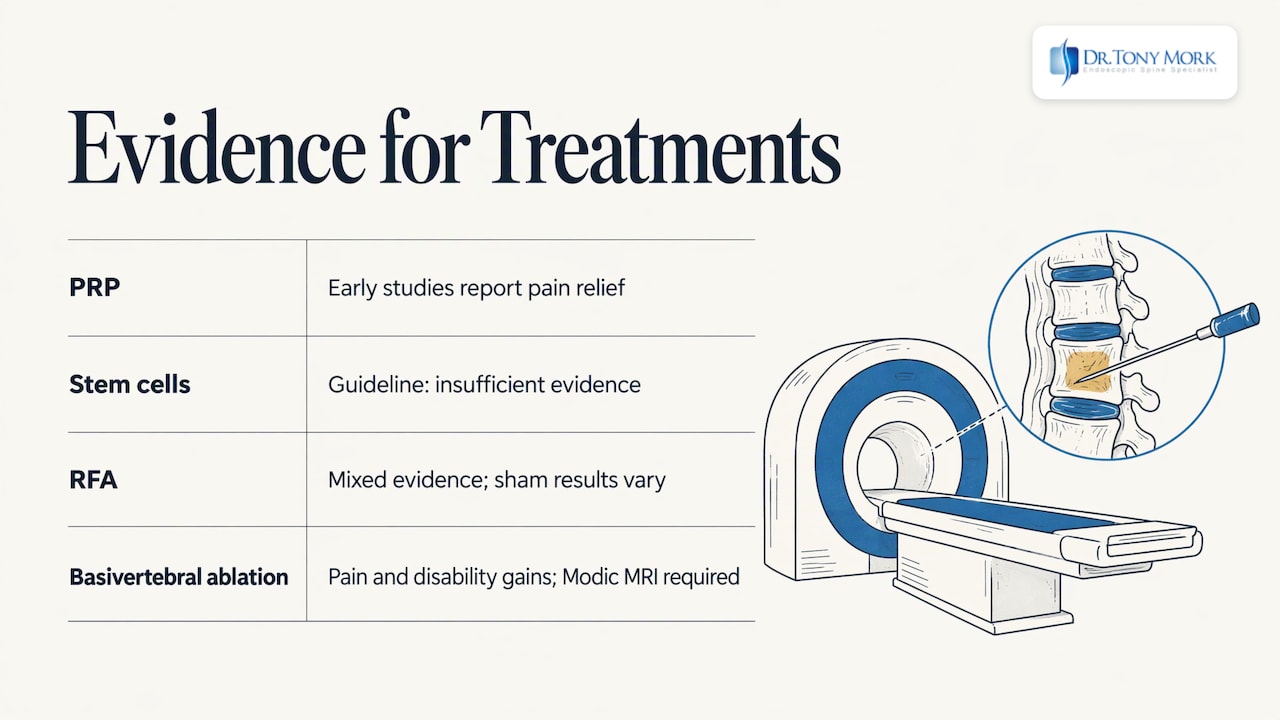
The evidence is still developing. Platelet-rich plasma (PRP, made from a small sample of your own blood) injected into the disc is being studied, and some early studies report pain relief. Larger studies are needed to confirm that.
Stem cell injections have the same problem. The 2022 VA/DoD Clinical Practice Guideline for low back pain found insufficient evidence to recommend for or against orthobiologics such as PRP or stem cells.
I tell patients plainly: these injections may appeal to you, and the research may grow. Know what the evidence shows today before you pay for one. I do not claim that any herb or supplement heals the spine, and I would not trust that claim from anyone.
Radiofrequency ablation (RFA, using heat to quiet pain-carrying nerves) is another option. The VA/DoD guideline describes the evidence for disc pain as mixed. Some studies found no benefit over a sham procedure, and others did.
Basivertebral nerve ablation is a newer outpatient treatment aimed at the bone surface next to the disc. According to the 2022 International Society for the Advancement of Spine Surgery policy statement, studies report improvements in pain and disability for vertebrogenic pain, which is pain from the vertebral endplate. It fits only patients with specific MRI findings called Modic changes. An exam and an MRI are needed to know whether you are one of them.
When is surgery a reasonable option for disc pain?
Surgery is reasonable when disc pain is disabling, a clear diagnosis points to the disc, and a fair trial of conservative care has not given enough relief. It is never the first step.
The 2025 algorithm I mentioned suggests a surgical consultation for functionally disabling lumbar discogenic pain with advanced disc degeneration. A consultation is a conversation. It is not a commitment.
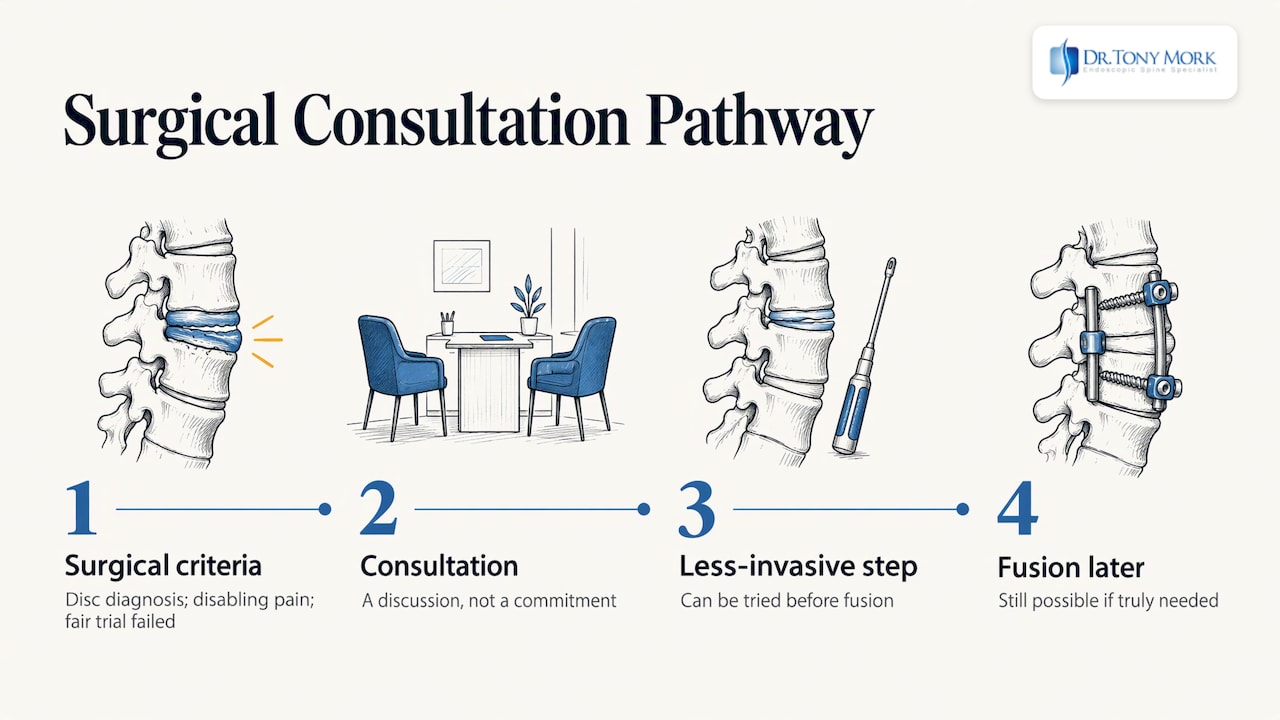
Traditional treatment for disc pain that does not settle has often meant spinal fusion, which joins two vertebrae together with hardware. I see fusion as a last resort. If you have been told it is your only option, a second opinion is reasonable. Fusion can still be done later if it is truly needed, so trying a less invasive step first does not close that door.
My goal is to remove the source of pain, not only manage it. If the disc wall tear is the source, the aim is to treat that tear.
What is endoscopic spine surgery, and how does it treat the disc?
Endoscopic spine surgery is a procedure through a small incision using a camera, done as outpatient surgery, with no hardware and no fusion. The camera lets me see the disc and the nerves directly on a screen, so I can treat the painful area through a narrow tube.
Here is what it can involve:
- Looking: I inspect the disc and the surrounding tissue.
- Removing: I take out the damaged disc material or tissue irritating a nerve. For herniations, that is endoscopic discectomy.
- Treating the tear: I address the painful part of the disc wall.
- Using a laser as one tool: A laser can help in some steps. It is one tool, never a cure by itself.
The term “minimally invasive” is about how much healthy tissue is disturbed, not only how short the incision is. Some operations that use small cuts still move a lot of muscle aside. You can read more in how minimal minimally invasive surgery gets. For a full overview, see my endoscopic spine surgery guide for patients.
What do patients commonly report afterward? Many go home the same day and many return to light daily activity quickly. Recovery often takes longer for full activity such as golf or heavy lifting, and results vary. I never promise a pain-free result.
What are the pros and cons of endoscopic surgery?
The main advantages are less disturbance of healthy tissue, no fusion and an outpatient stay. The main limits are that it does not fit every spine and cannot promise relief. Here is the balanced view.
| Potential benefits | Limits to know | |
|---|---|---|
| Tissue | Small incision and less healthy tissue disturbed | Some problems cannot be reached well this way |
| Hardware | None, and the spine keeps its motion | Not a fit for spines that are unstable or severely deformed |
| Recovery | Outpatient, and many patients get back to daily life soon | Full recovery takes time and results vary |
| Pain relief | Aims at the source of pain | Not every patient gets full relief |
| Future options | Fusion can still be done later if needed | A disc that has worn down further may need another approach |
I go through these points in more detail in the pros and cons of endoscopic spine surgery.
Good candidates generally have a clear diagnosis, pain that matches the imaging and a fair trial of conservative care behind them. Active adults between 30 and 60, lifters, golfers and people with lingering pain after a car accident often come in with this story. If you also love the course, read about laser back surgery for golfers.
What if I already had surgery and still hurt?
Persistent pain after a prior spine surgery has a cause that can usually be found, and the first step is again a clear diagnosis. Scar tissue, a remaining disc problem, a pinched nerve or a painful facet joint (a small joint at the back of the spine) can each play a role.
I see many patients with ongoing pain after earlier surgery. I review the original images and your new MRI before anything else. Related conditions I treat include bulging disc, herniated disc, facet syndrome, spinal stenosis (narrowing of the space around the nerves, like a narrowing in a waterway) and foraminal stenosis (narrowing of the opening where a nerve leaves the spine).
What does my perspective on disc pain look like?
I have spent my career watching patients arrive after years of pain, several doctors and a single suggestion: fusion. The spine was designed to move. When I can find the true source of pain and treat it without taking that motion away, I believe that serves you better.
That is why I practice endoscopic spine surgery exclusively and have since 1998. I founded the Endoscopic Spine Academy and co-founded Microspine, so I spend my time teaching and refining these methods as well as performing them.
Diagnosis is the heart of it. Many patients are told their MRI is normal, or that a bulge is just “part of aging,” and the disc is never examined as a pain source. I would rather spend an hour on your images and your story than rush to a procedure.
I also keep my practice personal. You reach me directly, and I stay involved after surgery. Fusion remains a last resort, and I will say so honestly if I think an operation is not right for you.
Dr. Tony Mork
How can my office help with discogenic pain?
My office can review your MRI or CT scan remotely, talk with you by phone and explain whether endoscopic surgery or another path fits you. I practice concierge medicine, so you have direct access to me before and after a procedure.
You can send your scans from anywhere. Many patients travel from other states. I see patients at my Irvine office, 2102 Business Center Dr #127, Irvine, CA 92612, and at my office in Naples, Florida.
Learn what endoscopic spine surgery involves, or see how alternatives to spinal fusion fit different spines. Insurance may cover facility and anesthesia fees, but not the surgeon’s fee, and my office can explain that before you decide.
When should I see a doctor right away?
See a doctor promptly if your back pain does not settle on its own or does not lessen after rest and self-care. Go to an emergency department right away for any of these:
- Bladder or bowel: New trouble controlling either one.
- Numbness: Loss of feeling in the groin or inner thighs.
- Legs: Severe leg pain or new weakness.
- Pain trend: Pain that keeps increasing steadily.
These warning signs come from the VA/DoD patient booklet on managing low back pain. Do not wait for an appointment if they appear.
What else do patients ask about discogenic pain?
Can discogenic pain go away on its own?
Often it improves over time with activity changes and physical therapy, and many back problems do. Some cases linger because a torn or worn disc keeps irritating the area. If your pain has lasted for months, get a thorough exam and an MRI to know for sure.
Is discogenic pain the same as a herniated disc?
No. A herniated disc is when disc material pushes out and may press on a nerve, which often causes leg pain. Discogenic pain is pain that comes from the disc itself, often felt in the low back. The two can occur together. See my page on herniated disc symptoms, diagnosis and treatment.
Will I need a spinal fusion for discogenic pain?
Not necessarily. Fusion is a last resort, and conservative care or a less invasive procedure is usually tried first. If fusion is ever needed, it can still be done later.
Can I send my MRI before I visit?
Yes. Remote MRI and CT review is part of how my office works, and it helps me tell you honestly whether a procedure might help. I cannot diagnose you from a description alone, so an exam and an MRI are needed to know for sure.
Where do I go from here?
If you have an MRI, upload it and I will review it personally and talk with you about your options. You can start on my consultation request page.
Recommended
- Disc Herniation
- Bulging Disc Treatment | Minimally Invasive Spine Surgery
- Herniated Disc Treatment | Minimally Invasive Spine Surgery
- Exercises That Strengthen Your Lower Back and Prevent Herniated Discs
This article is for general education and is not medical advice. Please see a qualified doctor about your symptoms.