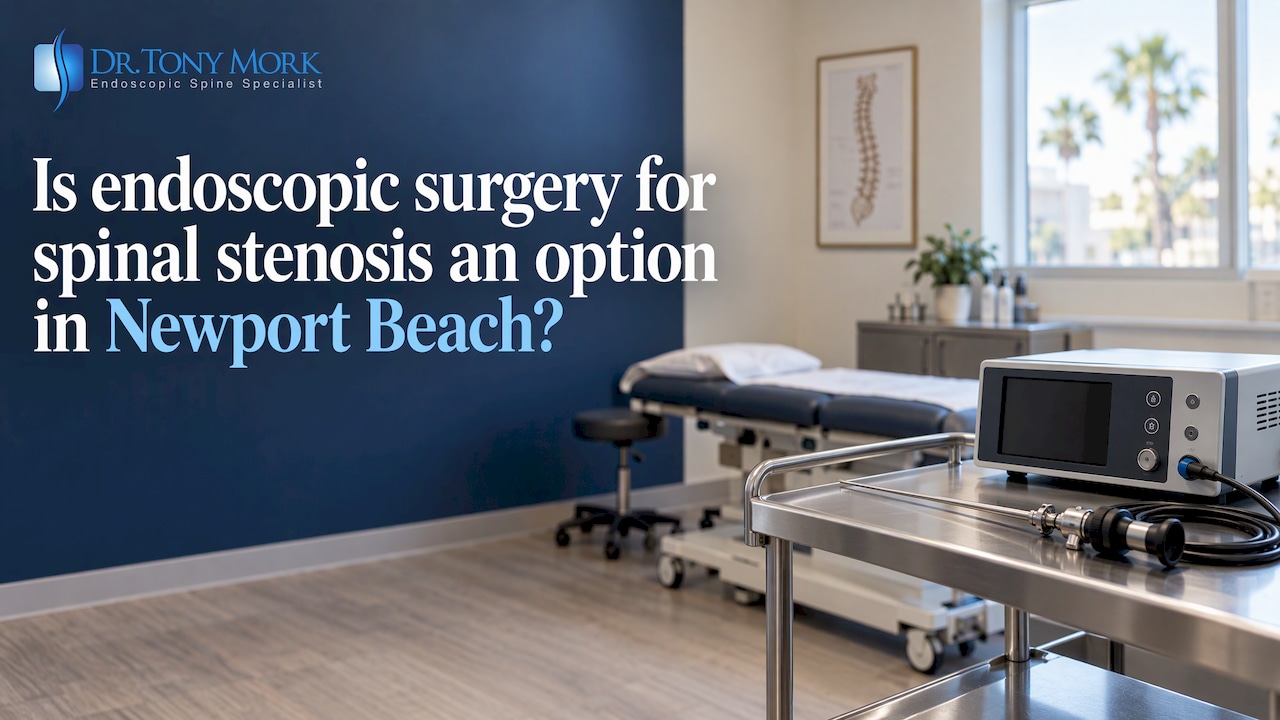
Yes, for many people with spinal stenosis it is. I perform endoscopic decompression, a procedure that frees pinched nerves through a small incision with a camera, with no fusion and no hardware, at my Irvine office, a short distance from Newport Beach.
I am Dr. Tony Mork, MD, a board-certified orthopedic surgeon. I have practiced endoscopic spine surgery exclusively since 1998 and have performed more than 8,000 endoscopic spine procedures. If walking to the mailbox, standing at the kitchen counter or lifting a grandchild has become a negotiation with your legs, this article explains what your options are.
TL;DR
- What it is: Endoscopic decompression removes the bone and thickened tissue pressing on your nerves, through a small incision, as an outpatient procedure.
- What it avoids: No fusion and no hardware. The spine was designed to move, and the goal is to keep it moving.
- Who it fits: An accurate diagnosis comes first. An exam and an MRI (magnetic resonance imaging) are needed to know for sure whether stenosis is the source of your pain.
- Where to start: Many people improve with conservative care first. If that has not worked, you can send me your MRI for review.
- Local access: My offices are in Irvine, California, and Naples, Florida.
What is spinal stenosis, and why does it make everyday life hard?
Spinal stenosis is a narrowing of the spaces in your spine that hold the nerves. When the space shrinks, the nerves get crowded.
Think of a waterway that narrows. The water still flows, but it backs up and pushes against the banks. In your spine, the nerves are the water, and thickened ligament, bone spurs and bulging disc material are the banks closing in.
Most people feel it in daily life before they ever see a scan. Common reports include:
- Walking: Leg heaviness, burning or cramping that builds after a block or two and eases when you sit down.
- Standing: Pain while cooking, shaving or waiting in line, relieved by leaning on a cart or counter.
- Sleeping: Waking up with numb or tingling legs or an aching low back.
- Driving and sitting: Deep low back pain or leg symptoms that change with position.
- Bending: Putting on shoes or picking something off the floor sets off pain or numbness.
A related problem is foraminal stenosis, a narrowing of the opening where a nerve leaves the spine. Both can cause sciatica, which is pain, burning or numbness traveling down the leg. Sciatica is a symptom, not a diagnosis, and it has several possible causes. You can read more on my spinal stenosis page.
Do I need surgery for spinal stenosis right away?
No. Many back problems improve with time, and conservative care comes first for most people.
That care usually includes:
- Time and activity changes: Adjusting how you lift, sit, walk and exercise while symptoms settle.
- Physical therapy: Guided stretching and strengthening. If therapy has made your pain worse, tell your therapist and your doctor.
- Medication: Taken as your own doctor directs. Never stop a medication without speaking to the doctor who prescribed it.
- Epidural steroid injections (ESI): Medication placed near the irritated nerve. For some people the relief is short-lived, which is useful information about where the pain comes from.
A 2022 consensus statement from the American Society of Pain and Neuroscience on minimally invasive lumbar stenosis treatment lists physical therapy, medications and epidural steroid injections as conservative options, generally for mild or moderate symptoms. A 2021 peer-reviewed review of endoscopic decompression describes more than three months of unsuccessful conservative treatment as a context in which surgery is considered. It is not a rule for everyone.
Time is on your side. Stenosis rarely needs surgery overnight. There are a few warning signs that do need prompt attention: new loss of bladder or bowel control, numbness in the groin or saddle area, or fast-worsening leg weakness. Go to an emergency room if you have any of these.
How is spinal stenosis diagnosed before surgery?
Accurate diagnosis comes before surgery, always. Surgery only helps when it is aimed at the true source of your pain.
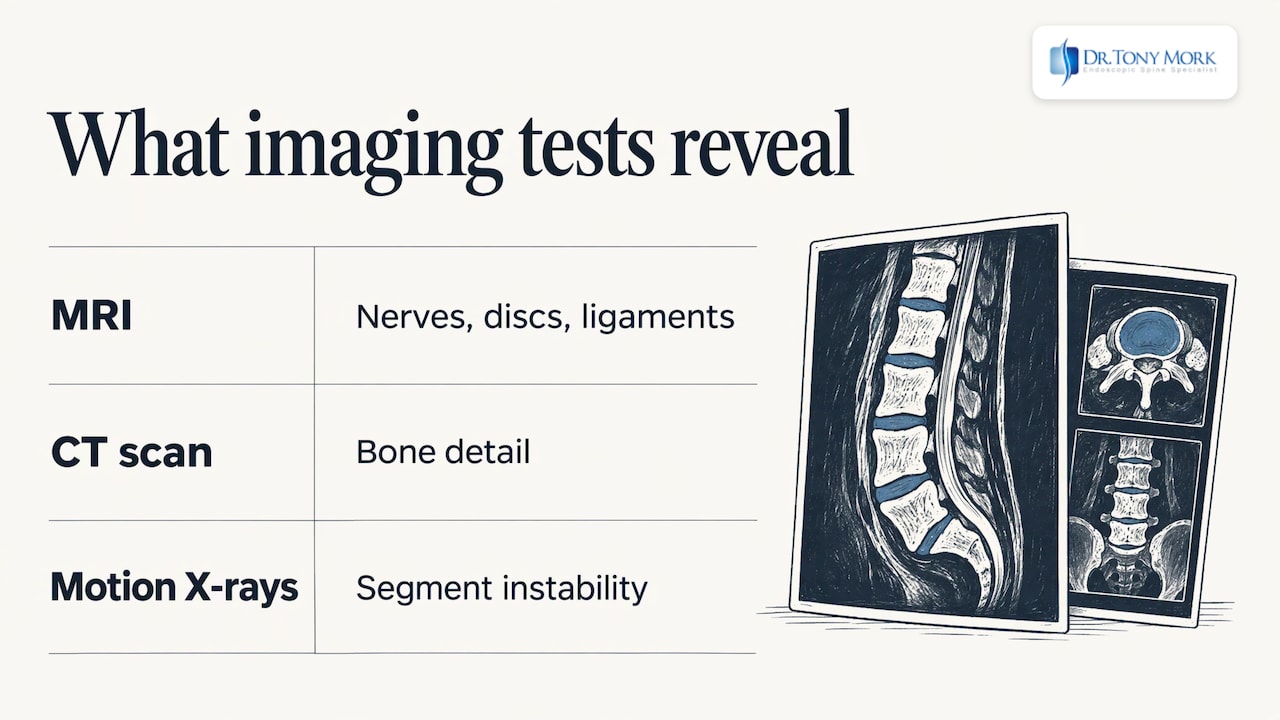
Diagnosis starts with your history and a physical exam. Then I look at your imaging. An MRI shows the nerves, discs and ligaments. A CT (computed tomography) scan shows bone detail. X-rays that show the spine in motion can reveal whether any segment is unstable.
The imaging has to match your symptoms. A scan can show stenosis in a person who has no pain, and a scan can look reassuring in a person who is hurting. Pain that sits in the middle of the low back, or that does not follow the scan, may come from a disc, a facet joint or another structure. Sorting that out is the work, and it is why some patients who have seen several doctors still have no answer.
An exam and an MRI are needed to know for sure. I cannot diagnose you from an article, and nobody should.
If you live in Newport Beach and already have an MRI or CT on a disc, you do not need to travel first. My office offers remote evaluation of MRI and CT scans, so I can look at your images before you decide on anything else.
What is endoscopic spinal stenosis surgery?
It is a decompression operation done through a small incision with a camera. Decompression means making room for the nerves by removing what is crowding them. There is no fusion and no hardware, and it is done as an outpatient procedure.
In a 2021 peer-reviewed review of uniportal endoscopic decompression, the operation is described with the patient lying face down, under general anesthesia or epidural anesthesia with sedation. The incision is about 10 millimeters, roughly the width of a pencil. A thin endoscope (a tube with a camera and light) and small instruments go through it. The surgeon removes thickened ligament and bone around the nerves while watching a high-definition screen.
The same review describes angling the endoscope across the canal to relieve both sides through one opening, while preserving as much normal structure as possible. A 2016 paper on the biportal technique describes a variation that uses two small portals, one for the camera and fluid, one for instruments.
I use a laser in some cases. It is one tool among several, never a cure by itself. The cure comes from correctly identifying and removing the source of pressure.
What does “minimally invasive” really mean?
It describes how much healthy tissue is disturbed, not only how small the scar is. A small cut can still go through a lot of muscle.
In a traditional open operation, the surgeon strips muscle off the bone to reach the spine. With an endoscope, the instruments work through a narrow channel and spread muscle fibers rather than cutting them away. Less muscle disturbed generally means less pain from the approach itself. Many patients go home the same day and return to light daily activity within days, but recovery often takes longer for full activity, and results vary.
How is endoscopic surgery different from fusion?
Fusion permanently joins two or more vertebrae with screws, rods or cages. Endoscopic decompression leaves the joint moving.
The spine was designed to move. Every segment you fuse asks the segments next to it to do more work. Fusion has a real place, and I consider it a last resort. It can be done later if needed, and choosing endoscopic decompression first does not close that door.
A 2023 review of biportal endoscopic treatment notes that fusion may be added to decompression when a spine is unstable, when the nerve openings need to be restored in height, or when the spine is out of balance. That is the honest dividing line. If your spine is stable, decompression alone is often the better first operation. If it is slipping or badly curved, we talk about that openly.
Here is how the two compare:
| Feature | Endoscopic decompression | Fusion |
|---|---|---|
| Incision | Small, about 10 millimeters in published descriptions | Larger |
| Hardware | None | Screws, rods or cages |
| Spinal motion | Preserved | The fused level no longer moves |
| Setting | Outpatient | Usually a hospital stay |
| Best fit | Stable spine with nerve compression | Instability or significant deformity |
| Can fusion follow later? | Yes, if needed | Not applicable |
If someone has told you fusion is your only option, ask whether your spine is unstable and whether decompression alone has been considered. A second look at your images is reasonable. I hold the view that routine fusion for stenosis is not necessary for many patients.
Am I a candidate for endoscopic decompression?
You may be if your symptoms and your imaging agree, you are stable, and conservative care has not been enough.
Published descriptions of good candidates include these:
- Symptoms: Leg pain, numbness or heaviness with walking or standing, called neurogenic claudication (nerve-related leg symptoms that ease when you sit or bend forward).
- Imaging: An MRI or CT that confirms narrowing at the level that matches your symptoms.
- Stability: X-rays that show the spine does not slip abnormally with motion.
- Prior care: A reasonable trial of conservative treatment.
The type of narrowing matters too. A 2022 consensus statement notes that stenosis can come from thickened ligament, disc disease, bony joint overgrowth or a combination, and that some minimally invasive tools only address the ligament. Choosing the right instrument for your anatomy is part of the surgeon’s job.
Some situations call for a different approach or a more careful look. The 2021 review lists severe fibrotic scarring, a calcified disc, painless weakness and cauda equina syndrome (severe nerve compression that can affect bladder and bowel function) among general contraindications for lumbar endoscopy. Complex deformity such as significant scoliosis often needs another approach.
If you have had previous spine surgery and your pain remains, that is a situation I evaluate often. The answer depends on what your scans show now, and I review it case by case.
What are the benefits and the limits?
The benefits are real, and so are the limits. I want you to hear both.
What patients commonly report as benefits:
- Less tissue disturbed: The approach is gentle on the muscle around the spine.
- Outpatient care: Most people sleep in their own bed that night.
- Motion kept: No fusion and no hardware.
- Return to activity: Many patients return to regular daily activities within days. Recovery often takes weeks to build back to golf, lifting or long drives, and results vary.
A 2025 analysis of national surgical quality data (ACS-NSQIP, the American College of Surgeons database) looked at single-level lumbar decompressions from 2017 to 2022. After matching similar patients, it found total adverse outcomes of 1.2% for endoscopic procedures and 4.8% for non-endoscopic ones. That study was retrospective, covered 30 days of follow-up and lacked some details such as the exact level treated, so it is encouraging but not a promise for any one person.
The limits:
- Not every spine qualifies: Instability, deformity and some types of narrowing need a different plan.
- Risks exist: A 2023 review of endoscopic complications names a tear in the nerve covering (dural tear), bleeding around the nerves (hematoma), temporary altered sensation and, rarely, nerve injury. The 2021 uniportal review also lists infection.
- Experience matters: The same review says the surgeon’s learning curve can affect outcomes. That is why I have focused only on endoscopic spine surgery since 1998.
- Pain may not vanish: The goal is to remove the source of pain, not just manage it. When the source is correctly found, many patients improve. I never promise a pain-free result.
What does recovery look like?
Recovery often takes days to return to light activity and several weeks to return to more demanding ones. Everyone heals at a different pace, and results vary.
A typical pattern, in general terms:
- First days: Walking, short outings and desk work for many patients, with soreness at the incision.
- First few weeks: Gradual increase in walking and daily tasks, guided by how you feel and by my instructions.
- Later: A return to lifting, golf or gym work in stages, sometimes with physical therapy.
You will not be left to wonder about any of it. My concierge practice gives you direct access to me and immediate post-operative support, so your questions go to the surgeon who did your operation.
Does insurance cover endoscopic spine surgery?
Partly, in many cases. My practice is fee-for-service, which means my surgeon’s fee is paid directly to my office before surgery. Insurance may cover facility and anesthesia fees, but not the surgeon’s fee.
Because plans differ, my office can walk you through what to expect before you commit to anything. Ask about it when you contact us.
Why consider my practice for endoscopic stenosis care near Newport Beach?
Because the operation depends heavily on the surgeon’s experience, and because you deserve a surgeon you can reach.
I founded the Endoscopic Spine Academy and co-founded Microspine. I practice endoscopic spine surgery exclusively. My office offers:
- Remote review: Send your MRI or CT and I evaluate it.
- Phone consultation: A one-on-one conversation with me about your options.
- Treatment for stenosis and more: Endoscopic decompression, foraminal decompression, discectomy and care after failed prior surgery.
- Concierge access: Direct contact with me, including after surgery.
You can find me at 2102 Business Center Dr #127, Irvine, CA 92612, which is the closest of my offices to Newport Beach. I also have an office in Naples, Florida, for patients in Southwest Florida. Patients also travel from other states for endoscopic surgery. You can read about my approach on my mission page or start at my main site.
What would I say to you in my office?
I have seen thousands of people who were told they had to accept a fusion, or learn to live with leg pain. Many had never been told that decompression without fusion could be an option for their specific anatomy.
My view is simple to state. The spine was designed to move, so I try to protect that motion. Fusion is a last resort, and it can still be done later if needed. Before any operation, I want to be sure we know exactly where your pain comes from, because accurate diagnosis comes before surgery.
I also believe the goal is to remove the source of the pain, not only to manage it. That is why I look at your images carefully, ask about your daily life, and tell you honestly when endoscopic surgery is not the right tool.
Time is on your side. Take the time to understand your options.
Dr. Tony Mork
What should I send for a review?
Send whatever imaging you have. An MRI is the most useful, and a CT scan adds bone detail. Add a short note about when your symptoms started, what makes them better or worse, and what you have already tried, such as therapy, injections or a prior operation.
My office offers MRI evaluation and one-on-one phone consultations with me, and concierge spine services for patients who want direct access. If you are ready, contact my office through my website and we will arrange it.
What else do Newport Beach patients ask?
How long does endoscopic spinal stenosis surgery take to recover from?
Recovery often takes days to return to light daily activity and several weeks for more demanding activity such as lifting or golf. Results vary with your age, your anatomy and how long the nerves were compressed. I give you specific guidance for your own case.
Is endoscopic surgery for stenosis the same as a laser procedure?
No. The endoscope, a small camera with instruments, is the core of the operation. A laser can be one tool used through it, but a laser is never a cure by itself. What helps you is removing what presses on the nerve.
Can I still have a fusion later if endoscopic surgery is not enough?
Yes. Endoscopic decompression does not rule out fusion later. I treat fusion as a last resort, and starting with a smaller operation keeps that choice open if your spine ever needs it.
Do I need a diagnosis before I contact you?
No. If you have pain and have not found the cause, I can review your MRI or CT and talk through what it shows. I still need an exam and an MRI to know for sure what is causing your symptoms, and I will say so plainly.
If you have an MRI, upload it through my website and I will review it personally and talk with you about your options.
Recommended
This article is for general education and is not medical advice. Please see a qualified doctor about your symptoms.