
A short flare of back pain after an epidural steroid injection is common, and it usually settles within a few days as the medicine starts to work. Pain that is severe, comes with fever, new weakness or numbness, or trouble controlling your bladder or bowels is different, and it needs a call to your doctor or a trip to the emergency room right away.
I am Dr. Tony Mork, a board-certified orthopedic surgeon. I have practiced endoscopic spine surgery exclusively since 1998, and I see many patients who ask this exact question after an injection. Here is what is normal, what to do at home, and what to consider if the relief does not last.
TL;DR
- Common flare: Some people feel more pain for 2 to 3 days after an epidural steroid injection before it improves, according to University of Washington Medicine.
- Home care: Ice for 15 to 20 minutes at a time and rest from heavy activity often help the injection site feel better.
- Call right away: Fever, severe headache, new numbness or weakness, or loss of bladder or bowel control need urgent medical care.
- If relief fades: An injection calms pain for a time. It does not repair the source, so an exam and an MRI are needed to know what is causing it.
- Surgery is not the only next step: Many back problems improve with time and conservative care, and fusion is a last resort.
Is it normal for back pain to get worse after an epidural steroid injection?
Yes, for many people it is. An epidural steroid injection (ESI) places a steroid medicine near the irritated nerve in the space around the spinal cord. The needle, the fluid, and the first hours before the steroid works can all leave the area sore.
Kaiser Permanente’s discharge instructions say a very small percentage of patients notice an increase in their usual pain for two or three days after the procedure. University of Washington Medicine says that in rare instances, pain increases for several days after an epidural corticosteroid injection.
Picture the first day or two like a bruise that has not yet settled. You may feel it when you put on your shoes, when you sit through a workday, or when you turn over in bed.
A flare does not mean the injection failed. It also does not mean something went wrong. It does mean you should watch the pattern. Soreness that slowly eases is expected. Pain that keeps climbing is not.
How long does pain after an epidural injection last?
Most soreness at the injection site fades within hours to a few days. The Androscoggin Valley Hospital health encyclopedia says discomfort at the needle site should last only a few hours, and that pain may be worse for 2 to 3 days before it improves.
Here is the range reported by several sources:
- Site soreness: A few hours, according to Androscoggin Valley Hospital’s encyclopedia.
- Flare of your usual pain: 2 to 3 days, according to Kaiser Permanente and University of Washington Medicine.
- Steroid flush or mild headache: Healthline reports these may last 1 to 3 days after a lumbar epidural steroid injection.
- Slower cases: Medical News Today describes a 2021 study in which pain at the injection site resolved in less than 48 hours for most people. A few people reported it took up to 3 months.
The longer end of that range is uncommon. If you are still sore well past the first week, tell the doctor who gave the injection.
When does the injection start to help?
The steroid does not work at once. WebMD states the steroid should start working in 2 to 5 days but may take 1 to 2 weeks. Healthline says relief often begins within 2 to 3 days and can take up to a week, with benefits commonly lasting 3 to 6 months or longer when they occur.
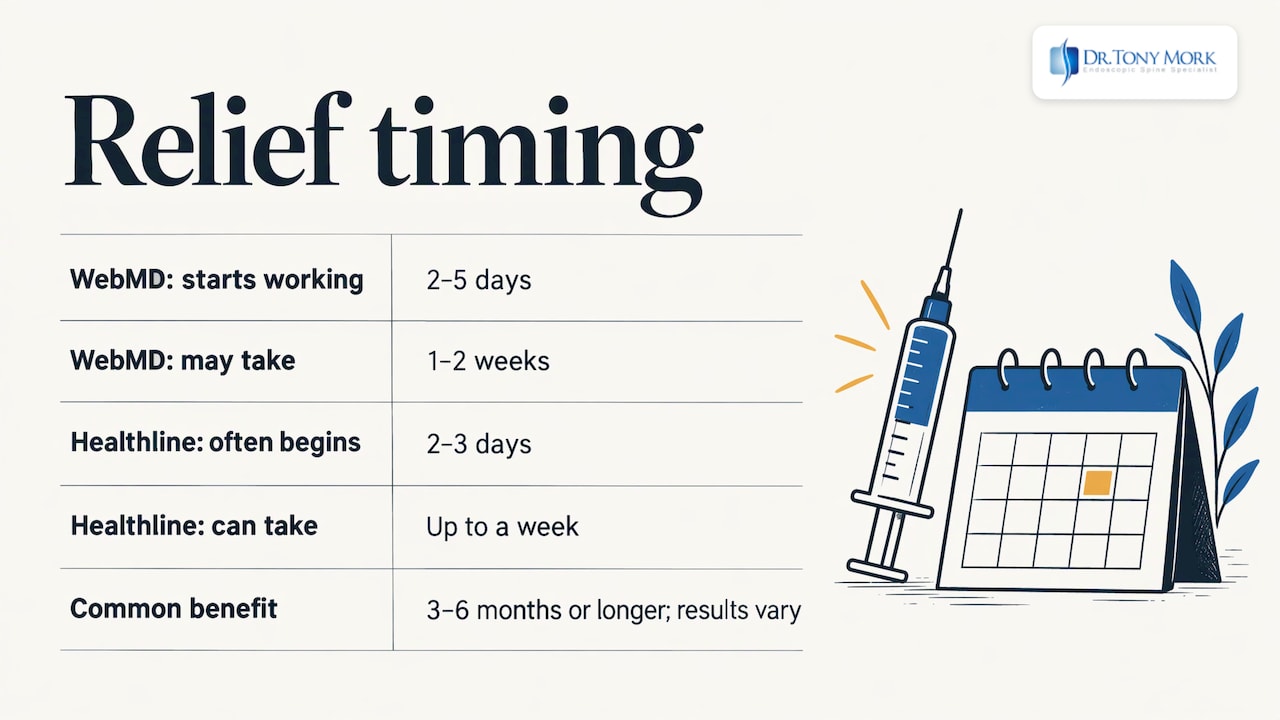
Results vary. Some people get weeks of relief, some get months, and some get little. That variation is a clue about the cause of your pain, and I come back to it below.
What can I do at home when the injection site hurts?
Start with gentle care and easier days. Many patients do well with ice and a short break from anything strenuous.
Spine-Health, in an article by Dr. Richard Staehler, says ice packs can be used for 15 to 20 minutes at a time, with a break of at least two hours between sessions to protect your skin. The same article says hot baths, saunas, and swimming are usually not recommended for 2 to 3 days after the injection, because of the risk of infection.
A practical plan for the first few days:
- Ice: Wrap the pack in a thin cloth. Never put it directly on skin, and keep to the time limits above.
- Activity: Take it easy. Skip heavy lifting, golf, and hard workouts until the soreness settles.
- Sitting and driving: Break up long stretches. Stand and walk for a minute every half hour if sitting aggravates your back.
- Sleep: Try lying on your side with a pillow between your knees, or on your back with a pillow under your knees.
- Medication: Follow the instructions the injecting doctor gave you. Ask that office before you add or change any medicine, and do not stop a prescribed medicine on your own.
- Walking: Short, easy walks are usually fine and keep your back from stiffening. Ask the injecting doctor how much activity is right for you.
Time is on your side in the first week. Most flares calm down with rest and patience.
What other side effects can happen after an epidural injection?
Most side effects are mild and short. They include soreness where the needle went in, flushing of the face, a mild headache, and temporary changes in feeling.
Healthline lists mild soreness, steroid flush, and headache as effects that may last 1 to 3 days. Steroid flush means warmth and redness in the face and chest. Some people also notice trouble sleeping or a jittery feeling for a day or two, which they commonly attribute to the steroid.
Some patients feel temporary numbness or heaviness in a leg after the injection, since the medicine sits near the nerves. It should fade within hours. Numbness or weakness that is new, spreading, or does not go away is a reason to call, as described in the next section.
Steroid injections also carry general risks that your doctor should have reviewed with you before the procedure, including infection and bleeding. If you take blood thinners, have diabetes, or have had a reaction to steroids, talk to the injecting doctor about how your situation fits.
Which symptoms mean I should call my doctor or go to the emergency room?
Call right away for fever, severe headache, new numbness or weakness, worsening redness or heat at the site, or loss of bladder or bowel control. These are not normal flare symptoms.
Kaiser Permanente’s instructions list soreness, redness, or heat at the injection site, severe headache, fever, new numbness or weakness in the hands or legs, a change in level of consciousness, and inability to control the bladder or bowels. They advise going to the nearest emergency room if you have one of these and cannot reach anyone.
University of Washington Medicine advises urgent medical care for a severe headache with nausea and vomiting, fever, loss of bowel or bladder control, or new numbness or tingling.
In plain terms:
- Fever or chills: Call the injecting doctor the same day, or go to the emergency room if you cannot reach anyone.
- Severe headache: Especially one that is worse when you sit up or comes with nausea and vomiting.
- New weakness or numbness: A leg that gives way, a foot that drags, or numbness that was not there before.
- Bladder or bowel changes: Trouble urinating or controlling your bowels, or numbness in the groin or inner thighs. Go to the emergency room.
- Redness, swelling, or heat at the site: Especially if it spreads or you see drainage.
Do not wait to see if these pass. Do not drive yourself if you feel faint or weak.
What if the injection did not help, or the relief wore off?
You have options, and fusion is not the first one. Start by going back to the doctor who gave the injection to talk about what you noticed. Then ask a bigger question: what is actually causing the pain?
Injections reduce inflammation around a nerve. That can bring real relief, and for some people it is enough while the body heals. But the goal I care about is removing the source of pain, not only managing it. If relief keeps fading, the source may still be there.
Here is a plain way to think about it. A disc is like a jelly-filled cushion between two vertebrae (the stacked bones of the spine). If the cushion bulges or tears, the filling can irritate nearby nerves. A steroid calms the irritation. It does not close the tear or take pressure off the nerve.
Why do some injections only help for a short time?
Short relief can happen for several reasons. The nerve may still be squeezed by a herniated disc (a disc whose inner material has pushed out). The opening where the nerve leaves the spine may be narrow, which is called foraminal stenosis. The pain may come from the disc itself, from a tear in its outer wall called an annular tear, or from the small joints at the back of the spine, which is called facet syndrome.
You can read more on my pages about herniated disc treatment, spinal stenosis treatment, and foraminal stenosis treatment.
Does accurate diagnosis come before surgery?
Always. Surgery makes sense only when we know what is producing your pain. An exam and an MRI (magnetic resonance imaging) are needed to know for sure, and sometimes a CT (computed tomography) scan adds detail.
I cannot diagnose you from an article, and I will not guess. Some patients are told their MRI is normal, yet the pain remains. Others have a bulge that is not the true cause. Matching the images to your symptoms is the work that comes first.
What should I try before considering surgery?
Many back problems improve with time, so conservative care comes first when it fits your situation. That usually means a stretch of time with activity changes, physical therapy, medication, and sometimes injections.
The spine was designed to move. Complete bed rest tends to leave you stiffer. Gentle, steady movement that does not provoke your pain is usually better, and a physical therapist can guide it.
If you have given conservative care a fair trial and your pain still limits sitting, sleeping, driving, or lifting a grandchild, that is the time to look for the cause more closely. It is not a failure. It is information.
Here is how I think about the options, with honest pros and cons:
- Time and activity changes: Low risk, and many problems settle. Progress can be slow, and it does not address a structural cause.
- Physical therapy: Builds strength and movement. The wrong program can aggravate some conditions, so it should match the diagnosis.
- Medication: Can ease pain while you heal. It treats symptoms, not the source.
- Epidural steroid injection: Can calm nerve inflammation for a period. Relief varies, and it is not a repair.
- Endoscopic spine surgery: Aims to remove the source of pain, such as disc material pressing on a nerve. It is still surgery, so it carries surgical risks, and results vary.
- Spinal fusion: Joins vertebrae together with hardware. It is a last resort, and it can still be done later if it is ever needed.
What is endoscopic spine surgery, and what are its limits?
Endoscopic spine surgery uses a small incision and a tiny camera to reach the problem. It is outpatient, which means you go home the same day. It uses no hardware and no fusion.
“Minimally invasive” describes how much healthy tissue is disturbed, not only how small the cut is. A small skin incision means little if muscle and bone are cut away underneath. The aim is to work through a narrow path, see the problem on camera, and treat only what is causing your pain.
I can use a laser as one tool during the procedure. It is never a cure by itself. What helps you is correctly identifying the source and treating it.
Many patients report returning to normal activities sooner after endoscopic surgery than they expected. Recovery often takes days to weeks for daily activities, and results vary from person to person.
The limits matter too:
- Not for every problem: Some conditions, such as severe spinal instability, may need a different approach. A thorough review of your imaging tells us.
- Still surgery: There are risks, including infection, bleeding, nerve irritation, and the chance that pain returns.
- No guarantee: I cannot promise a pain-free result or an exact recovery time.
- Diagnosis drives the decision: If the source of pain is not clear, surgery is not the answer yet.
You can read more about endoscopic spine surgery and about minimally invasive spine surgery on my site. An endoscopic discectomy removes the part of a disc pressing on a nerve, and an endoscopic decompression gives a pinched nerve more room.
What do I tell patients whose injections stopped working?
I hear the same story often. A patient has an injection, feels sore for a few days, gets some relief, and then the pain creeps back. They have been told the next step is another injection, and eventually a fusion.
I disagree with treating fusion as a routine answer. The spine was designed to move, and I want to protect that motion whenever I can. Fusion is a last resort, and it can still be done later if it is truly needed.
I have practiced endoscopic spine surgery exclusively since 1998 and have performed more than 8,000 endoscopic spine procedures. I founded the Endoscopic Spine Academy and co-founded Microspine. That experience taught me that the first job is diagnosis. When we find the real source of pain, we can talk about removing it instead of only managing it.
My practice is a concierge practice. You reach me directly, and you are not passed from desk to desk. I explain every option in plain words, including the ones that do not involve surgery.
Dr. Tony Mork
How can my office help you understand your options?
If an epidural injection gave you only short relief, or none, I can review your imaging and talk through what may be causing your pain. My practice offers MRI evaluations, including remote review of your MRI and CT scans, and phone consultations with me. I also treat herniated discs, annular tears, spinal stenosis, facet syndrome, and pain after earlier spine surgery.
My offices are at 2102 Business Center Dr #127, Irvine, CA 92612, and in Naples, Florida. Patients also travel from other states, and remote review means you can start from home.
If you have an MRI, upload it and I will review it personally and talk with you about your options.
Frequently asked questions
Is it normal for an epidural site to hurt after?
Yes. Soreness where the needle went in is common and usually lasts hours to a few days. The Androscoggin Valley Hospital encyclopedia says site discomfort should last only a few hours. Redness, heat, swelling, or fever are not normal, so call the injecting doctor if you notice them.
Can my back pain be worse before it gets better?
Yes, for some people. University of Washington Medicine says pain can increase for several days, and WebMD says the steroid may take 2 to 5 days, sometimes 1 to 2 weeks, to start working. If the pain keeps rising or new symptoms appear, call your doctor.
When should I worry about pain after an epidural injection?
Worry about fever, severe headache, new numbness or weakness, or loss of bladder or bowel control. Kaiser Permanente and University of Washington Medicine both list these as reasons for urgent care. If you cannot reach your doctor, go to the emergency room.
What if my pain comes back after the injection wears off?
It tells you something useful. Pain that returns may mean the source is still present. An exam and an MRI are needed to know for sure. From there, we can discuss conservative care, further evaluation, and whether endoscopic surgery fits your situation, with fusion kept as a last resort.
This article is for general education and is not medical advice. Please see a qualified doctor about your symptoms.