
Yes. Many disc and nerve problems in the back and neck can be treated without fusing the spine, and in California that includes endoscopic surgery through a small incision. In my practice, fusion is a last resort, and it can still be done later if you ever need it.
I am Dr. Tony Mork, a board-certified orthopedic surgeon. I have practiced endoscopic spine surgery exclusively since 1998 and have performed more than 8,000 endoscopic spine procedures. Below I explain who may be a candidate, what the surgery involves, and where its limits are.
TL;DR
- Fusion is not the only surgical option: Endoscopic surgery uses a small incision and a camera. It is done as an outpatient procedure with no hardware and no fusion.
- Diagnosis comes first: An exam and an MRI (magnetic resonance imaging) are needed to know for sure what is causing your pain.
- Conservative care comes first where it fits: Time, activity changes, physical therapy, medication, and injections help many people.
- The goal is to remove the source of pain: Managing pain is not the same as removing what causes it.
- Limits exist: Some spines are unstable and do need fusion. Results vary from patient to patient.
Which back and neck problems can be treated without fusion?
Many of the common ones can. Herniated discs, bulging discs, annular tears, spinal stenosis, foraminal stenosis, and facet pain are often treated without fusing the spine. Whether yours is one of them depends on your exam and imaging.
To picture a disc, think of a liquid-filled cushion between two vertebrae (the stacked bones of the spine). It absorbs shock and lets you bend. When the cushion bulges or tears, it can press on a nearby nerve or become painful itself.
Here is how the main conditions line up with what I treat:
- Herniated disc: The soft center of the disc pushes through the outer wall and irritates a nerve. You may feel it as leg pain, burning, or numbness. See my page on herniated disc treatment.
- Bulging disc: The disc extends past its normal border without breaking through. Read about bulging disc treatment.
- Annular tear: A crack in the disc’s outer wall, which can cause deep back pain when you sit or drive. Learn more in my annular tear assessment.
- Spinal stenosis: The space around the nerves narrows, often making walking or standing uncomfortable. My page on spinal stenosis treatment covers this in detail.
- Foraminal stenosis: Narrowing of the opening where a nerve leaves the spine. See endoscopic foraminal decompression.
- Facet syndrome: Irritation of the small joints at the back of the spine. It can ache with twisting or standing.
Many patients also come to me after a previous surgery that did not relieve their pain. That is a situation I evaluate carefully, case by case.
Why does the spine need to keep moving?
Because the spine was designed to move. Every disc and joint shares the work of bending, twisting, and absorbing load when you put on your shoes, reach into a back seat, or swing a golf club.
Fusion joins two or more vertebrae into one block of bone. It can be the right answer for some problems. But it removes motion at that level, and the neighboring levels may take on more work afterward.
That is why I treat fusion as a last resort. If a less invasive procedure does not solve the problem, fusion remains available later. You do not lose that option by trying something gentler first.
You can read more on my page about alternatives to spinal fusion. If your problem is in the neck, see cervical fusion alternatives.
What is endoscopic spine surgery?
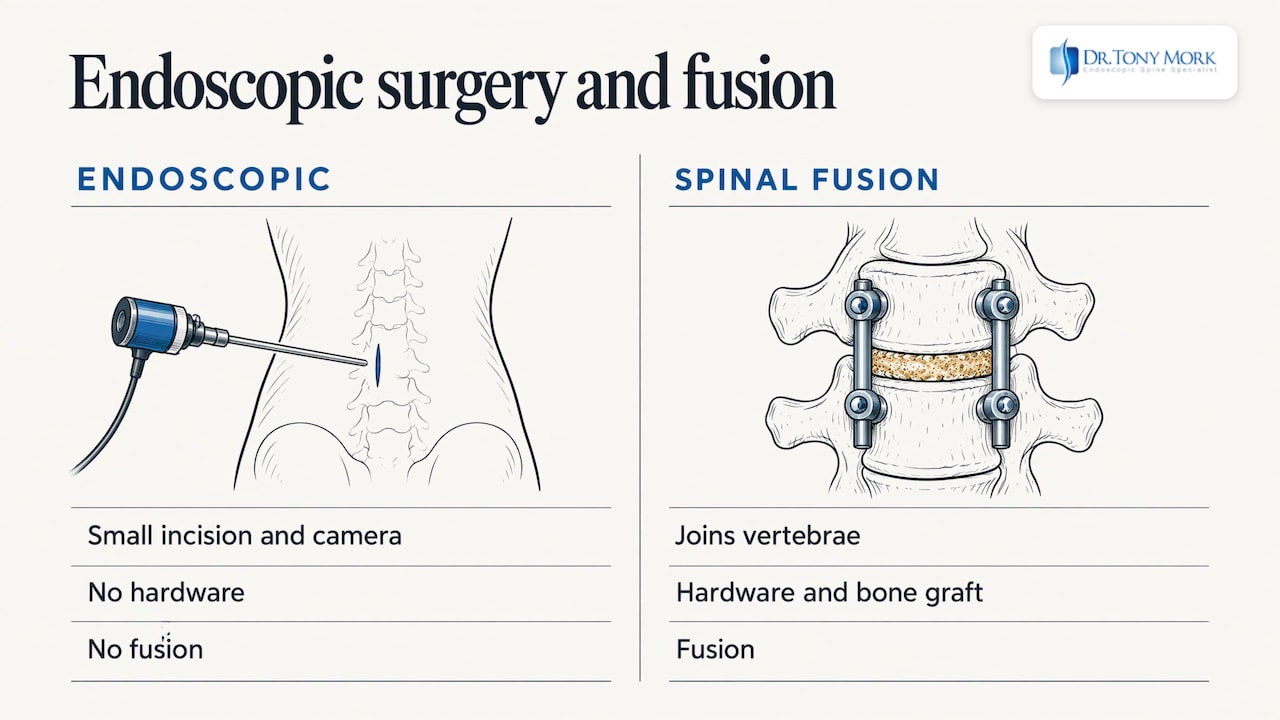
It is surgery done through a small incision using a thin tube with a camera. Endoscopic spine surgery means a small incision, a camera, an outpatient setting, no hardware, and no fusion.
The camera shows me the problem on a screen. Working through that narrow channel, I can remove the piece of disc pressing on a nerve, or widen a tight space around a nerve. That second type of procedure is called decompression (making room for the nerve).
You go home the same day. No screws, rods, or cages are placed, because nothing is being fused.
Some patients ask about the laser. A laser is one tool among several. It is never a cure by itself. The result depends on finding the true source of pain and treating that source.
For more detail, see my guide to endoscopic spine surgery and my page on endoscopic spine surgery.
What does minimally invasive actually mean?
It describes how much healthy tissue is disturbed, not only how long the incision is. A small cut on the skin can still hide a large amount of muscle being moved or bone being removed underneath.
In my work, the aim is to leave healthy muscle, bone, and ligament as undisturbed as possible while I reach the problem. That is the point of the endoscopic approach.
The term is used loosely in the medical world. When you hear it, ask what tissue is actually being cut or removed. I explain this further in my articles on what minimally invasive spine surgery means and how minimal it can get.
Should I try conservative care first?
In most cases, yes. Many back problems improve with time, and surgery is not the first step for most people.
Conservative care usually includes:
- Time and activity changes: Easing off the movements that aggravate your pain, while staying as active as you comfortably can.
- Physical therapy: Guided exercise can help some people. If it makes your pain worse, tell your therapist and your doctor.
- Medication: Take what your doctor prescribes. Never stop a medication without talking to the doctor who prescribed it.
- Injections: Epidural steroid injections (ESIs) place medicine near irritated nerves. Many people get relief that lasts weeks or months. For others it wears off quickly.
Time is on your side. Surgery is worth discussing when pain keeps interfering with sleep, work, driving, or the things you love, and when conservative care has not given lasting relief.
My article on controlling lumbar stenosis without surgery or medication covers self-care in more depth.
Why does diagnosis come before surgery?
Because surgery only works when it is aimed at the right target. Accurate diagnosis comes before surgery, always.
Back pain can come from a disc, a nerve, a facet joint, or sometimes more than one. A normal-looking MRI does not always mean nothing is wrong, and an abnormal MRI does not always mean the finding is causing your pain. Many people have bulges on imaging and no symptoms at all.
That is why I match your symptoms, your exam, and your images together. An exam and an MRI are needed to know for sure.
Some of the patterns I look for include:
- Sitting pain: Deep, central low back pain that worsens when you sit through a workday or drive.
- Repeated flare-ups: A back that goes out again and again for no clear reason.
- Referred pain: Groin, testicular, or tailbone pain when hip and hernia checks came back normal.
- Nerve symptoms: Leg burning, numbness, or sciatica without an obvious herniated disc.
These patterns do not diagnose you. They tell me where to look. Sometimes extra testing, such as a CT (computed tomography) discogram, helps clarify which disc is painful.
If you want another set of eyes on your scans, read should I get a second opinion on my spine MRI. For nerve-opening problems, see diagnosing foraminal stenosis.
When is fusion still the right choice?
Fusion can be right when the spine is truly unstable, when one vertebra has slipped significantly over another, or when a deformity needs to be corrected. In those cases, motion at that level is part of the problem.
The decision should rest on your imaging and your exam, not on a routine. I disagree with the idea that fusion should be the default answer for disc pain or nerve compression. Many of those problems can be addressed without it.
If you have been told fusion is your only option, a second opinion is reasonable. You can read my views on spinal fusion surgery and my press release on reconsidering fusion.
What are the pros and cons of endoscopic spine surgery?
Endoscopic surgery has real advantages and real limits. You deserve both sides.
What many patients value:
- Less disturbance of healthy tissue: The approach is designed to work through a narrow channel.
- Outpatient care: You go home the same day.
- No hardware, no fusion: The spine keeps its motion.
- Recovery: Recovery often takes less time than after larger operations, and many patients return to regular activities within days. Results vary.
What you should know:
- Not every problem fits: Instability, severe deformity, or very advanced narrowing may call for a different operation.
- Pain can persist or return: No surgery guarantees a pain-free result, and a disc can herniate again.
- Risks exist: Any surgery carries risks such as bleeding, infection, nerve irritation, or the need for more treatment. I go over these with you before you decide.
- Skill matters: Endoscopic technique takes years of focused training.
I describe both sides in more detail in the pros and cons of endoscopic spine surgery.
What is recovery like after endoscopic spine surgery?
Recovery often takes days to weeks for daily activities, but it varies with the condition, your health, and your job. I do not promise an exact timeline.
Many patients report being up and walking the same day. Many return to desk work or light activity within days. Heavier lifting, golf, and sports come back more gradually, and I guide you on timing based on your case.
Patients commonly tell me they notice the nerve-related pain easing first, while soreness around the incision fades over time. Nerves that were compressed for a long time can take weeks or months to settle. Be patient with them.
As part of my concierge practice, you have direct access to me after surgery. If something feels off, you do not have to wait for a call back from a front desk.
What do I tell patients in California who are worried about fusion?
I tell them three things. First, you have more options than you may have been told. Fusion is a last resort, and it can still be done later if it is ever needed.
Second, the spine was designed to move. My goal is to remove the source of your pain, not only manage it, and to preserve your motion while I do it.
Third, getting the diagnosis right matters more than any tool. I am a board-certified orthopedic surgeon. I have practiced endoscopic spine surgery exclusively since 1998, I founded the Endoscopic Spine Academy, and I co-founded Microspine. I bring that experience to every set of images I review.
I will tell you honestly if I think you are not a candidate, or if conservative care should come first. I would rather you make the right decision than a fast one.
Dr. Tony Mork
Where can I be seen, and can you review my MRI from a distance?
I see patients in my Irvine office at 2102 Business Center Dr #127, Irvine, CA 92612, which serves Orange County and Newport Beach. I also have an office in Naples, Florida. Patients from across California and other states travel to see me.
If you cannot come in right away, I can review your MRI or CT scan remotely and talk with you by phone. My practice is built around personalized, concierge care, so you work with me directly.
To start, visit my practice website and upload your images. You can also look at my page on minimally invasive spine surgery.
For a closer look at the procedure itself, see what endoscopic decompression surgery is. More articles are on my blog.
What else do patients ask?
Is endoscopic spine surgery the same as spinal fusion?
No. Endoscopic spine surgery uses a small incision and a camera, and it places no hardware and does no fusion. Fusion joins vertebrae together with hardware and bone graft. The two procedures solve different problems.
Will I need fusion later if I have endoscopic surgery now?
Not necessarily. Many patients never need it. If your condition changes, fusion remains an option, so trying a less invasive procedure first does not close any doors.
Can surgery without fusion help if I have already had back surgery?
Sometimes. Ongoing pain after a prior surgery can come from a new disc problem, leftover nerve pressure, or another source. I need to see your imaging and examine you to know for sure.
How do I know if I am a candidate?
Candidacy depends on your symptoms, your exam, and your MRI, together with how you responded to conservative care. I never diagnose anyone from a description alone. Send me your images and we can talk about what they show and what your options are.
If you have an MRI, upload it and I will review it personally, then talk with you about your options.
Recommended
- Dr. Mork in Irvine, CA Wants You To Reconsider Spinal Fusion Surgery
- Alternatives to Spinal Fusion | Why You Should Consider Other Options
- Cervical Fusion Alternatives: Your Options for Neck Pain
This article is for general education and is not medical advice. Please see a qualified doctor about your symptoms.