
You can have endoscopic spine surgery in Florida through my Naples office, and you can start by sending me your MRI (magnetic resonance imaging) scan from anywhere in the state. I am Tony Mork, MD, a board-certified orthopedic surgeon, and I have practiced endoscopic spine surgery exclusively since 1998.
If you are worried that you need a fusion, I want you to know there is often another path. It begins with an accurate diagnosis, and it ends with removing the source of your pain, not only managing it.
TL;DR
- Where: I see Florida patients at my Naples office, and I review scans remotely for patients elsewhere in the state. My Irvine, California office is at 2102 Business Center Dr #127, Irvine, CA 92612.
- What it is: Endoscopic spine surgery uses a small incision and a camera. It is outpatient, with no hardware and no fusion.
- Before surgery: An exam and an MRI are needed to know for sure what is causing your pain. Conservative care comes first where it fits.
- Limits: Not every spine problem can be treated endoscopically. Results vary, and I will tell you plainly if surgery is not right for you.
- Fusion: I treat fusion as a last resort. It can still be done later if it is ever needed.
What is endoscopic spine surgery?
Endoscopic spine surgery is an operation done through a small incision using an endoscope, a thin tube with a light and a camera on the end. The camera lets me see the nerve and the disc on a screen, so I can remove only what is pressing on the nerve.
In my practice, the operation has a simple description:
- Incision: Small, usually about the width of a fingertip.
- Camera: I work while looking directly at the tissue involved.
- Outpatient: Most patients go home the same day.
- No hardware: No screws, rods, or cages are placed.
- No fusion: The spine keeps its natural motion.
The American Academy of Orthopaedic Surgeons (AAOS) describes endoscopic diskectomy as a minimally invasive operation with potential benefits that include smaller incisions, less scarring, and a shorter recovery. It also notes that the procedure is done through an incision of about 1 centimeter, or two incisions of about 7 millimeters.
What does “minimally invasive” really mean?
“Minimally invasive” describes how much healthy tissue is disturbed, not only how long the incision is. A small cut can still hide a large amount of muscle being stripped or bone being removed underneath.
In endoscopic surgery, I pass the camera and instruments through a narrow channel and work between your muscles instead of cutting them away. The goal is to leave the muscles, ligaments, and joints that hold your spine together as undisturbed as possible.
That matters in daily life. Muscles that are not damaged tend to recover faster, and that can make a difference when you want to sit through a workday, drive, or lift a grandchild without fear of a flare-up.
You can read more in my guide to minimally invasive spine surgery and my patient guide to endoscopic spine surgery.
Do I need surgery at all?
Not always. Many back and neck problems improve with time, and I recommend conservative care first where it fits.
Conservative care usually includes:
- Time: Many episodes of pain settle over weeks to months.
- Activity changes: Adjusting how you sit, lift, and sleep while the pain calms down.
- Physical therapy: Guided exercise to build strength and flexibility.
- Medication: Taken as your own doctor directs. Never stop a medication on your own.
- Injections: Epidural steroid injections (medication placed near the irritated nerve) can calm inflammation for a period.
Surgery becomes a reasonable conversation when pain keeps you from sleeping through the night, from putting on your shoes, or from sitting in the car for 20 minutes, and when these measures have not given lasting relief. Leg weakness that is getting worse needs a prompt visit with a doctor.
The AAOS says endoscopic diskectomy is an option for patients with a herniated disc, and it also says that long-term outcomes compared with open surgery are still being studied. I share that openly. You should have all the information before you decide.
Which conditions can endoscopic spine surgery treat?
It can treat several of the most common causes of back, neck, and leg pain, when the imaging and exam point to a problem that can be reached endoscopically. I cannot diagnose you from a web page. An exam and an MRI are needed to know for sure.
Here is how I think about the main conditions:
- Herniated disc: A disc is like a liquid-filled cushion between two vertebrae (the bones of the spine). When the cushion’s wall tears and some of its center pushes out, it can press on a nerve. Endoscopic discectomy removes the material that is pressing. See herniated disc treatment.
- Bulging disc: The cushion bulges outward without breaking through. Some bulges cause no symptoms at all, so the match between the scan and your pain matters. See bulging disc treatment.
- Annular tear: A small tear in the outer wall of the disc, which can be a source of deep, central back pain that worsens with sitting. See my annular tear assessment.
- Spinal stenosis: Narrowing of the space around the spinal nerves, which can cause leg pain or heaviness when you stand or walk. See spinal stenosis treatment.
- Foraminal stenosis: Narrowing of the opening where a nerve leaves the spine. See foraminal stenosis treatment.
- Facet syndrome: Pain from the small joints at the back of the spine. I explain my approach in facet syndrome after transfacet decompression.
- Sciatica and pinched nerve: Pain, burning, or numbness traveling down the leg or arm. Sciatica is a symptom, not a diagnosis, and the cause has to be found. See sciatica treatment and pinched nerve treatment.
I also see patients whose pain continues after a previous spine surgery, and patients who have been told their MRI is normal yet still hurt. Those cases take careful detective work, and I enjoy that work.
Why does accurate diagnosis come before surgery?
Because the best operation in the world fails if it is aimed at the wrong spot. Accurate diagnosis comes before surgery, every time.
MRI shows structure, but structure is not always the same as pain. Many people have bulging discs or tears on a scan and feel nothing. Others have real pain and a scan that looks unremarkable. My job is to match what the images show with what you feel and what I find on exam.
I look for patterns such as:
- Where it hurts: Deep midline low back pain, groin or tailbone pain, or leg symptoms.
- What makes it worse: Sitting, driving, bending, or standing for long periods.
- What has not worked: Physical therapy that made things worse, injections that wore off, or adjustments that never lasted.
Sometimes additional testing, such as a CT (computed tomography) scan or a discogram (a test that identifies which disc is painful), helps confirm the source. I only recommend a test if the answer will change what we do.
Is fusion my only option?
Usually not. Spinal fusion joins two or more vertebrae into one solid piece of bone, and it has a place for some conditions. I see it as a last resort, and it can still be done later if it is ever needed.
The spine was designed to move. Every segment shares the load, and when one level is locked together, the levels next to it can take on more stress. For many problems, removing the source of pain while preserving motion is a better first step.
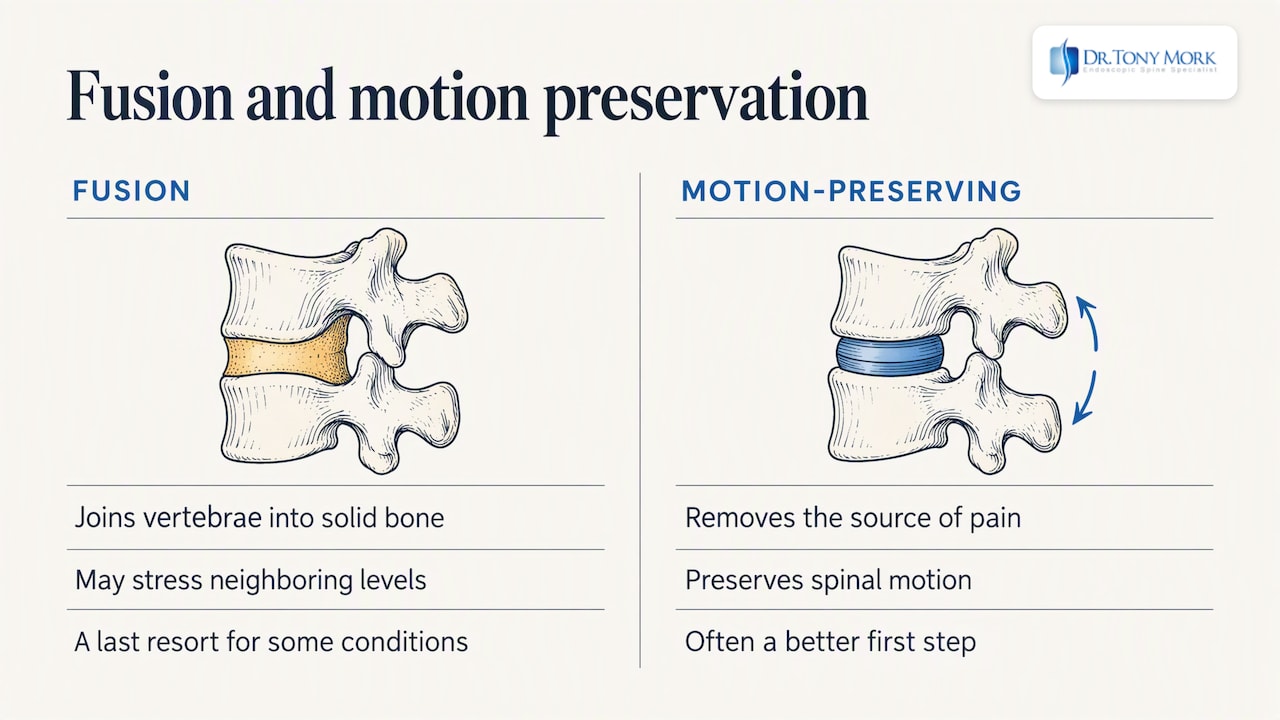
My practice is built around that idea. If you have been told fusion is your only option, I would like to look at your imaging and examine whether that is really the case. You can read more in my article on reconsidering spinal fusion surgery.
I will be honest, though. Some conditions, such as certain deformities or unstable segments, may still call for a different operation. I will tell you if that is you.
What happens during endoscopic spine surgery?
You are asleep or comfortably sedated, and the operation takes place through a very small opening. The AAOS notes that the anesthesia is general anesthesia or local anesthesia with sedation, with X-ray guidance used to place the endoscope.
The typical steps look like this:
- Positioning: You lie comfortably, and the area is made sterile.
- Access: Using X-ray guidance, I create a narrow channel to the spot where the nerve is irritated.
- Visualization: The camera shows the nerve and disc on a screen.
- Treatment: I remove the disc fragment or the tissue pressing on the nerve. A laser can be used as one tool among several. It is never a cure by itself.
- Closure: The small incision is closed, and you recover and go home.
Two main routes exist. A transforaminal approach goes in from the side, through the opening where the nerve exits. You can read about it in my article on the lumbar transforaminal approach for disc herniation. An interlaminar approach goes in from the back, between two vertebrae, and can suit certain cases of stenosis. Which one is right depends on your anatomy.
What is recovery like?
Many patients are up and walking the same day, and recovery often takes days to a few weeks for everyday activities. Results vary, and I do not promise an exact timeline.

What patients commonly report is that they feel better able to sit, sleep, and walk soon after surgery, because the muscles around the spine were not cut. Heavier activity returns more gradually. I guide you on when to return to a desk, to driving, and later to golf, the gym, or lifting.
In general, I ask patients to:
- Walk daily: Gentle movement helps recovery.
- Avoid heavy lifting and hard twisting early on: I will give you specifics for your case.
- Call me with questions: Direct access matters most in the first days after surgery.
A physical therapist can help rebuild strength and movement once you are cleared to start.
What are the risks and limits?
Every operation has risks, and endoscopic surgery is no exception. The AAOS lists infection, bleeding, nerve damage, tears of the covering of the nerves (called dural tears), and symptoms that persist or return.
The limits are worth knowing as well:
- Not every condition fits: Some problems, such as certain tumors, infections, or unstable spines, need a different approach.
- Anatomy matters: Some people have bone shapes that make an endoscopic route harder to reach.
- Surgeon experience matters: Endoscopic surgery has a steep learning curve. That is one reason I founded the Endoscopic Spine Academy to teach the technique, and why I have focused only on it for so long.
- Pain can return: A new disc problem can develop, and a different level can become painful.
For a more complete discussion, read the pros and cons of endoscopic spine surgery.
How much does endoscopic spine surgery cost in Florida?
The cost depends on your condition, the facility, and your insurance, so I cannot quote a single number for everyone. In my practice, surgery is fee-for-service, and payment is arranged before your procedure.
Insurance may cover the facility and anesthesia fees, but it does not cover the surgeon’s fee. Your plan’s terms vary, and the billing office can help you understand what to expect before you commit to anything.
How does my practice work for Florida patients?
I practice from Irvine, California, and from Naples, Florida. In Southwest Florida, you can be seen at my Naples office.
If you live in Tampa, Miami, Jacksonville, or elsewhere, we can begin remotely. You send your MRI or CT images, I review them myself, and we talk about what they show and what I would recommend. Many patients travel for an endoscopic procedure once the diagnosis is clear.
My practice is a concierge practice. You have direct access to me, and I provide immediate support after surgery. You are not handed off to a call center.
What do I believe about spine surgery?
I have performed more than 8,000 endoscopic spine procedures, and I co-founded Microspine. What those years have taught me is that most patients do not want an operation. They want to sit through a workday, sleep through the night, and play with their grandchildren again.
I believe the goal is to find the source of the pain and remove it, not to manage it forever. That means taking the time to get the diagnosis right, and to be honest when surgery is not the answer.
I also believe the spine was designed to move. When I can solve the problem through a small incision, with no hardware and no fusion, I preserve that motion. Fusion remains a last resort, and it can still be done later.
If you have been told you have no options, I would like to take a look for myself.
Dr. Tony Mork
Ready to have someone review your scans?
If you are in Florida and have been told you need a fusion, or you have been to several doctors without an answer, I can review your imaging. My concierge practice offers MRI evaluation, phone consultations, and surgical care with direct access to me.
If you have an MRI, upload it through my consultation request page and I will review it personally and talk with you about your options. Learn more about endoscopic spine surgery before you decide.
Common questions about endoscopic spine surgery in Florida
Who does endoscopic spine surgery in Florida?
A limited number of surgeons focus on endoscopic techniques. I treat Florida patients through my Naples office and review scans remotely for patients anywhere in the state. I have practiced endoscopic spine surgery exclusively since 1998.
How successful is endoscopic spine surgery?
Results vary, and I cannot promise an outcome. The American Academy of Orthopaedic Surgeons says early results of endoscopic diskectomy are promising, while long-term outcomes compared with open surgery are still being studied. Success depends largely on an accurate diagnosis and on choosing the right patient for the procedure.
Will I need a fusion later?
Many patients do not. Fusion remains available later if it is ever needed, so choosing a motion-preserving operation first does not close any doors. I explain this fully during your review.
Is endoscopic spine surgery done in a hospital?
It is an outpatient procedure, which means you go home the same day. There is no hardware, and no fusion. Your exact setting and plan are discussed before you schedule.
Can I send my MRI before traveling?
Yes. You can upload your MRI or CT scan, and I will review the images myself. That tells us whether a trip to Naples makes sense before you plan one.
Recommended
- Spine Surgeon Naples, FL
- Endoscopic Spine Surgery | Minimally Invasive Spine Surgery
- Endoscopic Spine Surgery Guide For Patients
- The Pros and Cons of Endoscopic Spine Surgery
This article is for general education and is not medical advice. Please see a qualified doctor about your symptoms.