
Recovery often takes several weeks to a few months, and it depends heavily on how much healthy tissue the operation disturbs. With endoscopic decompression, which uses a small incision and a camera, many patients go home the same day and return to light daily activity quickly. Results vary.
I am Dr. Tony Mork, MD, a board-certified orthopedic surgeon. I have practiced endoscopic spine surgery exclusively since 1998 and have performed more than 8,000 endoscopic spine procedures. I founded the Endoscopic Spine Academy and co-founded Microspine. Here is what I tell patients in my office about recovery.
TL;DR
- Approach matters: Decompression (taking pressure off a pinched nerve) done through a small endoscopic incision disturbs less healthy tissue than open surgery, and recovery often reflects that.
- Same-day discharge: Many decompression operations are done as outpatient surgery, and going home that day depends on your age, general health and support at home.
- Stages: Expect early walking, gradual activity limits over the first weeks, and a slower rebuild of strength over the following months.
- Diagnosis first: An exam and an MRI (magnetic resonance imaging) are needed to know for sure that decompression is right for you.
- Warning signs: New weakness, numbness in the groin, or trouble urinating need a call to your surgeon right away.
What is decompression surgery, and why does the approach change recovery?
Decompression surgery removes whatever is pressing on a nerve, such as bone spur, thickened ligament or part of a disc. The goal is to remove the source of the pain, not only manage it.
Think of stenosis (narrowing of the spinal canal or the opening where a nerve leaves the spine) as a narrowing in a waterway. The water, here the nerve, cannot flow freely until the channel is widened.
The spine was designed to move. That is why I try to preserve motion and avoid fusion (permanently joining vertebrae with hardware). Fusion is a last resort, and it can still be done later if needed.
“Minimally invasive” describes how much healthy tissue is disturbed, not only how small the incision is. A 2025 narrative review of lumbar decompression reports that minimally invasive laminotomies, compared with open approaches, show shorter hospital stays, fewer wound complications, less blood loss, less opioid use afterward and shorter recovery times. Some studies in that review found no significant difference in overall clinical outcomes, so the benefit is mostly in the recovery period.
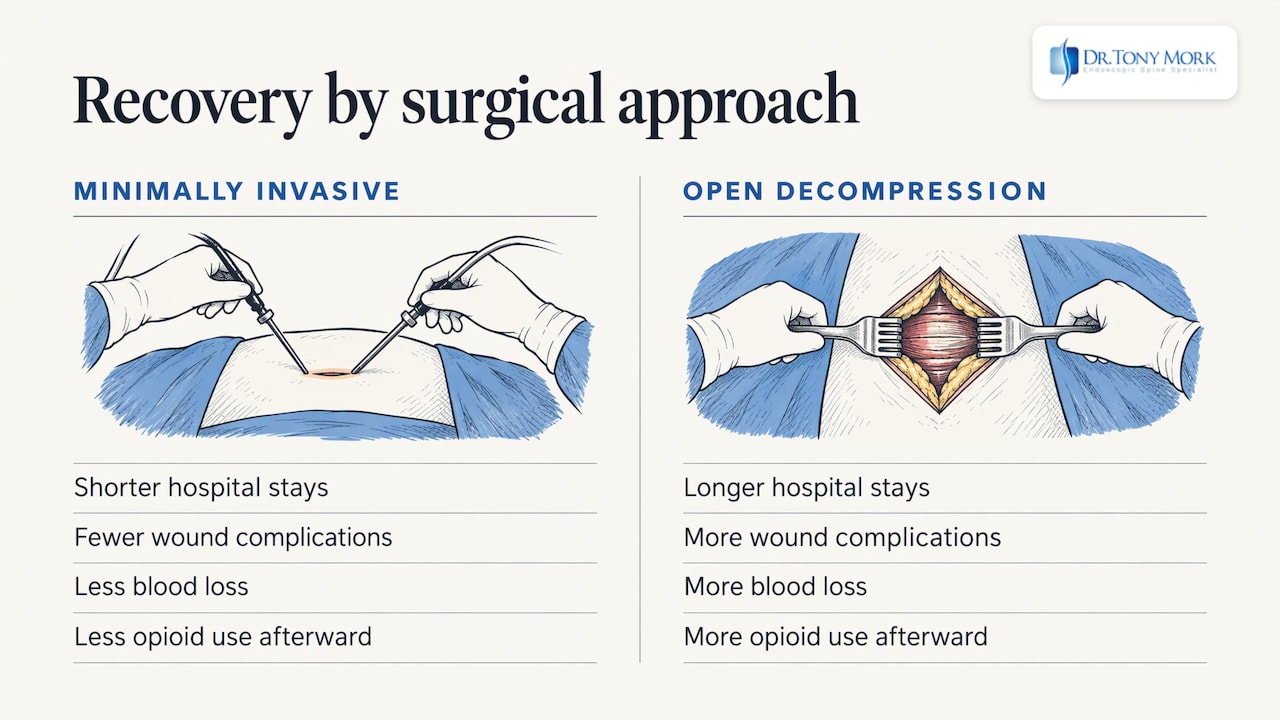
Endoscopic spine surgery, as I perform it, means a small incision, a camera, outpatient care, no hardware and no fusion. You can read the details in my guide to endoscopic decompression surgery. A laser is one tool I may use. It is never a cure by itself.
Can decompression surgery be done the same day?
Yes, for many patients. The American Academy of Orthopaedic Surgeons says outpatient spine surgery is increasingly common in the United States, and lists microdiscectomy, laminectomy and spinal decompression among the common procedures done that way.
Whether you go home that day depends on:
- Age: Older patients are less likely to be discharged the same day.
- General health: Heart disease, lung disease or diabetes can change the plan.
- Mental health and cognition: Your ability to follow instructions at home matters.
- Support at home: Someone should be with you after surgery.
A 2022 systematic review of same-day lumbar decompression found complication rates from 0% to 7.8%, with nine studies under 4%, and readmission rates from 0% to 7.7%. Patient acceptability was consistently high across six studies.
Staying overnight is sometimes the better plan. That is a safety decision, not a setback.
What does recovery look like week by week?
Healing is gradual. The timeline below is a general pattern, not a promise. Recovery often takes longer for open surgery and shorter for endoscopic surgery, and results vary.
- First days: You walk soon after surgery. Early walking is standard, and the AAOS notes that same-day physical therapy is linked to quicker recovery, fewer complications and lower readmission risk. Many of my patients report that the leg pain they came in with feels different quickly, though soreness at the incision is normal.
- Weeks 1 to 4: You move within the limits I give you. Short walks, light household tasks and sitting for modest periods are typical. Avoid heavy lifting, bending and twisting.
- Weeks 4 to 8: Controlled rehabilitation begins. Physical therapy builds core and hip strength so your back is supported.
- Weeks 8 to 12 and beyond: You rebuild capacity for lifting, golf, gym work or picking up a grandchild, in steps.
Nerves heal slowly. Numbness or tingling can linger after the pressure is gone, even when the original pain improves. Patience is part of the recovery.
When can I drive, sit through a workday and go back to work?
Driving and work depend on your job, your pain control and your medication. As a general pattern, desk work often resumes sooner than physical labor. Driving is safe only when you can turn, brake hard and sit comfortably without narcotic pain medicine.
I do not give exact dates in an article, because they differ for each patient. In my practice, we set your limits after your procedure, based on what was done and how you feel. Never stop a prescribed medication on your own, and follow your surgeon’s instructions.
Helpful habits during the early weeks:
- Sitting: Get up and walk every 30 to 45 minutes instead of sitting for hours.
- Sleeping: Lie on your side with a pillow between your knees, or on your back with a pillow under your knees.
- Putting on shoes: Sit and bring your foot to you, rather than bending forward at the waist.
- Lifting: Keep objects light and close to your body until cleared.
What makes recovery faster or slower?
Several factors shape how you heal:
- Surgical approach: Less tissue disturbed generally means less soreness and quicker return to activity.
- How long the nerve was compressed: A review of lumbar disc herniation surgery lists chronic pain, neurologic deficits and being unable to work for more than 2 to 3 months among the risk factors for a less satisfactory outcome.
- Age and general health: Older age and other medical conditions can slow healing.
- Your preparation and support: A clear plan for rides, meals and help at home reduces stress. Planning ahead with a post-op recovery checklist can make those first weeks easier to organize.
- Diagnosis: Accurate diagnosis comes before surgery. If the surgery treats the wrong pain source, recovery will disappoint.
The review also notes that most herniated-disc symptoms resolve within 6 to 12 weeks with time and conservative care for many people. That is why I look at time, activity changes, physical therapy, medication and injections first where they fit. Surgery is for the patient whose pain persists and whose imaging and exam point to a clear source.
What warning signs mean I should call right away?
Call my office or your surgeon the same day for:
- Fever or wound drainage: Redness, swelling or fluid at the incision.
- New or worsening weakness: A foot that drags or a leg that gives way.
- Trouble urinating: A 2024 study of 738 lumbar spine surgery patients found new urinary retention in 3.1%, and it often took weeks to resolve.
- Numbness in the groin or saddle area, or loss of bowel or bladder control: Go to an emergency room immediately. These can signal cauda equina syndrome (severe compression of the nerves at the base of the spine), which needs urgent decompression.
Most patients never face these. Knowing them lets you act quickly.
What are the honest pros and cons of endoscopic decompression?
Pros:
- Less tissue disturbed: Muscle and bone are preserved.
- Outpatient: Many patients go home the same day.
- No hardware, no fusion: The spine keeps its motion.
Limits:
- Not every problem fits: Some severe deformities or instability need a different operation.
- Imaging must match symptoms: An MRI finding alone does not justify surgery.
- Nerves heal on their own schedule: Numbness can take months to fade.
You can read more in the pros and cons of endoscopic spine surgery.
What if I was told I need a fusion or still have pain after surgery?
Fusion should be a last resort. Many patients told it was their only option have a specific pinched nerve that can be treated by removing the pressure. Whether that applies to you needs an exam and an MRI. See my page on minimally invasive lumbar fusion to understand when it is considered.
If pain persists after a previous operation, read about post-laminectomy syndrome treatment. Related conditions are covered in lumbar spinal stenosis facts and foraminal stenosis surgery.
Where can I be evaluated?
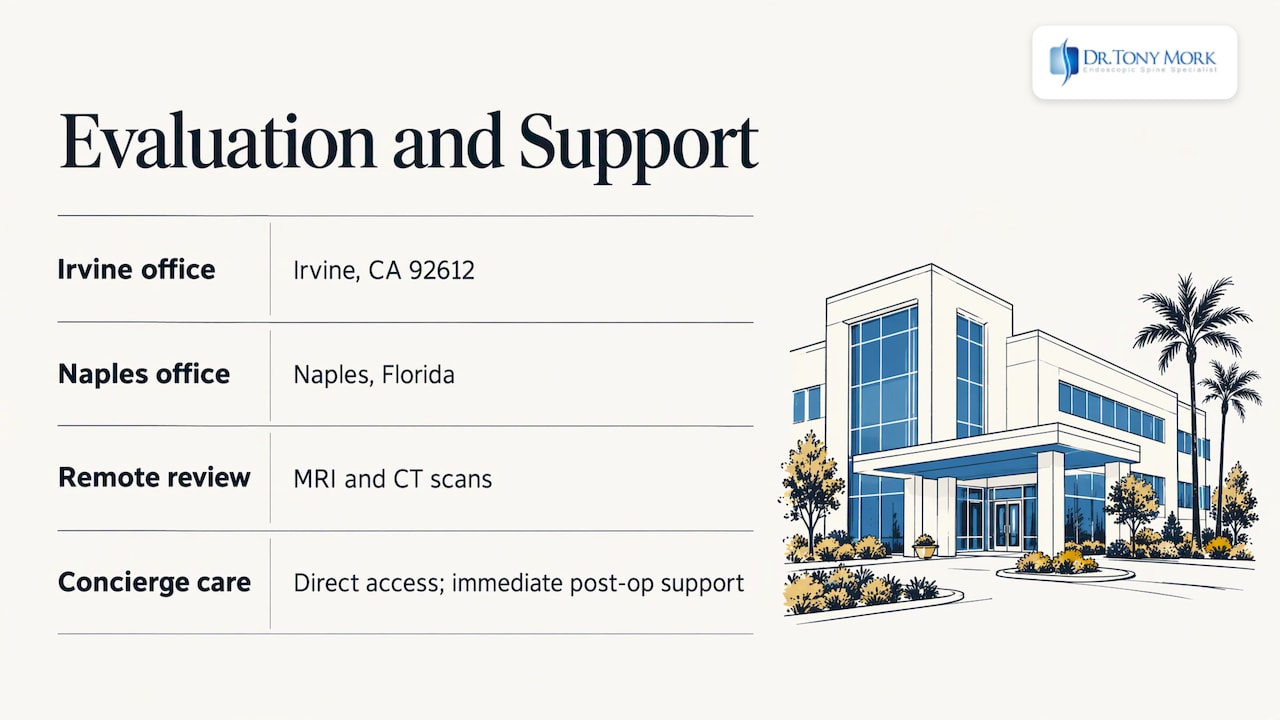
My offices are at 2102 Business Center Dr #127, Irvine, CA 92612, and in Naples, Florida. I also review MRI and CT (computed tomography) scans remotely, so patients from other states can learn their options before traveling. My practice is a concierge practice, which means you have direct access to me and immediate post-operative support. Insurance may cover facility and anesthesia fees, but not the surgeon’s fees.
Learn about endoscopic decompression for stenosis or the overall endoscopic spine surgery approach.
What is my perspective on recovery?
Recovery starts with the diagnosis. If we find the true source of your pain, and remove it through the smallest path possible, your body has less to heal from. The spine was designed to move, and my goal is to keep it moving.
In my practice I do not use fusion as a first answer. I treat it as a last resort that remains available later if you ever need it. I am honest about the limits of endoscopic surgery, and I tell you when another option fits better.
Many patients tell me they were back to regular activities within days. Results vary, and I never promise an outcome. What I promise is that I will explain your options in plain words.
Dr. Tony Mork
Frequently asked questions
Is decompression surgery outpatient?
Often, yes. Many decompression procedures are done as same-day surgery, especially minimally invasive and endoscopic ones. Your age, health and support at home decide whether you go home that day.
How long until I can walk normally?
You walk soon after surgery, and early walking is part of recovery. Many patients find walking gets easier over the first weeks, though soreness and nerve symptoms vary.
Will I need physical therapy?
Often, yes, usually starting a few weeks after surgery to rebuild core and hip strength. Your plan depends on what was done and how you are healing.
Does decompression mean I will need a fusion later?
Not necessarily. Decompression removes pressure on a nerve and keeps your spine’s motion. If fusion is ever needed, it can still be done later.
If you have an MRI, I will review it
If you have an MRI, upload it and I will review it personally and talk with you about your options. Request your consultation here.
Recommended
- What is endoscopic decompression surgery for back pain?
- What is the treatment for post-laminectomy syndrome?
- Do I need surgery for foraminal stenosis?
- Is endoscopic surgery for spinal stenosis an option in Newport Beach?
This article is for general education and is not medical advice. Please see a qualified doctor about your symptoms.