
Many people get relief from spinal stenosis leg pain with activity changes, exercise and physical therapy, and many improve with time. When those steps stop working, removing the pressure on the nerve with endoscopic decompression (a small-incision surgery that uses a camera) can treat the source of the pain without fusion.
I am Dr. Tony Mork, a board-certified orthopedic surgeon. I have practiced endoscopic spine surgery exclusively since 1998 and have performed more than 8,000 endoscopic spine procedures. Here is how I walk patients through their options, starting with the gentlest.
TL;DR
- Start here: Nonsurgical care comes first. Activity changes, walking in short stretches, exercise and physical therapy help many people.
- Injections: Epidural steroid injections can calm inflammation, but relief is often temporary and results vary.
- Surgery: If leg pain keeps limiting your walking after months of conservative care, decompression can remove the pressure on the nerve.
- Fusion: Fusion is a last resort. It can still be done later if needed, and many stenosis patients never require it.
- Diagnosis first: An exam and an MRI (magnetic resonance imaging) are needed to know for sure what is causing your pain.
What causes leg pain with spinal stenosis?
Spinal stenosis is a narrowing of the spaces in your spine that crowd the nerves. Picture a waterway that narrows: the same flow has less room, and pressure builds. In your lower back, the crowded nerves send pain, burning, heaviness or numbness into your buttocks and legs.
According to a 2022 JAMA review, the clinical syndrome affects approximately 11% of U.S. adults and becomes more common with age. The same review describes a typical pattern: back and leg pain that comes on when you stand upright or lean back, and eases when you bend forward. CT (computed tomography) or MRI confirms the diagnosis.
In daily life, that pattern looks like this:
- Walking: Your legs grow heavy or ache after a few blocks at the grocery store.
- Standing: Standing at a counter to cook becomes uncomfortable.
- Relief: Sitting down or leaning on a shopping cart eases the pain.
- Sleeping: Lying flat can bother you, while curling up feels better.
I cover the condition in more depth on my page about lumbar spinal stenosis.
Can activity changes and exercise relieve the pain?
Yes, for many people they are the right first step. The spine was designed to move, so the goal is to keep moving in positions that give the nerves room.
The National Institute of Arthritis and Musculoskeletal and Skin Diseases (NIAMS) advises exercising at least three times a week for 30 minutes, pacing your activities, using assistive devices for stability, and flexing the spine to open the spaces and relieve nerve pressure. It also lists maintaining a healthy weight and quitting smoking.
Practical changes I often discuss:
- Pacing: Break walks into shorter stretches with rests in between.
- Posture: Lean slightly forward, for example on a cart or a cane, when you walk.
- Cycling: A stationary bike keeps you in a forward-flexed position, and many patients tolerate it well.
- Physical therapy: A therapist can build core and hip strength and teach you positions that ease the nerve.
The American Academy of Family Physicians’ 2024 guideline review states that nonoperative treatment should be first-line for lumbar spinal stenosis when nothing calls for urgent surgical evaluation. I agree. Time is on your side in most cases.
I also describe a nonsurgical approach to lumbar stenosis pain on my site.
Do medications and epidural injections help?
They can help for a while. Never stop a medication without talking to the doctor who prescribed it.
The 2024 guideline review above supports anti-inflammatory medicines (NSAIDs, nonsteroidal anti-inflammatory drugs such as ibuprofen) as a first-line option for chronic low back pain when you can tolerate them. Ask your doctor what suits you, especially if you have stomach, kidney or heart conditions.
Epidural steroid injections (ESIs) place a steroid near the irritated nerve to reduce inflammation. A JAMA review of lumbar spinal stenosis care describes the pain relief as modest and generally lasting less than 3 weeks, with a small risk of serious side effects such as infection or bleeding. The American Academy of Neurology’s February 2025 review found that injections might modestly reduce disability for up to six months or more, but did not find they reduced pain at three months.
If your injections gave only short relief, that does not mean something is wrong with you. It often means the injection calmed inflammation but the narrowing is still there. If your back felt worse afterward, read why back pain can increase after an epidural injection.
What happens if I wait and do nothing?
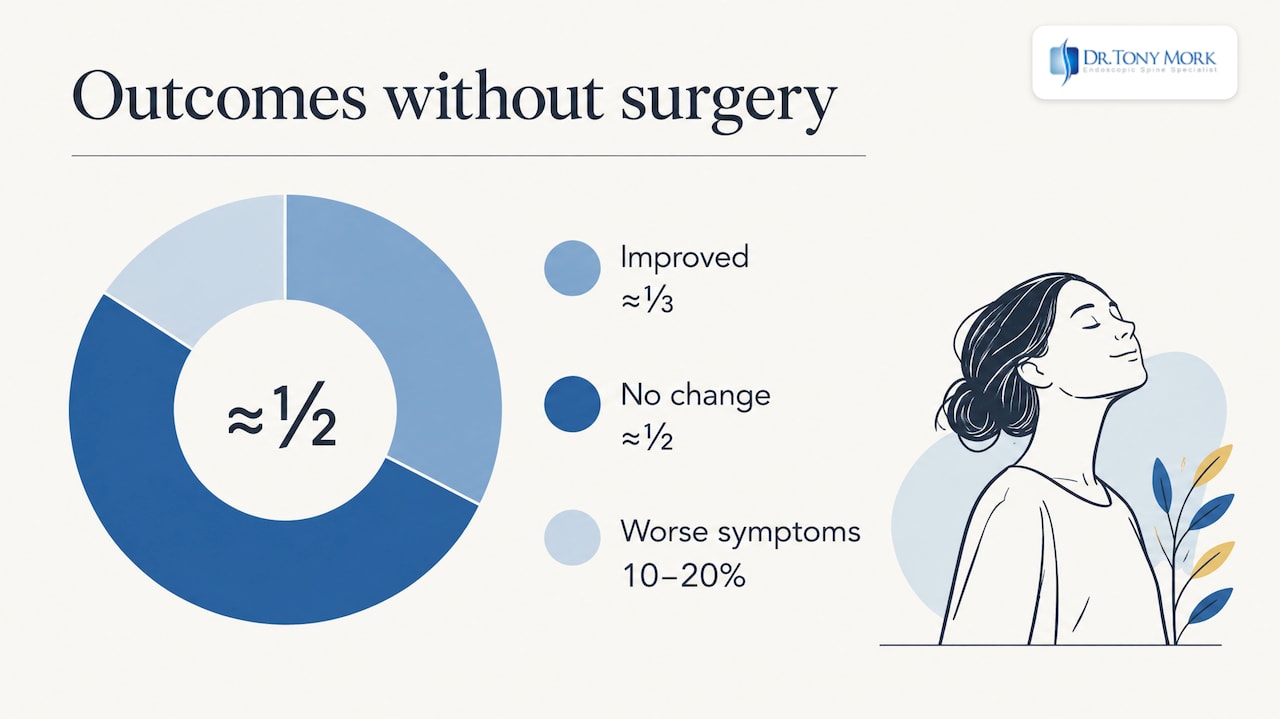
Outcomes vary. In the JAMA review of patients followed up to three years without surgery, about one-third reported improvement, about half reported no change, and 10% to 20% reported worse back pain, leg pain and walking.
That is why I ask a simple question: is your leg pain taking things you care about? Playing golf, walking the dog, lifting a grandchild, standing through a family dinner. If the answer is yes and months of conservative care have not changed it, it is reasonable to look at the source of the pain rather than keep managing it.
When should I consider surgery for stenosis leg pain?
Surgery is worth considering when symptoms persist despite roughly 3 to 6 months of conservative care, or when walking has become intolerable. A 2025 review in the Asian Spine Journal lists these same triggers, along with progressive neurological weakness and cauda equina syndrome.
Some symptoms need care right away. Call your doctor or go to an emergency room for:
- Bladder or bowel changes: New trouble controlling urination or bowel movements.
- Saddle numbness: Numbness in the groin, genitals or inner thighs.
- Progressive weakness: A foot that drags or a leg that gives way.
These can signal cauda equina syndrome (severe compression of the bundle of nerves at the base of the spine). Do not wait on these.
For everyone else, accurate diagnosis comes before surgery. An exam and an MRI are needed to know for sure that stenosis is the source of your leg pain, and which level and which side. Stenosis can also coexist with other problems, so I look at the whole picture. If you want a fresh look at your scans, see my page on getting a second opinion on your spine MRI.
Do I need a spinal fusion for stenosis?
Usually not. Fusion joins vertebrae together so they no longer move. I treat it as a last resort, and it can still be done later if truly needed.
The Asian Spine Journal review explains that decompression without fusion suits stenosis that is limited to the central canal or the side recess when the spine is stable. It also cautions that removing more than half of a facet joint may create instability, which is why preserving healthy tissue matters. Because the spine was designed to move, I aim to relieve the pressure and keep your motion. I explain my thinking in more detail in why I ask patients to reconsider spinal fusion.
What is endoscopic decompression for spinal stenosis?
It is a procedure that widens the narrowed space so the nerve has room. My endoscopic approach uses a small incision and a camera, is done as outpatient surgery, and uses no hardware and no fusion.
The term “minimally invasive” refers to how much healthy tissue is disturbed, not only the size of the incision. A small cut that strips away a lot of muscle is less gentle than it sounds. Endoscopic work lets me remove the bone and tissue pressing on the nerve while leaving as much healthy structure as possible. A laser may be one of the tools I use. It is never a cure by itself.
What does the research show? A 2023 meta-analysis of 11 studies with 930 patients compared biportal endoscopic and microscopic decompression. Leg pain, function, complications and satisfaction were similar after 12 months, while endoscopy had less bleeding during surgery and a shorter hospital stay. In a 2024 Swedish study of 50 patients after decompression without fusion for central stenosis, leg pain dropped noticeably by the first day after surgery, and by two weeks most patients reported meaningful leg pain improvement.
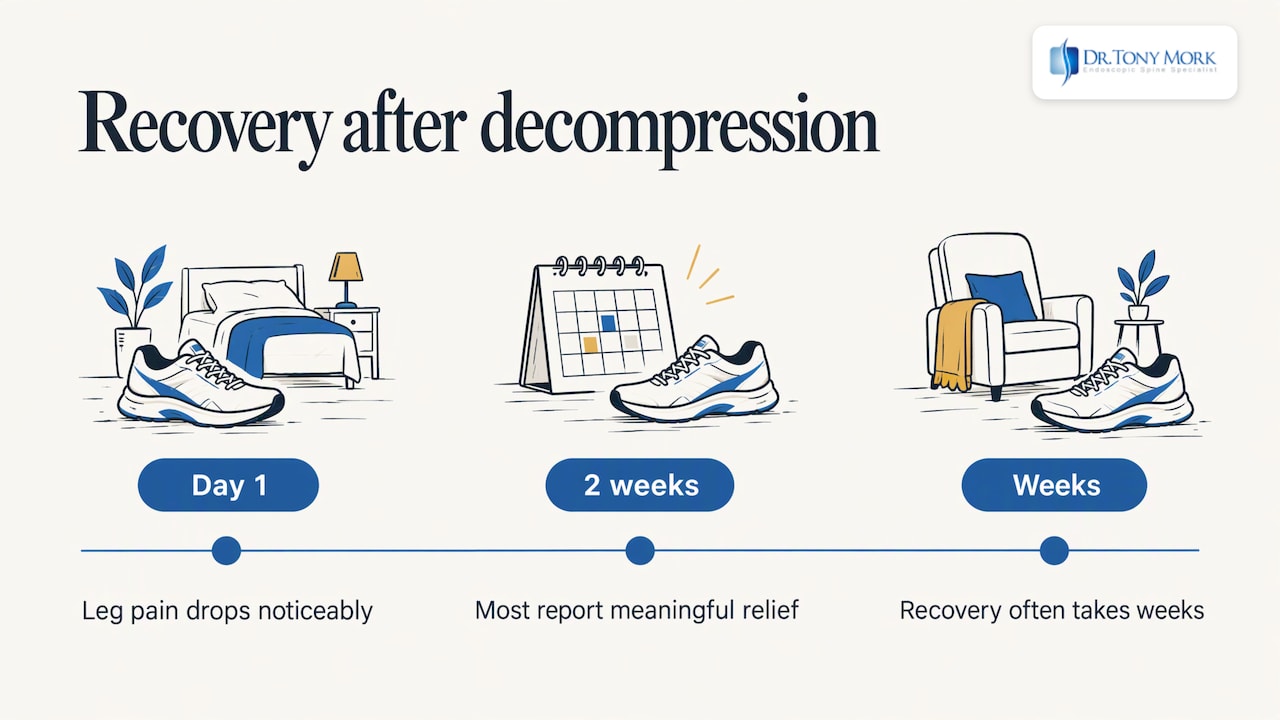
Patients commonly report that leg symptoms ease early and that back soreness takes longer. Recovery often takes weeks, and results vary.
What are the honest pros and cons?
- Pros: Small incision, outpatient setting, no hardware, no fusion, and a direct effort to remove the pressure source.
- Limits: Endoscopic surgery does not suit every spine. Severe instability or certain deformities may need a different plan.
- Risks: Every surgery carries risks, including infection, bleeding, nerve irritation and the chance that symptoms return or persist. The AFP review notes that decompression may improve function and pain but carries a risk of complications.
- Cost: Insurance may cover facility and anesthesia fees but not the surgeon’s fee, so we should talk about this before you decide.
My page on the pros and cons of endoscopic spine surgery goes further.
What does stenosis treatment look like in my office?
I offer endoscopic decompression for spinal stenosis, and endoscopic foraminal decompression when the narrowing is where the nerve exits the spine. You can read a patient guide to endoscopic spine surgery first.
My practice is concierge, which means you have direct access to me, and I provide direct support after surgery. I can evaluate your MRI or CT scan remotely, so you can be reviewed from anywhere. My offices are at 2102 Business Center Dr #127, Irvine, CA 92612, and in Naples, Florida. Out-of-state patients travel to see me.
A word from me
Stenosis leg pain is frightening because it takes away ordinary things: the walk to the mailbox, a round of golf, standing at the stove. Most people should begin with time, movement and physical therapy, and I tell them so.
When the pressure on the nerve is the cause and conservative care has run its course, I believe the goal should be to remove that source of pain, not manage it forever. That is why I have devoted my career to endoscopic techniques that disturb as little healthy tissue as possible, with no hardware and no fusion.
Diagnosis comes first, always. Then we decide together.
Dr. Tony Mork
FAQ
Can spinal stenosis leg pain go away on its own?
Sometimes it improves, and many people do well with conservative care. In the JAMA review, about one-third of patients followed without surgery reported improvement. Others stay the same or get worse, so an exam and an MRI are needed to know where you stand.
What position relieves stenosis leg pain fastest?
Many patients feel better when the spine is slightly flexed forward: sitting, leaning on a cart, or curling up on one side. This opens the spaces around the nerves. The relief is a clue to the diagnosis, not a treatment on its own.
Does spinal stenosis always lead to surgery?
No. Most people begin with activity changes, exercise, physical therapy and sometimes medication or injections. Surgery comes up when leg pain persists and limits your life, or when there is nerve weakness or loss of bladder or bowel control.
Does decompression mean I will need fusion later?
Not necessarily. Decompression aims to preserve your motion, and fusion remains a last resort that can still be done later if needed. Results vary, so I review your imaging before suggesting any plan.
If you have an MRI, upload it and I will review it personally and talk with you about your options.
Recommended
- Eliminate Lumbar Stenosis Pain Without Surgery Or Medication
- Lumbar Spinal Stenosis Facts and Answered Questions
- Lumbar Spinal Stenosis | Symptoms, Diagnosis and Treatments
- What is Spinal Stenosis? – Symptoms, Causes, Treatments & More
This article is for general education and is not medical advice. Please see a qualified doctor about your symptoms.