
A spine surgery consultation is a conversation. I listen to your story, examine you or review your imaging, and explain what is causing your pain and what your options are. Seeing a surgeon does not mean you are having surgery.
I am Tony Mork, MD, a board-certified orthopedic surgeon. I have practiced endoscopic spine surgery exclusively since 1998 and have performed more than 8,000 endoscopic spine procedures. I want you to walk into a consultation knowing what will happen and what to bring.
TL;DR
- Purpose: A consultation is about finding the source of your pain and weighing options. Many back problems improve with time and conservative care.
- Diagnosis first: Accurate diagnosis comes before any talk of surgery. An exam and an MRI are needed to know for sure.
- Bring: Your MRI or CT images (not only the written report), a list of treatments you have tried, and your questions.
- Online option: A virtual visit can work well when I can review your images. If an in-person exam is needed, I will tell you.
- Fusion: I treat fusion as a last resort, and it can still be done later if needed.
What is a spine surgery consultation for?
It is for getting a clear answer to a simple question: what is producing your pain? Sitting through a workday, putting on your shoes, sleeping through the night, lifting a grandchild. These are the moments that tell me where to look.
I start with your history. When did the pain begin? What makes it worse? Does it stay in your back, or does it travel into a hip, groin, or leg? Where you feel it, and when, often points toward the cause.
Then I look at your imaging and examine how you move, your strength, your reflexes, and your sensation. The goal is to remove the source of pain, not only manage it. That requires knowing the source.
Does seeing a spine surgeon mean I need surgery?
No. Most people who see me are not told to have surgery the same day, and many are told to try something else first.
Conservative care comes first where it fits. That includes time, activity changes, physical therapy, medication, and injections. Many back problems improve on their own, and time is on your side.
Surgery enters the conversation when the cause is clear and your symptoms have not improved with reasonable nonsurgical care, or when nerve symptoms such as growing weakness make waiting unwise. If you take medication, keep taking it as your own doctor directed. A consultation does not replace your regular physician.
Who should I see for back or neck pain?
Start with your primary care doctor if you have not seen anyone. For ongoing pain, a spine surgeon is an orthopedic surgeon or neurosurgeon who focuses on spinal disorders. Some patients see a physical therapist or pain specialist along the way, and that is reasonable.
See a surgeon when:
- Duration: Your pain has lasted weeks to months despite care.
- Nerve symptoms: You have leg burning, numbness, or sciatica (pain traveling down the leg from an irritated nerve).
- Repeated failure: Therapy, injections, or chiropractic care brought only short relief.
- Mixed messages: You have seen several doctors and still have no clear diagnosis.
- Fusion advice: You were told spinal fusion is your only option and want to understand the alternatives.
If you have sudden weakness in a leg, loss of bladder or bowel control, or numbness in the groin area, go to an emergency room right away.
What should I bring to a consultation?
Bring your images, not only the report. A report is someone’s summary. The images let me see the disc, the nerves, and the spaces around them myself.
- Imaging: MRI (magnetic resonance imaging) and CT (computed tomography) scans, plus any X-rays, on a disc or a download link.
- Prior treatments: Physical therapy, chiropractic care, medications, and epidural steroid injections (ESIs, medicine placed near irritated nerves), with how long each helped.
- Past surgery: Operative reports if you have had spine surgery before.
- Symptom notes: Where the pain sits, what triggers it, and what eases it. Sitting, driving, bending, and sleeping are good anchors.
- Questions: Write them down. You will forget half of them in the room.
A useful habit is to describe your pain by what it stops you from doing. “I cannot sit through a movie” tells me more than a number on a pain scale.
What happens during an in-person visit?
Expect a conversation first, then an exam, then a plan. In my practice, you have direct access to me, not a hand-off to someone else.
I ask about your symptoms and past treatments. I examine your posture, how you walk, your range of motion, and the strength and feeling in your legs or arms. I review your imaging on screen and show you what I see.
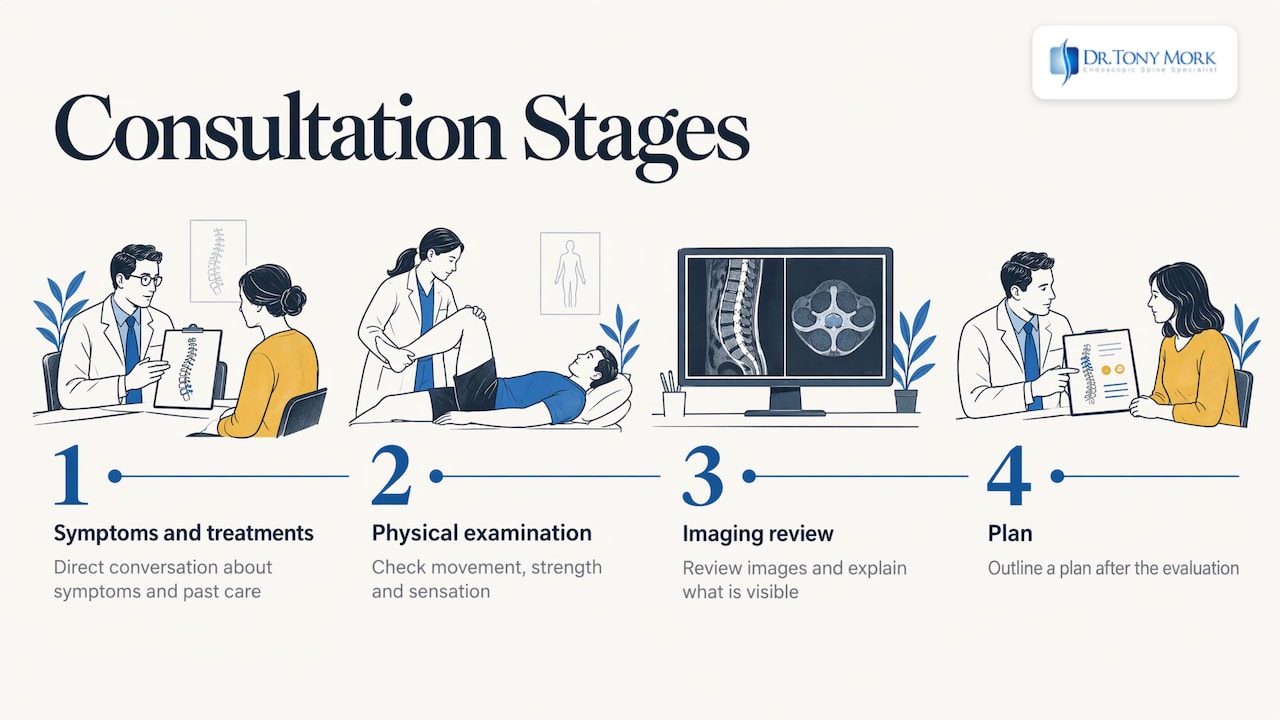
I also tell you what I do not see. A normal-looking MRI does not mean your pain is imaginary. Some sources of pain, such as a painful disc, can be easy to miss on a standard scan, which is why diagnosis takes care.
You can see the steps in more detail on my spine surgery evaluation process page.
Can I have a spine surgery consultation online?
Yes. A remote or virtual consultation works well for many patients, especially when you are traveling from out of state or live far from my offices. My practice offers remote MRI and CT scan evaluation and phone appointments.
The key is your imaging. If I can see your scans, I can often explain what is going on, what is likely causing it, and whether endoscopic surgery, conservative care, or more testing makes sense.
The limit is the physical exam. I cannot test your reflexes through a screen. If your story and images do not fit together, or if I need to feel and measure how you move, I will recommend an in-person visit. That is part of an honest remote evaluation.
How do I prepare for a virtual visit?
A little preparation makes a short visit much more useful.
- Send images early: Upload your MRI or CT so I can review it before we talk.
- Write a short summary: Two or three sentences on when the pain began and what you have tried.
- Set up your space: A quiet room, good lighting, and a stable internet connection.
- Test your device: Camera and sound should work before the call.
- Wear movable clothing: I may ask you to stand, bend, or walk a few steps.
- List your medications: Names and doses, so I have the full picture.
What can I assess from a distance?
I can watch how you stand up from a chair, how you walk, and how you bend. I can ask you to lift a heel or a toe and describe what you feel. These checks are less complete than a hands-on exam, but together with your images they tell me a great deal.
One of my first questions is often about your MRI. If you were told it is normal, or if you have an annular tear (a crack in the tough outer wall of a disc), a bulging disc, or a high intensity zone (a bright spot on MRI that can mark an irritated area in the disc wall), I want to look at the images myself. You can read more on why a second opinion on your spine MRI can matter.
How do you decide between testing, conservative care, and surgery?
I start with the diagnosis, and I will not recommend an operation until I know where your pain comes from. Accurate diagnosis comes before surgery, always.
The path usually looks like this:
- Match symptoms to images. A finding on an MRI only matters if it explains what you feel. Plenty of people have disc bulges and no pain.
- Consider more testing. Sometimes a different scan or a targeted test is needed to confirm which structure hurts.
- Try conservative care when it fits. Time, activity changes, physical therapy, medication, and injections come first for many problems.
- Discuss surgery only when the cause is clear. And when care that fits your condition has not given you lasting relief, or your nerves are at risk.
If you have had epidural injections that helped only briefly, or physical therapy that made things worse, tell me. Those details help narrow down the cause.
What questions should I ask a spine surgeon?
Ask anything. A good surgeon welcomes questions and answers them plainly. These are the ones I find most useful:
- Diagnosis: What exactly is causing my pain, and how do you know?
- Alternatives: What are all my options, including nonsurgical ones?
- Without surgery: What is likely to happen if I wait or do nothing?
- The procedure: What would you do, and how much healthy tissue would it disturb?
- Risks and limits: What are the risks, and what can this not fix?
- Recovery: What does recovery often look like? Results vary, so what is a reasonable range for me?
- Hardware and fusion: Will I need hardware? Is fusion a possibility, now or later?
On that last question, here is my answer in advance. The spine was designed to move. I consider fusion a last resort, and it can still be done later if needed. You can read more about alternatives to spinal fusion.
What does endoscopic spine surgery involve if surgery is recommended?
Endoscopic spine surgery means a small incision, a camera, outpatient care, no hardware, and no fusion. I work through a small opening and watch the area on a screen while I address the source of the problem.
The disc is like a liquid-filled cushion between two vertebrae (the bones of the spine). When the cushion bulges or tears, it can press on a nearby nerve or become painful itself. Endoscopic surgery lets me reach the problem while disturbing as little healthy tissue as possible.
That last phrase matters. “Minimally invasive” refers to how much healthy tissue is disturbed, not only the size of the incision. A small cut that still strips away muscle is not truly minimal. You can read my explanation of what minimally invasive spine surgery means.
A laser can be one tool in this work. It is never a cure by itself.
Depending on your diagnosis, the procedure might be:
- Endoscopic discectomy: Removing the part of a herniated disc pressing on a nerve. See herniated disc treatment.
- Endoscopic decompression: Creating more room for nerves in spinal stenosis (narrowing of the spinal canal). See spinal stenosis treatment.
- Foraminal decompression: Opening the foramen, the passage where a nerve leaves the spine. See foraminal stenosis treatment.
- Bulging disc care: Addressing a painful bulge when it is the confirmed source. See bulging disc treatment.
For pain that comes from the disc itself, read how discogenic back pain is treated.
What are the honest limits of endoscopic surgery?
Endoscopic surgery is not right for everyone. It is one option, and it depends on your diagnosis.
- Benefits: Many patients have less tissue disturbed, no hardware, and an outpatient visit. Many return to daily activities sooner than they would after a larger operation.
- Limits: Some conditions, such as severe deformity or significant instability, may need a different approach.
- Risks: Every surgery carries risks, including infection, bleeding, nerve irritation, and the chance that pain returns or does not fully resolve.
- Results vary: I cannot promise an outcome or a pain-free result. I can promise an honest assessment.
When endoscopic surgery is not the right choice for you, I tell you so. My pros and cons of endoscopic spine surgery page goes through them in more detail.
Why do patients come to my practice for a consultation?
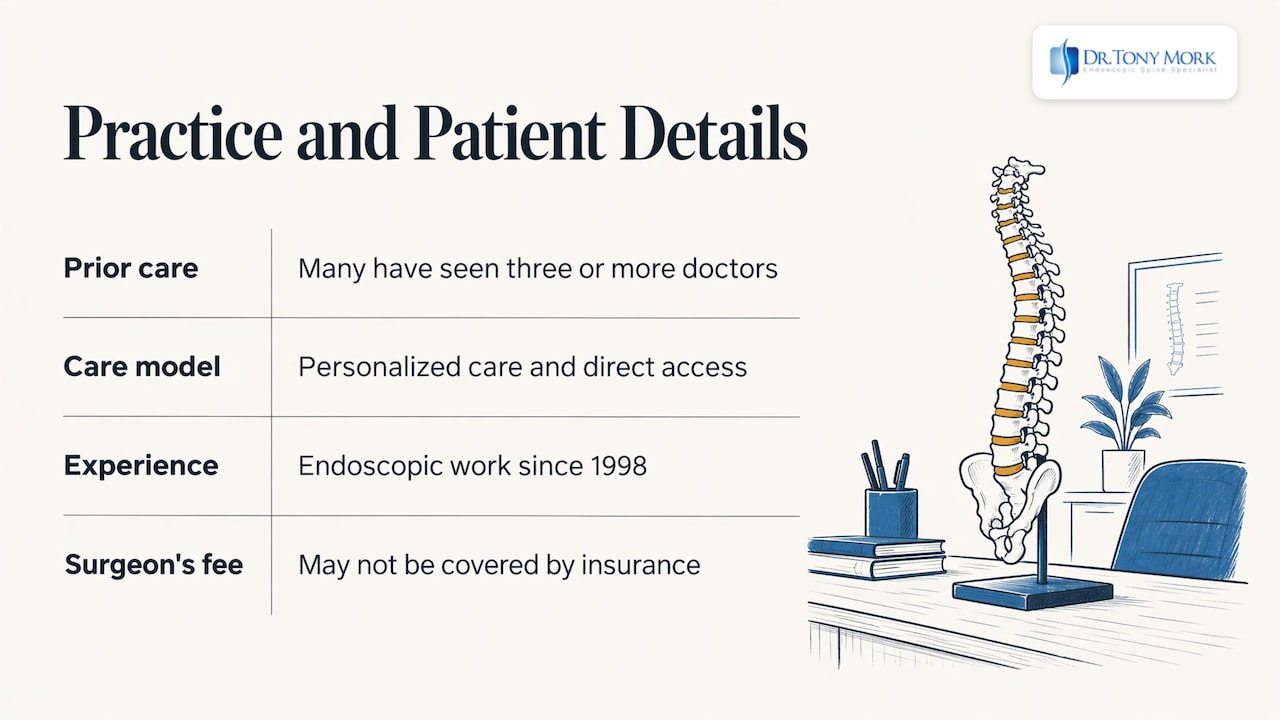
Most come after a long road. Many have seen three or more doctors, tried therapy and injections, and been told fusion is the only choice. Others have a normal MRI and ongoing pain, or pain after a previous spine surgery.
My practice is a concierge practice. That means personalized care, direct access to me, and immediate support after surgery. I founded the Endoscopic Spine Academy and co-founded Microspine, and endoscopic work has been my entire practice since 1998.
I see patients at my Irvine office, 2102 Business Center Dr #127, Irvine, CA 92612, and at my office in Naples, Florida. Many patients also travel from other states. If you are in Florida, read about endoscopic spine surgery in Florida.
One practical point: insurance may cover facility and anesthesia fees, but not the surgeon’s fee. Surgery is paid for before the procedure. I would rather you know that early than be surprised later.
How can you start with my office?
If you have an MRI or CT scan, the simplest first step is to send it to me. I review images personally, and I can talk with you by phone about what I see.
My practice offers MRI evaluation and one on one phone consultations with me. You can find both, along with my concierge spine services, on my main site.

If the question is whether you need surgery at all, my guide to endoscopic spine surgery is a good place to read first.
What is my view on consultations?
I have sat across the desk from thousands of patients, and most of them arrive with the same fear: that someone will tell them they need a fusion.
My view is simple to state. The spine was designed to move. Fusion is a last resort, and it can still be done later if needed. Before any of that, I want to know exactly where your pain comes from, because removing the source is a better goal than managing it.
That is why I look at your images myself and why I take the time to listen. Endoscopic surgery, with a small incision, a camera, no hardware, and no fusion, is what I have done every working day since 1998. I will tell you plainly whether it fits you, and I will tell you if it does not.
You deserve a surgeon who explains your options in words you can use at home.
Dr. Tony Mork
What else do patients ask before a consultation?
Do I need a referral for a spine surgery consultation?
In many cases you can contact my office directly. Check your own insurance plan if you want it to cover any part of your care, since requirements differ by plan. Bring any records you have, whether or not a doctor referred you.
Can a virtual visit replace an in-person exam?
For many patients, a review of images and a detailed conversation is enough to outline options. An in-person exam is sometimes needed to know for sure, and I will say so when it is. Some patients begin online and then come to Irvine or Naples.
Will I be pushed toward surgery?
No. Many back problems improve with time and conservative care, and I say so. If surgery is a reasonable option, I explain the benefits, limits, and risks, and you decide on your own schedule.
What if my MRI was read as normal and I still hurt?
A normal report does not mean there is no cause. I like to review the images myself and compare them with your symptoms. An exam and an MRI are needed to know for sure, and sometimes additional testing helps.
If you have an MRI, upload it and I will review it personally and talk with you about your options.
Recommended
- Spine Surgery Evaluation Process
- Should I get a second opinion on my spine MRI?
- Alternatives to Spinal Fusion | Why You Should Consider Other Options
- Endoscopic Spine Surgery Guide For Patients
This article is for general education and is not medical advice. Please see a qualified doctor about your symptoms.