
There is no single price. The total depends on the procedure, the spinal level, where the surgery is done, and what your insurance covers. I do not publish a surgery fee, because I quote it only after I have reviewed your imaging and know what you need.
I am Dr. Tony Mork, MD, a board-certified orthopedic surgeon. I have practiced endoscopic spine surgery exclusively since 1998, and I have performed more than 8,000 endoscopic spine procedures. Here is how the costs break down, so you can ask the right questions before you commit to anything.
TL;DR
- Total cost: It is made of separate bills: the surgeon, the facility, and the anesthesia. Each can be quoted and paid differently.
- Setting matters: A 2023 Medicare analysis in the Journal of Neurosurgery: Spine found spine decompression cost less in ambulatory surgery centers than in hospital outpatient departments.
- Insurance: It may cover facility and anesthesia fees. In my practice it does not cover the surgeon’s fee, which is paid before surgery.
- Fusion comparison: Fusion is usually a larger operation with hardware and often a hospital stay. I treat it as a last resort that can still be done later if needed.
- Next step: Accurate diagnosis comes before surgery, and before any price makes sense.
Why can’t anyone give you one price for endoscopic spine surgery?
Because “endoscopic spine surgery” covers different operations. Removing a small piece of herniated disc (disc material pushing out and pressing on a nerve) is not the same work as widening a tight nerve opening at several levels.
Endoscopic spine surgery, as I perform it, means a small incision, a camera, outpatient care, no hardware, and no fusion. The cost still changes with what has to be done inside the spine.
These factors move the total most:
- Condition: A single herniated disc, spinal stenosis (narrowing of the space around the nerves), and foraminal stenosis (narrowing of the opening where a nerve leaves the spine) call for different work.
- Number of levels: Treating more than one level takes more operating time and more supplies.
- Location in the spine: Lumbar (lower back) and cervical (neck) procedures are different operations.
- Prior surgery: Scar tissue from an earlier operation can change the plan.
- Facility: A surgery center and a hospital outpatient department bill differently.
- Insurance status: In-network, out-of-network, and self-pay arrangements produce very different bills.
If you want the basics of the procedure first, I explain them in my endoscopic spine surgery guide for patients.
What makes up the total bill?
Three main pieces make up the bill: the surgeon’s fee, the facility fee, and the anesthesia fee. Imaging and follow-up care are the other pieces to ask about.
- Surgeon’s fee: This pays for the operation itself and my time, planning, and follow-up. In my practice it is paid before surgery.
- Facility fee: This pays for the operating room, nursing staff, equipment, and supplies at the surgery center or hospital.
- Anesthesia fee: This is billed by the anesthesia provider and often comes as a separate statement.
- Imaging and evaluation: Your MRI (magnetic resonance imaging) or CT (computed tomography) scan has to be reviewed before a plan is made. Some patients also need a diagnostic test first.
- Follow-up and therapy: Visits after surgery and any physical therapy.
A single “all-in” figure can hide some of these. When you compare estimates, line up each piece against the same piece. Otherwise a low-looking quote may simply leave something out.
Does the surgery setting change the price?
Yes, and often by a lot. A surgery center is a facility where you have surgery and go home the same day. A hospital outpatient department is the hospital’s version of the same-day service.
According to a 2023 Medicare analysis published in the Journal of Neurosurgery: Spine, spine decompression had a mean total cost of $4,183 in ambulatory surgery centers (ASCs) and $7,583.67 in hospital outpatient departments. The same study found that surgeon fees did not change by setting. The difference came from the facility side.
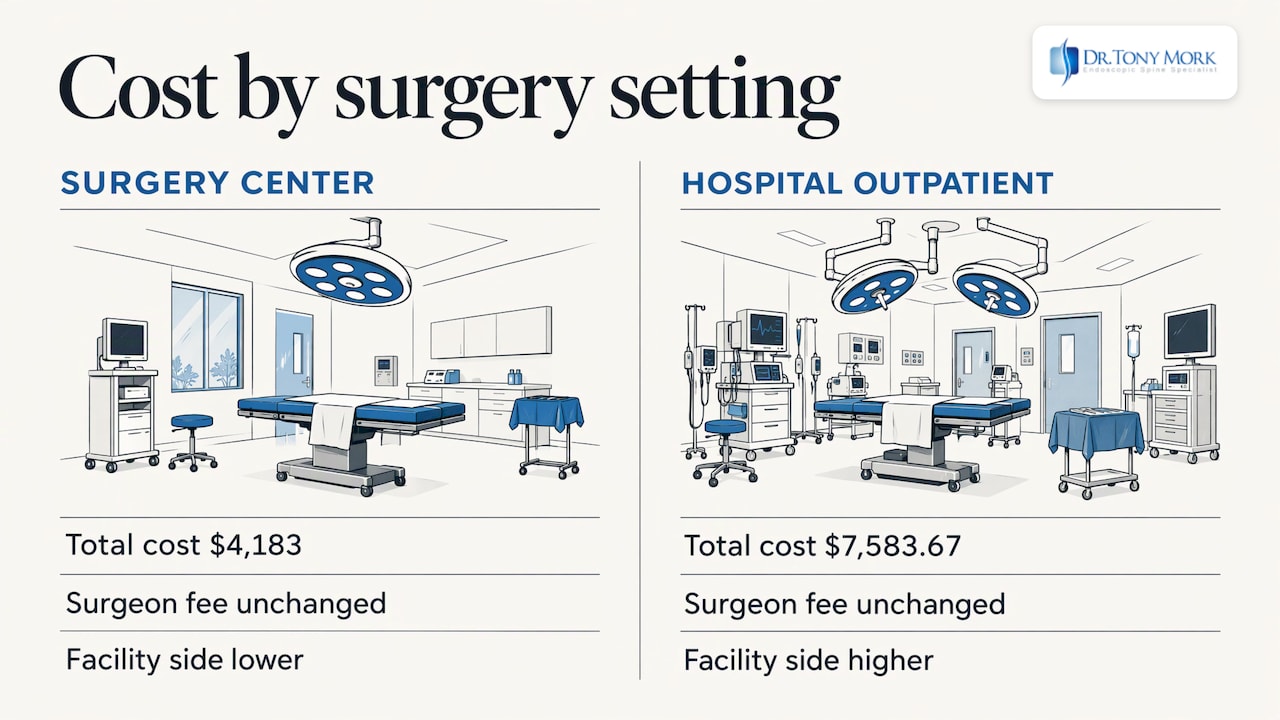
Those are Medicare payment figures for decompression in general. They are not a quote for your operation, and they are not what a self-pay patient pays. They do show the pattern: the same kind of work can cost far less in a surgery center.
The Centers for Medicare and Medicaid Services (CMS) says the physician decides the appropriate site of service based on your clinical needs. Your health decides where surgery happens. Price does not.
How does the cost compare with spinal fusion?
Fusion is a bigger operation, so its bill is usually bigger. In fusion, two or more vertebrae (the bones of the spine) are joined with hardware so they no longer move. Hospital stays are more common, and recovery is longer.
The research on costs is mixed, and I want to be honest about that. A 2020 review of minimally invasive spine surgery economics, which drew on a large national insurance database, found that minimally invasive approaches generally reduced reimbursement compared with open discectomy and posterior fusion. The authors also warned that cost reporting in this field is sparse and the methods are inconsistent. Any single number should be read with that in mind.
The same review credits possible savings mainly to shorter hospital stays, fewer complications, less pain, and a faster return to daily activities. Those savings come from how recovery goes, not from a cheaper operating room.
Here is how I see the comparison for a patient weighing both.
| Factor | Endoscopic spine surgery | Spinal fusion |
|---|---|---|
| Incision | Small | Larger |
| Hardware | None | Usually screws and rods |
| Setting | Outpatient | Often a hospital stay |
| Spine motion | Preserved | Joined segments no longer move |
| Best suited to | Many disc, stenosis, and nerve problems | Instability and some deformities |
| Later options | Fusion can still be done if needed | Further surgery can be more complex |
The spine was designed to move. Fusion removes motion at the joined level, so I keep it as a last resort. Choosing endoscopic surgery first does not close the door. Fusion can still be done later if it is needed.
Will my insurance cover endoscopic spine surgery?
It may cover part of it. Coverage depends on your plan, your diagnosis, and what the plan considers medically necessary.
In my practice, insurance may cover the facility and anesthesia fees. It does not cover the surgeon’s fee. That is why I work as a concierge practice, with payment required before surgery, so there are no surprise bills after the fact.
A few things are worth knowing about insurance in general:
- Plan terms: Some insurers treat certain endoscopic techniques differently from open surgery. Ask your plan how it classifies the specific procedure code.
- Medicare: Original Medicare generally pays 80% of the approved amount for outpatient care after the Part B deductible. Medicare Advantage plans vary.
- Network status: A study of anterior cervical fusion found that having both the surgeon and facility in-network was linked to 29.2% lower reimbursements than both being out-of-network. Network status can change the numbers a great deal.
- Prior authorization: Many plans require approval before surgery. Your plan can tell you what it needs and when.
Call the member services number on your insurance card. Ask what your plan pays toward facility and anesthesia charges, and what you would owe.
How can I compare written estimates before surgery?
Ask every provider for the same list in writing. Then compare each line instead of the bottom number.
- Who is billing: Ask whether the surgeon, facility, and anesthesia provider each bill separately.
- What is included: Ask whether the quote covers pre-operative visits, the operation, and post-operative visits.
- What is not included: Ask about imaging, medications, bracing, and physical therapy.
- Procedure details: Ask which procedure, which level or levels, and which side the estimate assumes.
- If the plan changes: Ask what happens to the price if more work is found during surgery.
- Payment timing: Ask when payment is due and what the refund policy is if you cancel.
Do not compare a quote for one level with a quote for two. Do not compare a surgeon-only quote with a facility-only quote.
What costs besides surgery should I plan for?
The medical bill is only part of the picture. Time away from work, travel, and follow-up care all add up.
- Time off work: Desk work and heavy labor are different. Many patients return to lighter activity sooner than to heavy lifting. Recovery often takes longer for physical jobs, and results vary.
- Travel: Some patients travel to my Irvine or Naples office from out of state. Plan for lodging and a travel companion for the first day or two.
- Physical therapy: Some patients benefit from a guided return to activity.
- Medications: Ask about prescriptions you may need afterward.
- Ongoing pain costs: Months of visits, injections, and treatments that bring only short relief also cost money and time.
That last point matters. Managing pain with repeated treatments is not the same as removing its source. My goal is to find the source of your pain and treat it. A treatment that costs less today can cost more over years if the source is never addressed.
What should I try before I think about surgery?
Conservative care comes first when it fits your situation. Many back problems improve with time, and surgery is not the right answer for everyone.
Conservative care includes:
- Time: Many episodes of back pain settle over weeks to months.
- Activity changes: Adjusting how you sit, lift, and sleep can ease flare-ups.
- Physical therapy: A therapist can build strength and flexibility.
- Medication: Use only what your doctor has prescribed or recommended, and keep taking it as directed.
- Injections: An epidural steroid injection (ESI) places anti-inflammatory medicine near an irritated nerve. Relief can be short-lived for some patients.
If you have done these things and still struggle to put on your shoes, sit through a workday, sleep through the night, or lift a grandchild, it may be time to find out what is causing the pain.
Why does diagnosis come before any price?
Accurate diagnosis comes before surgery. I cannot tell you what an operation will cost, or whether you need one, until I know what is causing your pain.
An exam and an MRI are needed to know for sure. Sometimes a CT scan or another test adds detail. Many patients come to me after seeing several doctors without a clear answer. A tear in the outer ring of a disc, a narrowed nerve opening, or an irritated facet joint (a small joint at the back of the spine) can each cause back pain, and each needs different treatment.
I never diagnose anyone from a description. I review your imaging and talk with you about what I see. You can read more on the conditions I treat:
- Herniated disc treatment
- Bulging disc treatment
- Spinal stenosis treatment
- Foraminal stenosis treatment
Think of a disc as a liquid-filled cushion between two bones. When the cushion wall weakens, it can bulge or leak and press on a nearby nerve. Fixing the pressure point is different from covering up the pain it causes.
What does “minimally invasive” actually mean for cost and recovery?
“Minimally invasive” describes how much healthy tissue is disturbed. A small incision is part of it, but not all of it.
Some operations use a small skin opening and still cut through a lot of muscle underneath. In endoscopic surgery, a camera and thin instruments reach the problem with as little disturbance to healthy tissue as possible. A laser may be one of the tools I use. It is one tool, not a cure by itself.
Less disturbed tissue often means less discomfort afterward, and many patients return to regular activities sooner. Results vary, and I never promise a specific recovery time. For a deeper look, read how minimal minimally invasive surgery can get.
What are the limits of endoscopic spine surgery?
Endoscopic surgery is not right for every spine. I want you to know the limits before you spend money.
- Instability: If a vertebra slips and the spine is unstable, fusion may be the better tool.
- Severe deformity: Large curves or major structural problems may need a different approach.
- Diagnosis match: If your pain does not come from a problem I can reach, surgery will not remove it.
- Recovery: Endoscopic surgery is still surgery. You will have some soreness, and a gradual return to activity.
- Results vary: No operation works for everyone, and I cannot promise a pain-free result.
I go through these in more detail in the pros and cons of endoscopic spine surgery. If your imaging shows that another path serves you better, I will say so.
What is your view on cost versus value?
I have spent my career doing one thing: endoscopic spine surgery. I started in 1998, I founded the Endoscopic Spine Academy, and I co-founded Microspine. Those years shape how I think about price.
The cheapest operation is the one that fixes the problem the first time. When I plan a procedure, I want to remove the source of your pain, not just manage it. I also want to protect the way your spine moves, because it was designed to move.
That is why my practice is built the way it is. You get direct access to me, a plan based on your own imaging, and support after surgery. You pay for the surgeon’s fee before the operation, so you know where you stand.
Fusion is a last resort in my practice, and it can still be done later if you ever need it. For many patients with disc, stenosis, and nerve problems, an endoscopic approach with a small incision, a camera, outpatient care, no hardware, and no fusion is a reasonable place to start.
Dr. Tony Mork
How can my office help you understand your options?
Start by sending your imaging. I review MRI and CT scans remotely, so you do not need to travel to learn where you stand. If you want to talk through what I see, I offer a one-on-one phone consultation as well.

If surgery is the right path, I will explain the procedure, the facility, and the fees in writing before you decide. My practice is based in Irvine at 2102 Business Center Dr #127, Irvine, CA 92612, and I also see patients at my Naples, Florida office. You can learn more about the concierge spine services and MRI evaluation I offer, or read about endoscopic spine surgery. If you are in Southwest Florida, here is where to find endoscopic spine surgery in Florida.
FAQ
Is endoscopic spine surgery cheaper than fusion?
Often the total bill is lower, because endoscopic surgery is outpatient and uses no hardware. Published studies are mixed, and the authors of one 2020 review warned that cost data in this field is sparse. Your own estimate depends on your diagnosis, your facility, and your plan.
Does insurance pay for the surgeon’s fee in your practice?
No. Insurance may cover the facility and anesthesia fees, but it does not cover my surgeon’s fee. Payment is required before surgery, and I put every piece of the estimate in writing so there are no surprises.
Why is a surgery center cheaper than a hospital?
The difference is mostly in the facility charge. A 2023 Medicare analysis in the Journal of Neurosurgery: Spine found lower mean total costs for spine decompression in surgery centers than in hospital outpatient departments, with surgeon fees unchanged. Where your surgery is done depends first on your health.
Can I get a cost estimate without traveling?
Yes. I review MRI and CT scans remotely, and we can talk by phone. An exam and an MRI are needed to know for sure what is causing your pain and what treatment fits.
Should I try other treatments before surgery?
Usually, yes. Time, activity changes, physical therapy, medication, and injections help many people, and many back problems improve with time. If you have tried these and the pain keeps returning, find out what is causing it.
If you have an MRI, upload it and I will review it personally and talk with you about your options. Time is on your side.
Recommended
- Endoscopic Spine Surgery Guide For Patients
- The Pros and Cons of Endoscopic Spine Surgery
- What is endoscopic decompression surgery for back pain?
This article is for general education and is not medical advice. Please see a qualified doctor about your symptoms.