
Most people feel real improvement within a few weeks of herniated disc surgery and return to desk work in about 2 to 4 weeks. Heavy lifting, golf, and sports take longer, and results vary from person to person.
I am Dr. Tony Mork, a board-certified orthopedic surgeon. I have practiced endoscopic spine surgery exclusively since 1998, and I have performed more than 8,000 endoscopic spine procedures. Below I explain what recovery usually looks like, what slows it down, and how to protect the result.
TL;DR
- Daily life: Many patients are walking the day of surgery. Desk work often resumes in 2 to 4 weeks, depending on the procedure and the job.
- Nerve symptoms: Leg pain, numbness, or weakness often begin to improve in a few weeks, but nerves heal on their own schedule.
- Heavy activity: Lifting, golf, and sports come back in stages. Recovery often takes longer for physical jobs and athletes.
- Procedure matters: Endoscopic surgery (surgery through a small incision using a camera) disturbs less healthy tissue, and fusion recovery is much longer than discectomy recovery.
- Accurate diagnosis comes first: Recovery goes best when the surgery treats the true source of your pain.
What does recovery look like in the first days after surgery?
The first days are about walking, resting, and keeping the incision clean. You will likely have some soreness, and your leg symptoms may not vanish right away.
A discectomy (removing the part of a disc pressing on a nerve) is often done as outpatient surgery, meaning you go home the same day. According to the American Academy of Orthopaedic Surgeons, patients having minimally invasive spine surgery go home the same day or within 1 to 2 days. The same source says pain afterward is generally less than after traditional open surgery, because muscles and soft tissues are disturbed less.
With endoscopic spine surgery, I use a small incision and a camera. There is no hardware and no fusion. That is why many patients report getting up and moving around quickly.
In the first week, expect this:
- Walking: Short, frequent walks on flat ground. Walking keeps blood moving and the back from stiffening.
- Incision care: Keep it dry. According to MedlinePlus, the National Library of Medicine’s health encyclopedia, discharge instructions after spine surgery call for keeping the incision dry for the first 5 to 7 days.
- Pain: Soreness at the incision is common. Your medication plan comes from your surgeon, and you should never stop a medication without talking to your doctor.
- Sleep: Find the position that is comfortable, often on your back with a pillow under your knees or on your side with a pillow between your knees.
When will my leg pain, numbness, and weakness improve?
Often within a few weeks, though not always on a fixed schedule. A herniated disc (a disc whose soft center has pushed through its outer wall) can irritate a nerve for a long time before surgery, and an irritated nerve needs time to settle.
MedlinePlus says that after a diskectomy or foraminotomy (enlarging the opening where a nerve leaves the spine), pain, numbness, or weakness along the nerve path should improve in a few weeks. WebMD gives a similar picture: improvement in pain, weakness, and numbness within a few weeks.
Think of the nerve like a garden hose that has been stepped on. Once the weight is lifted, the flow returns, but the hose may be sore and sensitive for a while.
Several things can slow nerve recovery:
- Weakness before surgery: A study in the Asian Spine Journal found that complete muscle weakness before surgery and diabetes were the two factors linked to slower motor recovery after lumbar microdiscectomy. Early evaluation matters for this reason.
- Length of time the nerve was compressed: A nerve pinched for many months may recover more slowly.
- Overall health: Blood sugar control, smoking, and general fitness all influence healing.
That same study reported that most patients had recovered motor function by 2 months, while a smaller group still showed no recovery at 1 year. I share that so you understand the range, not to alarm you. Recovery varies, and results vary.
How long until I can drive, sit, and go back to work?
Plan on 2 weeks or so before driving, and 2 to 4 weeks for a desk job. These are general guidelines, and your surgeon’s instructions for your own case come first.
MedlinePlus advises no driving for the first 2 weeks after spine surgery and only short walks during that time. It also recommends not sitting longer than 20 to 30 minutes at a time. Spine-Health, a patient education site written by physicians, adds that most patients can return to driving at about 2 weeks if pain is controlled without opioids.
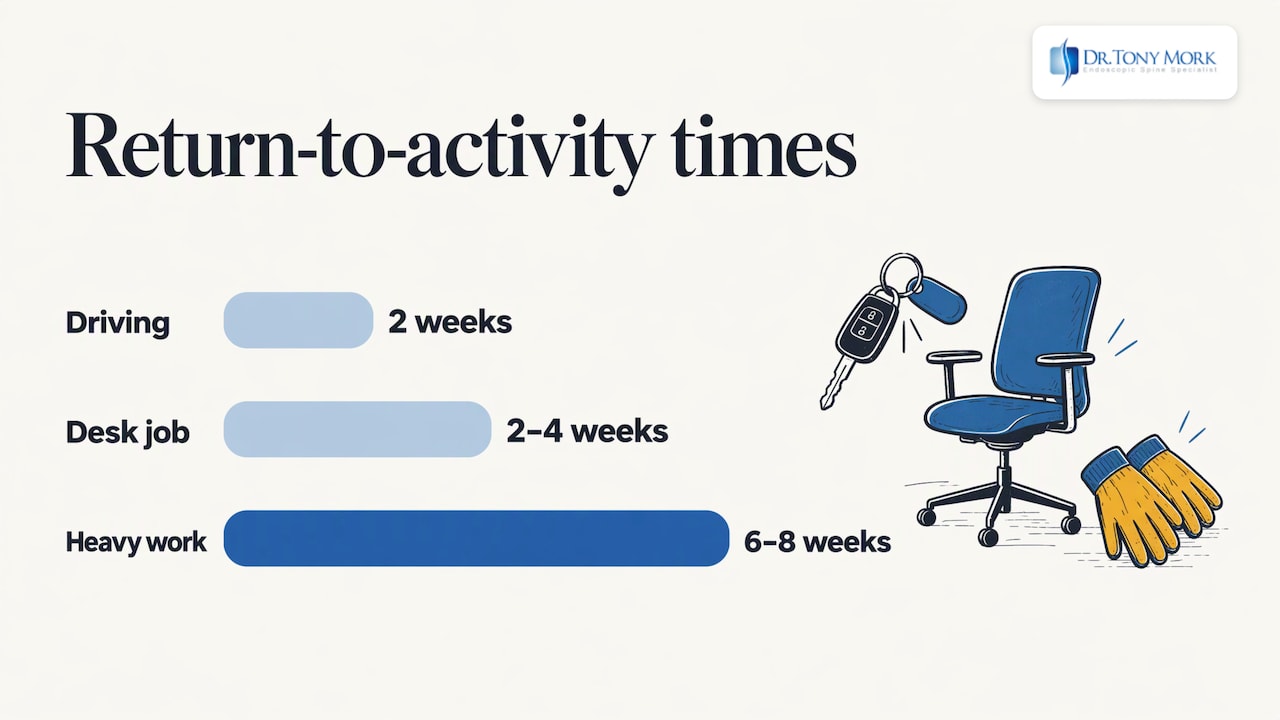
WebMD reports that people can go back to a desk job in 2 to 4 weeks, while those who lift heavy objects or run big machines may wait 6 to 8 weeks.
Sitting deserves special attention. Your discs bear more load sitting than standing. Sitting through a workday, a long drive, or a long dinner can bring back that deep ache in the low back. Here is what helps:
- Break it up: Stand and walk for a few minutes every 30 minutes to an hour.
- Support: Use a chair that supports the curve of your low back.
- Driving: Start with short trips, and stop to stretch on longer ones.
- Work: If your job is physical, ask me or your surgeon about a gradual return with lifting limits.
Putting on shoes and socks is another early test. Many patients find it easier within a few weeks. Sit on a chair and bring your foot up to you rather than twisting and reaching down.
Is recovery faster after endoscopic discectomy?
Often the early recovery is smoother, but the long-term results look similar across techniques. I want you to have both facts.
A 2026 meta-analysis (a study combining many studies) in e-Neurospine reviewed 17 studies with 3,115 patients. It found that endoscopic discectomy shortened hospital stay compared with microdiscectomy and showed greater short-term improvement on the Oswestry Disability Index (a questionnaire about how back pain affects daily life). It found no differences in long-term disability scores or pain scores, and fewer wound complications with endoscopic surgery.
The same analysis notes that in the United States, where discectomies are often outpatient, hospital stay differences are less noticeable. Patients are frequently discharged within hours either way.
Here is how I explain “minimally invasive.” The term refers to how much healthy tissue is disturbed, not only incision size. A small skin cut means little if the muscle underneath is stripped away. In endoscopic surgery, I work through a small opening with a camera, and the goal is to leave the surrounding muscle and bone as undisturbed as possible. You can read more about the technique on my endoscopic discectomy page and in my guide to endoscopic spine surgery.
The laser, when I use it, is one tool among several. It is never a cure by itself.
How do the main procedures compare?
| Procedure | Incision and tissue | Hardware | Typical early recovery pattern |
|---|---|---|---|
| Endoscopic discectomy | Small incision, camera, less tissue disturbed | None | Outpatient, many patients walking right away, desk work often in 2 to 4 weeks |
| Microdiscectomy | Slightly larger incision, microscope | None | Often outpatient, about 6 weeks for fuller recovery per many sources |
| Open laminectomy or fusion | Larger incision, more tissue disturbed | Fusion uses screws and rods | MedlinePlus says bone healing takes at least 3 to 4 months |
Times in the table are general patterns. Your own recovery may be shorter or longer.
How long does recovery take after spinal fusion compared with a discectomy?
Fusion takes much longer. MedlinePlus states that recovery after laminectomy and fusion takes at least 3 to 4 months for the bone to heal, and healing can continue for at least a year.
The spine was designed to move. Every vertebra (spinal bone) shares the work of bending, twisting, and absorbing load. When bones are fused together, the levels above and below take on extra motion. That is one reason I treat fusion as a last resort. It can still be done later if needed, so choosing a less invasive procedure first does not close any doors.
If you have been told fusion is your only option, read my thoughts on reconsidering spinal fusion. An accurate diagnosis comes before any surgery, and many back problems improve with time and conservative care.
When can I get back to exercise, golf, and lifting?
In stages, and later than daily activities. Walking comes first, then light core and hip work, then lifting, then sport.
A 2025 review of return to sport after lumbar disc herniation surgery, published in Scientific Research Publishing, reported average return-to-play times of 5.19 months after microdiscectomy and 4.6 months after full endoscopic discectomy. The same review concludes there is no consensus on exact timing, because recovery varies so much. It recommends that surgeons, physical therapists, and trainers work together.
I agree with that approach. A reasonable progression looks like this:
- Weeks 0 to 2: Short walks, incision care, no driving, no lifting beyond a light grocery bag.
- Weeks 2 to 6: Longer walks, gentle stretching, physical therapy if your surgeon recommends it, a gradual return to desk work.
- Weeks 6 to 12: Building strength in the core, hips, and legs. Lifting a grandchild or a bag of mulch with good form.
- After 12 weeks: Sport-specific work, such as a golf swing progression, only with your surgeon’s approval.
I wrote more about how to pace this in my article on the best way to advance activity after spine surgery. If golf is your goal, see my page on back surgery for low back pain in golfers. For building strength later, my guide to exercises that strengthen your lower back is a good place to start.
Which symptoms after surgery need prompt attention?
Call your surgeon’s office promptly for signs of infection, new weakness, or pain that is getting worse instead of better. Call 911 or go to an emergency room for the most serious signs.
These are the signs I want every patient to know:
- Infection: Fever, chills, redness, swelling, warmth, or drainage at the incision.
- New or worsening weakness: A foot that drags, or a leg that gives out, when it did not before.
- Bladder or bowel changes: Trouble urinating, loss of control, or numbness in the groin or inner thighs. Seek emergency care right away.
- Calf pain and swelling: One calf that is swollen, warm, or tender can signal a blood clot, which needs urgent evaluation.
- Chest pain or shortness of breath: Call 911.
- Pain that returns suddenly and severely: A new disc herniation at the same level can happen, and an exam and an MRI (magnetic resonance imaging) are needed to know for sure.
Mild soreness and some leg tingling during healing are common. If you are unsure, call. You will never bother me by asking.
What are the pros and cons of endoscopic surgery for recovery?
Endoscopic surgery offers a smaller incision and less tissue disturbance, but it is not right for every spine. Honest limits matter as much as benefits.
- Benefit, less tissue disturbed: Muscles and soft tissue are spared, which is why many patients report less post-operative soreness.
- Benefit, no hardware or fusion: Your spine keeps its motion.
- Benefit, outpatient: You sleep in your own bed that night.
- Limit, recurrence: Any discectomy carries some chance that the disc herniates again. The e-Neurospine analysis found a higher recurrence risk with one transforaminal endoscopic technique, so technique and experience matter.
- Limit, not every condition qualifies: Severe instability or certain deformities may need a different plan.
- Limit, nerve healing takes time: The surgery removes the pressure, but a nerve may need weeks or months to settle.
More on this is in the pros and cons of endoscopic spine surgery.
What can I do to help my own recovery?
Walk daily, sit smart, protect your back when you lift, and keep your follow-up visits. Small habits add up over weeks.
- Walking: Increase gradually. Stop if pain ramps up, and tell your surgeon.
- Posture: Keep a gentle curve in your low back when sitting and avoid slouching in the car.
- Lifting: Bend at the hips and knees, hold items close, and avoid twisting while carrying weight.
- Sleep and stress: Rest helps tissue repair, and tension can make pain feel worse.
- Supplements and remedies: No herb, supplement, or alternative remedy has been proven to heal the spine. Talk to your doctor before adding anything, especially if you take other medication.
If your pain does not improve, a different problem may be involved, such as a bulging disc, an annular tear, spinal stenosis, foraminal stenosis, or facet syndrome (pain from the small joints at the back of the spine). That is why diagnosis comes first. I cover bulging disc treatment and sciatica and lumbar radiculopathy options on my site.
What is my approach to herniated disc surgery?
The goal of my work is to remove the source of your pain, not only to manage it. That starts with an accurate diagnosis, because surgery on the wrong target gives the wrong result.
I am a board-certified orthopedic surgeon. I founded the Endoscopic Spine Academy and co-founded Microspine, and I have practiced endoscopic spine surgery exclusively since 1998. Over those years and more than 8,000 procedures, I have seen that the spine was designed to move, and I try to protect that motion.
Conservative care comes first when it fits: time, activity changes, physical therapy, medication, and injections. Many back problems improve. When surgery is the right step, I prefer a small incision, a camera, and an outpatient procedure with no hardware and no fusion. Fusion remains a last resort, and it can still be done later if needed.
Recovery is personal. I stay in direct contact with my patients afterward, because questions come up at 8 on a Tuesday night, not only during office hours.
Dr. Tony Mork
Can I have my MRI reviewed before deciding on surgery?
Yes. My practice offers remote review of your MRI or CT (computed tomography) scan, plus one on one phone appointments, so you can understand your options from home. It is useful if you are out of state, have seen several doctors without a clear answer, or have been told fusion is your only option.
My concierge practice gives you direct access to me and immediate post-operative support. I see patients at my Irvine office, 2102 Business Center Dr #127, Irvine, CA 92612, and at my office in Naples, Florida. You can learn more about my concierge spine services or read about endoscopic spine surgery.
Insurance may cover facility and anesthesia fees, but not the surgeon’s fee. Payment is required before surgery, and my office will explain the details when you contact us.
FAQ
How long is the full recovery after herniated disc surgery?
Many patients feel much better within a few weeks, and some sources describe about 6 weeks for a fuller recovery after microdiscectomy. Heavy lifting and sports can take 3 months or longer. Results vary, and your surgeon will guide your timeline.
Is endoscopic discectomy recovery shorter than open surgery?
Early recovery is often smoother because less healthy tissue is disturbed. Studies, including a 2026 e-Neurospine meta-analysis, found a shorter hospital stay and greater short-term improvement, but similar long-term pain and disability scores. Fusion is a separate, longer recovery.
Can I sit after disc surgery?
Yes, in short stretches. MedlinePlus advises limiting sitting to 20 to 30 minutes at a time early on. Stand and walk for a few minutes between sits.
When can I go back to the gym or golf?
Usually in stages after the first several weeks, once your surgeon clears you. A 2025 review found average return-to-sport times of several months, with wide variation. Walking and gentle strengthening come first.
Will my disc herniate again?
It can, though many patients never have a second herniation. Following lifting and posture guidance and building core strength may help. Any sudden return of severe leg pain needs an exam and an MRI.
If you have an MRI, upload it and I will review it personally and talk with you about your options. Time is on your side.
Recommended
- What is Herniated Disc Surgery? All You Need To Know About Herniated Disc Surgery
- Considering Herniated Disc Surgery? Read This Before You Make a Decision
- Herniated Disc Treatment | Minimally Invasive Spine Surgery
- Exercises That Strengthen Your Lower Back and Prevent Herniated Discs
This article is for general education and is not medical advice. Please see a qualified doctor about your symptoms.