Yes. Many back and neck problems can be treated surgically without a fusion, and fusion should be a last resort that can still be done later if you need it. The key is an accurate diagnosis first, because the right operation depends on exactly what is causing your pain.
I am Dr. Tony Mork, a board-certified orthopedic surgeon. I have practiced endoscopic spine surgery exclusively since 1998, and I have performed more than 8,000 endoscopic spine procedures. I also founded the Endoscopic Spine Academy and co-founded Microspine. This article explains what non-fusion surgery means, who it may help, and how to decide.
TL;DR
- Fusion: It joins vertebrae (the bones of the spine) together so they no longer move. Your spine was designed to move, so I treat fusion as a last resort.
- Non-fusion surgery: It removes the source of pain, such as a piece of disc pressing on a nerve, and leaves the spine’s motion in place.
- Endoscopic spine surgery: It uses a small incision and a camera, is done outpatient, and uses no hardware and no fusion.
- Diagnosis first: An exam and an MRI are needed to know for sure what is causing your pain, and many back problems improve with time and conservative care.
- Results vary: No operation fits every patient, and every surgery has risks.
What does non-fusion spine surgery mean?
It means an operation that treats the cause of your pain without permanently joining bones together. The goal is to remove the source of pain, not just manage it.
A fusion uses bone graft, and usually screws and rods, to make two or more vertebrae heal into one piece. A non-fusion operation does something different. It might remove the part of a disc that is pinching a nerve, or widen a narrowed space so a nerve has room again.
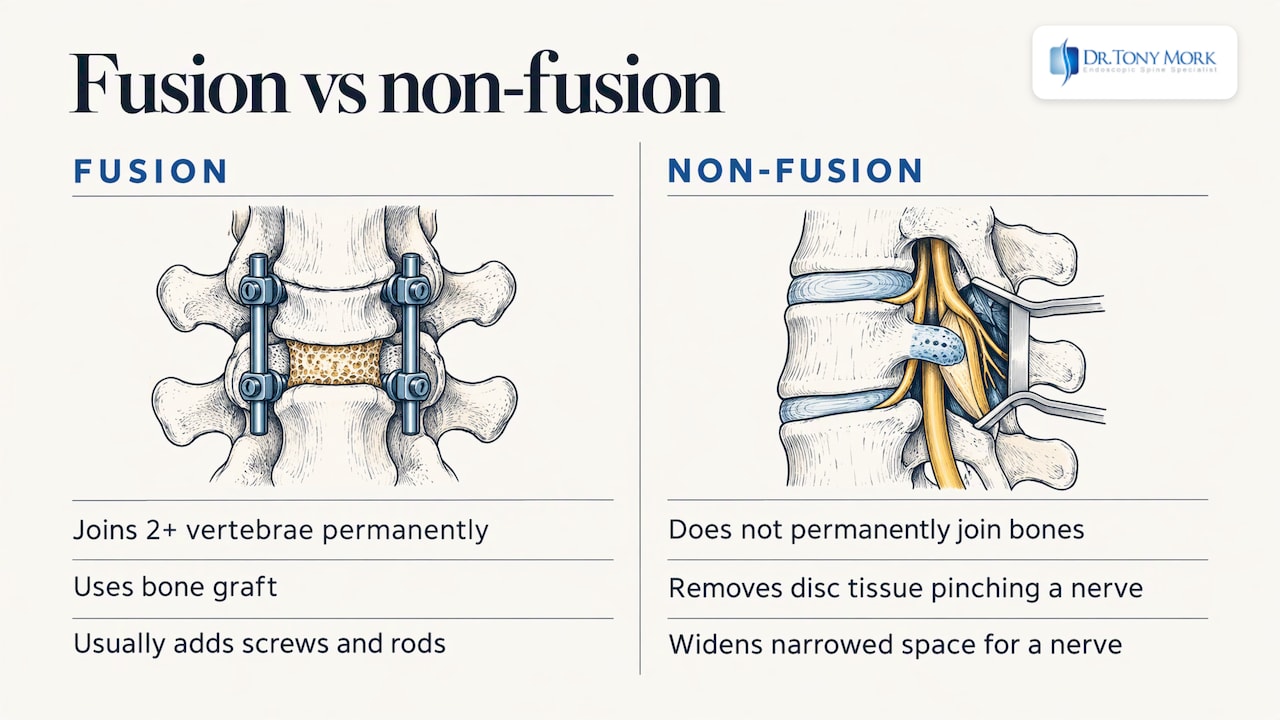
Think of a nerve passing through a narrow waterway. If the channel is pinched, the flow suffers. Opening the channel can fix the problem without rebuilding the whole waterway.
One point confuses many patients. “Minimally invasive” describes how the surgeon reaches the problem, not whether the operation includes a fusion. According to the American Academy of Orthopaedic Surgeons, both decompression and fusion can be done through minimally invasive approaches. In my view, the term refers to how much healthy tissue is disturbed, not only how small the incision is. You can read more in my page on what minimally invasive spine surgery really means.
What non-fusion options are there for back pain?
The options depend on the diagnosis. They are not interchangeable.
- Discectomy: Removing the part of a herniated disc (a disc whose soft center pushes out) that presses on a nerve. This is the most common reason people feel leg pain, burning, or numbness. See endoscopic discectomy.
- Decompression: Making more room for nerves in spinal stenosis (narrowing of the spinal canal). Patients often notice it when they walk or stand for a while. See endoscopic decompression.
- Foraminal decompression: Opening the foramen, the opening where a nerve leaves the spine. See endoscopic foraminal decompression.
- Bulging disc and annular tear care: A bulging disc pushes outward without breaking through, and an annular tear is a crack in the disc’s tough outer wall. Some are treated endoscopically when they are the confirmed pain source. See bulging disc treatment and the annular tear assessment.
- Disc replacement: An artificial disc that keeps motion. The International Society for the Advancement of Spine Surgery supports FDA-labeled disc replacement as a fusion alternative for carefully selected patients. It is a different operation from the endoscopic procedures I perform.
A 2025 review in the Journal of Neurosurgery: Spine notes that surgery is generally not offered for nonspecific low back pain. It is considered when an anatomical cause, such as a herniated disc or stenosis, has been identified. That is why diagnosis matters so much.
How does endoscopic spine surgery work?
In short: a small incision, a camera, outpatient, no hardware, no fusion.
I make a small incision and pass a thin tube with a camera to the problem area. The camera lets me see the nerve and disc on a screen. Through the tube I remove the tissue that is causing the problem. Because the tube moves muscle aside rather than cutting through it, less healthy tissue is disturbed.
A laser can be one of the tools I use. It is one tool, never a cure by itself. The skill is in finding and removing the true source of pain.
You go home the same day. Many patients return to light daily activities quickly, but recovery often takes longer for full activity, and results vary. My page on how long decompression surgery recovery takes goes through it in more detail. For a full walkthrough, see my guide to endoscopic spine surgery.
What are the pros and cons of non-fusion surgery?
Every treatment has trade-offs. Here is an honest list.
Possible advantages
- Tissue: Less muscle and healthy tissue is disturbed. The American Association of Neurological Surgeons lists smaller incisions, less blood loss, less muscle damage, and faster recovery as potential advantages of minimally invasive surgery.
- Motion: The spine keeps its natural movement at the treated level.
- Later options: Fusion can still be done later if it is ever needed.
Limits and risks
- Not for everyone: Some conditions, such as significant spinal instability (a spine segment that slips or moves abnormally), may need a different operation.
- Risks remain: Anesthesia reactions, bleeding, infection, and nerve irritation are still possible. Minimally invasive is not risk-free.
- No guarantee: Pain may persist or return. Results vary.
My page on the pros and cons of endoscopic spine surgery covers this further.
Do I need to try other treatment first?
Usually, yes. Many back problems improve with time. Conservative care comes first where it fits: time, activity changes, physical therapy, medication, and injections.
The American Academy of Orthopaedic Surgeons says surgery is generally considered after nonsurgical treatment has not relieved symptoms and the source of pain can be identified. I agree with that approach.
If you are already taking medication, keep taking it as your doctor directed, and talk with your doctor before changing anything. Time is on your side in most cases.
Some patients tell me they have done all of this. Physical therapy made them worse. Epidural steroid injections (ESIs, medicine injected near the spinal nerves) helped for a short while. Chiropractic relief never lasted. If that sounds like you, it often means the true source of pain has not been found yet.
Why does diagnosis matter so much?
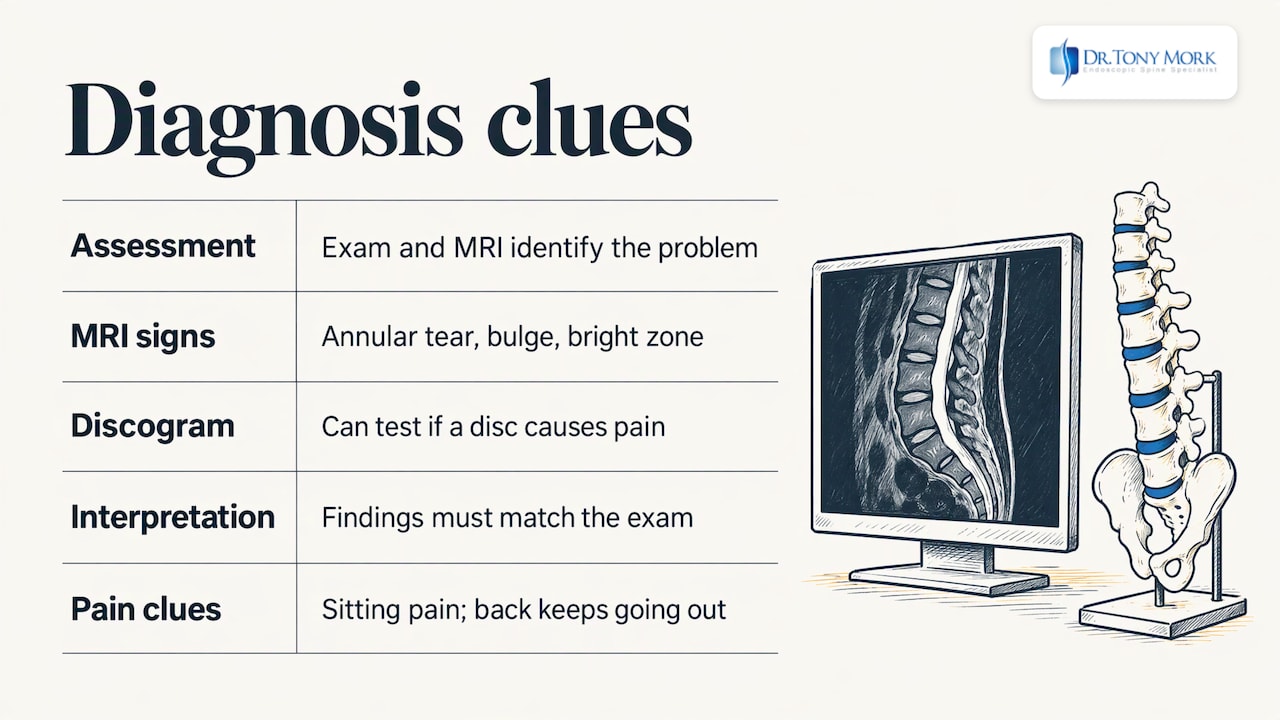
Because surgery only works when it targets the right problem. An exam and an MRI (magnetic resonance imaging, a scan that shows discs and nerves) are needed to know for sure.
Some patients have deep low back pain that worsens when sitting or driving. Some have a back that keeps “going out.” Some have groin or tailbone pain after normal hip and hernia checks. Others have been told their MRI is normal, or have seen several doctors without an answer. I cannot diagnose you from an article. These patterns are reasons to have a careful look at the discs and nerves.
Sometimes an MRI shows an annular tear, a bulge, or a high intensity zone (a bright spot on the scan in the disc wall). A CT discogram (a CT, computed tomography, scan after dye is placed in the disc) can help show whether a specific disc is the source of pain. Not every scan finding causes symptoms, so the findings have to match your exam.
If you want another set of eyes, see my page on getting a second opinion on your spine MRI.
What if I was told fusion is my only option?
Get a clear explanation of why. Fusion has a place, but I present it as a last resort. Many patients are told it is the only choice when a more targeted operation may fit their diagnosis.
A fusion permanently stops motion at the treated level. The spine was designed to move, and the levels next to a fusion may take on extra load. I disagree with fusion as a routine first answer.
The Pacific Spine and Pain Society’s 2024 evidence review found no significant difference in pain or disability outcomes between fusion and conservative management for lumbar degenerative disc disease. For more, read my pages on alternatives to spinal fusion, lumbar fusion alternatives, and spine surgery without fusion in California.
What about injections like PRP or stem cells?
PRP (platelet-rich plasma, made from your own blood) and stem cell injections are sometimes offered for disc pain. I do not claim any supplement or alternative remedy is proven to heal the spine. If you are considering them, ask what the treatment is meant to do for your specific diagnosis, and have your doctor involved in the decision.
What if I already had spine surgery and still hurt?
Pain after a previous operation has a cause that can usually be looked for. It may be a remaining disc fragment, a narrowed nerve opening, or a joint problem such as facet syndrome (pain from the small joints at the back of the spine). A fresh review of your imaging and exam is the starting point. Endoscopic surgery can be an option for failed prior surgeries when the source is identified.
How can my office help?
My practice is a concierge practice. You have direct access to me, and I give direct post-operative support. I see patients at my Irvine office, 2102 Business Center Dr #127, Irvine, CA 92612, and at my office in Naples, Florida. Patients also travel from other states.
If you cannot come in right away, I can evaluate your MRI or CT scans remotely. You can learn about the procedures on my endoscopic spine surgery page, or the broader minimally invasive spine surgery page.
What do I think about fusion?
I have spent more than 25 years doing one kind of surgery: endoscopic spine surgery. Early on, I saw how many patients were offered fusion when the real problem was a small, specific source of pain.
My view is simple. Find the source of pain first. Remove it with as little disturbance to healthy tissue as possible. Keep the spine moving. Fusion can still be done later if it is truly needed.
I do not promise outcomes. I promise a careful review of your case and an honest discussion of your options, including the limits of what I do.
Dr. Tony Mork
FAQ
Is minimally invasive spine surgery the same as non-fusion surgery?
No. Minimally invasive describes the way the surgeon reaches the problem with less disturbance to healthy tissue. A fusion can be done that way too. Endoscopic spine surgery, as I perform it, uses no hardware and no fusion. You can read my page on minimally invasive lumbar fusion to see the difference.
Will I be able to go home the same day?
Endoscopic spine surgery is outpatient, so you go home the same day. Recovery often takes weeks for full activity, and results vary. Your exact plan depends on your diagnosis and the operation.
Does insurance cover non-fusion surgery?
Insurance may cover facility and anesthesia fees, but not the surgeon’s fee. Payment is required before surgery. Check your own plan for what it covers.
Can non-fusion surgery help after a failed back surgery?
It can be an option when the source of continuing pain is identified. That starts with a review of your symptoms, exam, and scans. Results vary.
Your next step
If you have an MRI, upload it and I will review it personally and talk with you about your options. Request a consultation here.
Recommended
- Can I have spine surgery without fusion in California?
- Alternatives to Spinal Fusion
- What are the alternatives to lumbar fusion?
- Cervical Fusion Alternatives: Your Options for Neck Pain
This article is for general education and is not medical advice. Please see a qualified doctor about your symptoms.