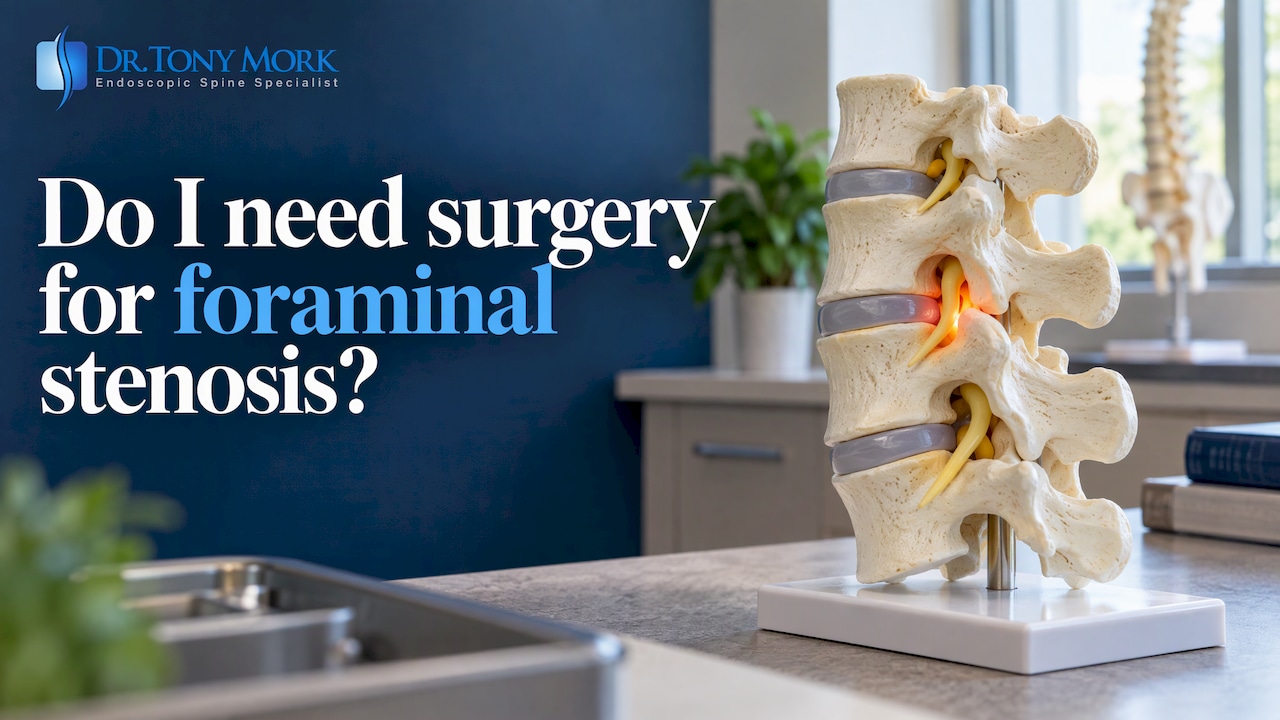
Not always. Many people with foraminal stenosis (narrowing of the opening where a nerve leaves the spine) improve with time and conservative care. Surgery becomes a reasonable option when leg or arm pain, numbness, or weakness keeps limiting your daily life despite that care, and an exam and an MRI (magnetic resonance imaging) show a narrowed opening pressing on the nerve that matches your symptoms.
I am Dr. Tony Mork, a board-certified orthopedic surgeon. I have practiced endoscopic spine surgery exclusively since 1998. Below I explain how I think about this problem, in the same way I would in my office.
TL;DR
- Diagnosis first: An exam and an MRI are needed to know for sure whether a narrowed foramen is the source of your pain. Accurate diagnosis comes before any surgery.
- Conservative care first: Time, activity changes, physical therapy, medication, and injections help many people. Time is on your side when there is no serious weakness.
- The goal: Surgery aims to remove the source of pain, which is the pressure on the nerve, not just manage it.
- Endoscopic option: A small incision, a camera, outpatient care, no hardware, no fusion. It has limits, and I cover them below.
- Fusion: It is a last resort and can still be done later if it is ever needed.
What is foraminal stenosis?
Foraminal stenosis is a narrowing of the foramen, the small tunnel on each side of every vertebra (spine bone) where a nerve root exits the spinal canal. “Foraminal encroachment” means the same thing in plain terms: something, usually a bulging disc, a bone spur, or a thickened joint, is crowding into that tunnel.
Here is the comparison I use with patients. The foramen is like a doorway, and the nerve is a person walking through it. If the frame thickens or something is stacked in the doorway, the person gets squeezed.
The nerve then becomes irritated. In the lower back (lumbar spine), that often shows up as pain, burning, tingling, or numbness traveling down the leg. In the neck (cervical spine), it can travel into the shoulder, arm, or hand.
You can read more in my two-part series, lumbar foraminal stenosis problems and treatment, part 1 and part 2.
What does foraminal stenosis feel like in daily life?
It usually feels like nerve pain, not just a sore muscle. Patients describe it in everyday terms:
- Shoes and socks: Bending to put on your shoes sends a sharp or burning pain into one leg.
- Sitting: Getting through a workday or a long drive becomes uncomfortable, and you shift constantly.
- Walking and standing: Leg heaviness or numbness builds as you stand at the kitchen counter or walk through a store.
- Sleep: Certain positions wake you up with pain or pins and needles.
- Activity: Playing golf, gardening, or lifting a grandchild brings on the symptoms.
In the neck, the same pressure can mean arm pain while you reach, drive, or work at a computer.
I cannot diagnose you from a list of symptoms. Other problems can look the same, including a herniated disc, spinal stenosis in the central canal, or joint pain from the facets (the small joints at the back of the spine). An exam and an MRI are needed to know for sure.
Why does my MRI look bad but my pain is mild, or the reverse?
Because the picture and the pain do not always match. A narrowed foramen on an MRI does not automatically mean a nerve is hurting. Radiology literature, including a 2023 MRI grading review in the National Library of Medicine, explains that fat around the nerve root offers some protection, so a small amount of narrowing may cause few symptoms.
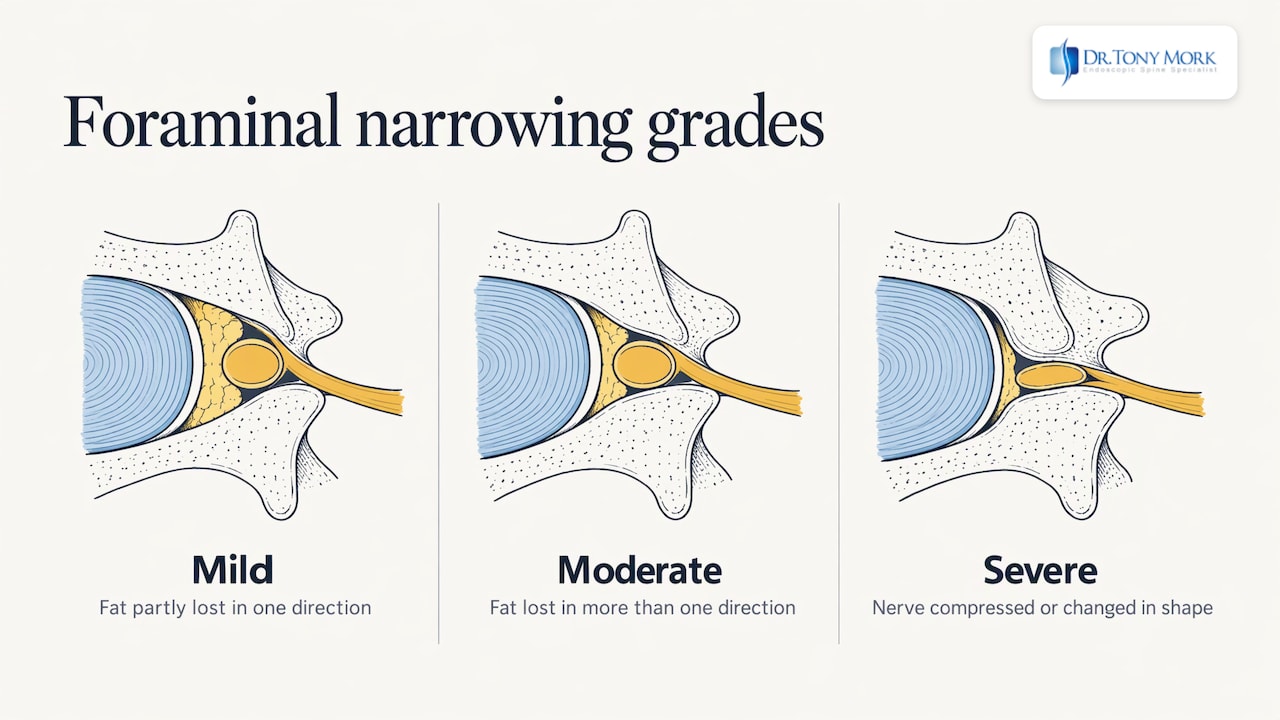
That same review describes the grades this way: in mild narrowing the fat around the nerve is partly lost in one direction, in moderate narrowing in more than one direction, and in severe narrowing the nerve itself is compressed or changed in shape.
The lesson for you is that I treat the person, not the scan. Surgery makes sense when your symptoms, your exam, and your imaging all point to the same nerve. If they do not agree, I keep looking. That sometimes means a different diagnosis altogether, such as a disc problem on the other side or pain from the disc itself.
Should I try conservative care first?
Yes, in most cases. Many back and leg problems improve with time, and I would rather you avoid surgery if you can.
Conservative care usually includes:
- Time and activity changes: Staying active within your comfort, and adjusting how you sit, lift, and sleep.
- Physical therapy (PT): Guided exercises to improve movement and strength. A good therapist should adjust the program if it makes your leg pain worse.
- Medication: As prescribed by your own physician. Never stop a medication without talking to your doctor.
- Injections: Epidural steroid injections (ESIs) place anti-inflammatory medicine near the irritated nerve. For some people they give short-term relief and a window to heal. For others the relief wears off.
How long should you wait? Spine societies and many insurers commonly describe a trial of roughly 6 weeks or more of nonsurgical care before elective surgery, in patients who are neurologically stable. A 2014 review in the Journal of Spine Surgery reported that the best timing for surgery may fall somewhere between 4 and 8 weeks, but it also noted that few studies support any exact number. Your situation is individual.
Some symptoms are different. See a doctor right away, or go to an emergency room, if you have new weakness in a leg, loss of bladder or bowel control, or numbness in the groin or saddle area. Those can signal serious nerve compression that should not wait.
When is surgery for foraminal stenosis a good option?
Surgery is worth discussing when four things line up:
- Persistent symptoms: Pain, numbness, or weakness continues despite a fair trial of conservative care.
- Daily life is limited: You cannot sit through work, sleep, drive, walk, or enjoy activities you love.
- Imaging matches: The MRI or CT (computed tomography) scan shows a narrowed foramen pressing on the nerve that explains your symptoms.
- Diagnosis is clear: The exam supports the same level and the same side.
The goal of surgery is to remove the source of pain. Pressure on the nerve is the source, so the operation widens the opening and clears whatever is crowding it. Managing symptoms is useful, but if the cause is still there, the pain often returns.
Sometimes patients have had several doctors without a clear answer, or an MRI called normal, or pain that never fully matched their scans. I review images remotely for those situations. A careful second look at the diagnosis is the right first step.
What is a foraminotomy, and what are the usual surgical choices?
A foraminotomy is an operation that enlarges the foramen to free the nerve. MedlinePlus, from the National Library of Medicine, describes the traditional version as done under general anesthesia through a midline incision in the back, with skin, muscle, and ligament moved aside, bone trimmed to widen the opening, and disc fragments removed. MedlinePlus also notes that a fusion may sometimes be added for stability.
In general, the choices fall into three groups:
- Open foraminotomy or decompression: A larger incision, with more muscle moved aside to reach the nerve.
- Decompression with fusion: Screws and rods, and often a spacer, join two vertebrae so they no longer move. This can be appropriate for a spine that is truly unstable.
- Endoscopic foraminal decompression: A small incision, a camera, outpatient care, no hardware, no fusion.
The spine was designed to move. Every fusion removes motion at one level, and the neighboring levels may carry more load afterward. That is why I treat fusion as a last resort. It can still be done later if it is ever needed, so choosing a less invasive operation first does not close that door.
How does endoscopic foraminal decompression work?
It works by reaching the nerve through a tiny corridor, instead of through the muscles of the back. I make a small incision and place a thin tube with a camera next to the foramen. The camera sends a magnified picture to a screen, and I use fine instruments to remove the bone spur, disc material, or thickened tissue pressing on the nerve.
The laser is one tool I may use, for example to shrink or trim tissue. It is never a cure by itself. The cure comes from correctly identifying the problem and removing the pressure.
Most often it is an outpatient procedure, which means you go home the same day. You can read more on my pages for endoscopic foraminal decompression and endoscopic spine surgery.
What does “minimally invasive” really mean?
It refers to how much healthy tissue is disturbed, not only how long the incision is. A short cut can still involve stripping large muscles off the bone. With the endoscopic approach, the aim is to leave the muscles, ligaments, and stabilizing joints as undisturbed as possible while I address the nerve.
That matters in foraminal stenosis. A 2023 scoping review in the National Library of Medicine notes that a surgeon must balance a thorough decompression against preserving the facet joint, because removing too much of it can cause instability that later requires fusion. Protecting healthy structures is part of the plan from the start.
What are the pros and cons of endoscopic surgery?
Every operation has trade-offs. Here is how I describe them honestly.
Possible benefits
- Less tissue disturbed: Muscles and joints are mostly left in place.
- Outpatient care: Many patients go home the same day.
- No hardware and no fusion: Your spine keeps its motion at that level.
- Recovery: Many patients return to regular activities sooner than after open surgery. Results vary.
- Fusion later if needed: Nothing is lost for future options.
Limits and risks
- It does not fit every spine: A severely unstable segment, a significant slipped vertebra, or a very deformed spine may need a different approach.
- Symptoms can persist or return: Nerves heal slowly, and numbness can linger for weeks or months. Some patients need further treatment.
- General surgical risks: Infection, bleeding, nerve irritation, a torn membrane around the nerve, and anesthesia risks all exist, even if they are uncommon.
- Expertise matters: Endoscopic work takes specific training and many repetitions. I have performed more than 8,000 endoscopic spine procedures, and I founded the Endoscopic Spine Academy to teach this approach. I also co-founded Microspine.
No surgeon can promise you a pain-free result or an exact recovery time. I will tell you what I see on your imaging and what outcome is realistic for you.
How long is recovery after foraminal stenosis surgery?
Recovery often takes days to a few weeks for the first steps, and longer for full activity. Results vary, and I will not give you a fixed number. It depends on your age, your job, how long the nerve was compressed, and how the nerve heals.
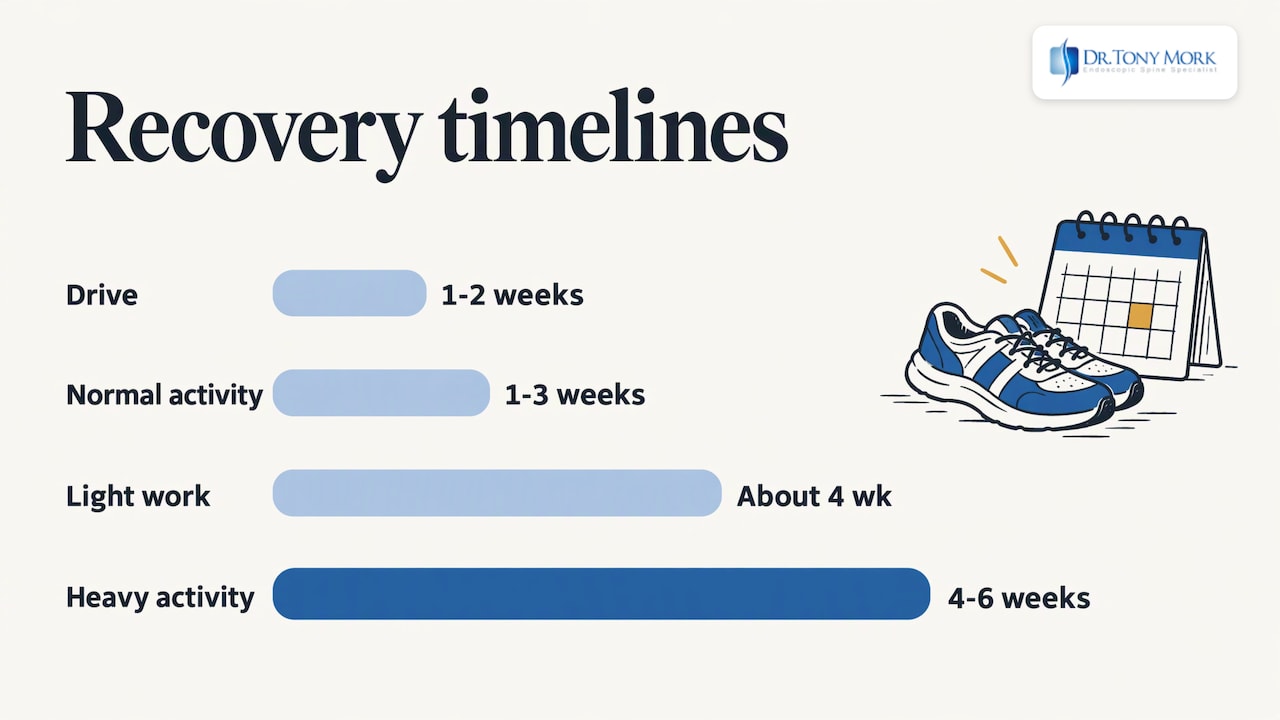
For context, MedlinePlus says that after a traditional foraminotomy most people can sit up within hours, leave the hospital the next day, drive within a week or two, and return to light work after about 4 weeks. The American College of Surgeons says patients commonly need 1 to 3 weeks to feel comfortable in normal activity after surgery, and are often advised to avoid lifting heavy items and strenuous activity for at least 4 to 6 weeks. Endoscopic recovery is often quicker, but I plan it around you.
In general, I tell patients to expect:
- First days: Walking is encouraged, with short, frequent walks.
- First weeks: Gradually longer walks and light daily tasks. Avoid heavy lifting and twisting.
- Return to work: Desk work often comes first. Physical jobs take longer.
- Sports and the gym: Golf, lifting, and training return in steps, guided by how you feel and how the nerve is doing.
You also have direct access to me after surgery. If something feels wrong, you contact me.
What if I have been told fusion is my only option?
Get the diagnosis confirmed first. Fusion is sometimes the right answer, but in my experience it is not the first or only answer for most foraminal stenosis. A 2023 scoping review in the National Library of Medicine states that if a foraminal decompression can be done without worsening instability at that level, a fusion can be avoided.
The question I ask is whether the segment is stable enough to keep moving once the nerve is free. If it is, a targeted decompression often makes more sense. If it is not, then fusion is a conversation we have honestly.
What if you have already had surgery and still hurt? Persistent pain after a prior operation does not mean nothing can be done. The cause may be scar tissue, a missed or recurrent problem, or a narrowed foramen at the same or an adjacent level. Read my page on post-laminectomy syndrome treatment for more.
What is my own view on foraminal stenosis surgery?
I have spent my entire career, since 1998, doing one thing: endoscopic spine surgery. That focus shapes everything I tell patients.
First, the spine was designed to move. When I can free a nerve without welding vertebrae together, I believe that is the better path. Fusion remains a last resort and can still be done later if it is truly needed.
Second, the diagnosis decides the operation. I will not operate until I am confident that the narrowed foramen, and not something else, is the source of your pain. Many of my patients come to me after seeing several doctors, and the most valuable thing I can give them is a clear answer.
Third, I want to remove the source of pain, not just manage it. That is why I review your MRI or CT personally and stay involved after surgery through my concierge practice.
Not everyone needs surgery, and I will tell you when you do not.
Dr. Tony Mork
Where can I see you for foraminal stenosis?
I see patients in two locations. My Irvine office is at 2102 Business Center Dr #127, Irvine, CA 92612. I also have an office in Naples, Florida, which you can see on my spine surgeon Naples, FL page. Patients also travel from other states, and I can begin by reviewing your MRI and CT scans remotely.
My concierge practice means you speak directly with me before surgery and have immediate access to me afterward. If you are wondering whether your pain is foraminal stenosis, or whether you need surgery at all, start at my practice site.
What else do patients ask about foraminal stenosis surgery?
Does spinal stenosis get worse over time?
It can progress slowly in some people, because the discs and joints change with age, but many people stay stable for years. Symptoms often come and go. If you develop weakness, worsening numbness, or loss of bladder or bowel control, see a doctor promptly.
Can mild bilateral foraminal stenosis cause symptoms?
Sometimes, though often it does not. Mild narrowing on both sides can show up on an MRI in people with no pain, because the nerve has some room. Whether it explains your symptoms depends on your exam and on whether the narrowed level matches where you hurt.
Is foraminotomy the same as endoscopic foraminal decompression?
They have the same goal, which is to widen the opening and take pressure off the nerve. The difference is the approach. Endoscopic decompression uses a small incision and a camera and disturbs less healthy tissue, with no hardware and no fusion.
Can foraminal stenosis come back after surgery?
It can. Discs and joints continue to change over the years, and a problem can develop at the same level or a neighboring one. Good posture, staying active, and keeping strong help, but I cannot promise it will not recur. If it does, there are still options.
What is the next step?
If you have an MRI, upload it and I will review it personally and talk with you about your options. You can start on my website. Whether the answer is surgery, more conservative care, or a different diagnosis, you will leave with a clear plan.
This article is for general education and is not medical advice. Please see a qualified doctor about your symptoms.