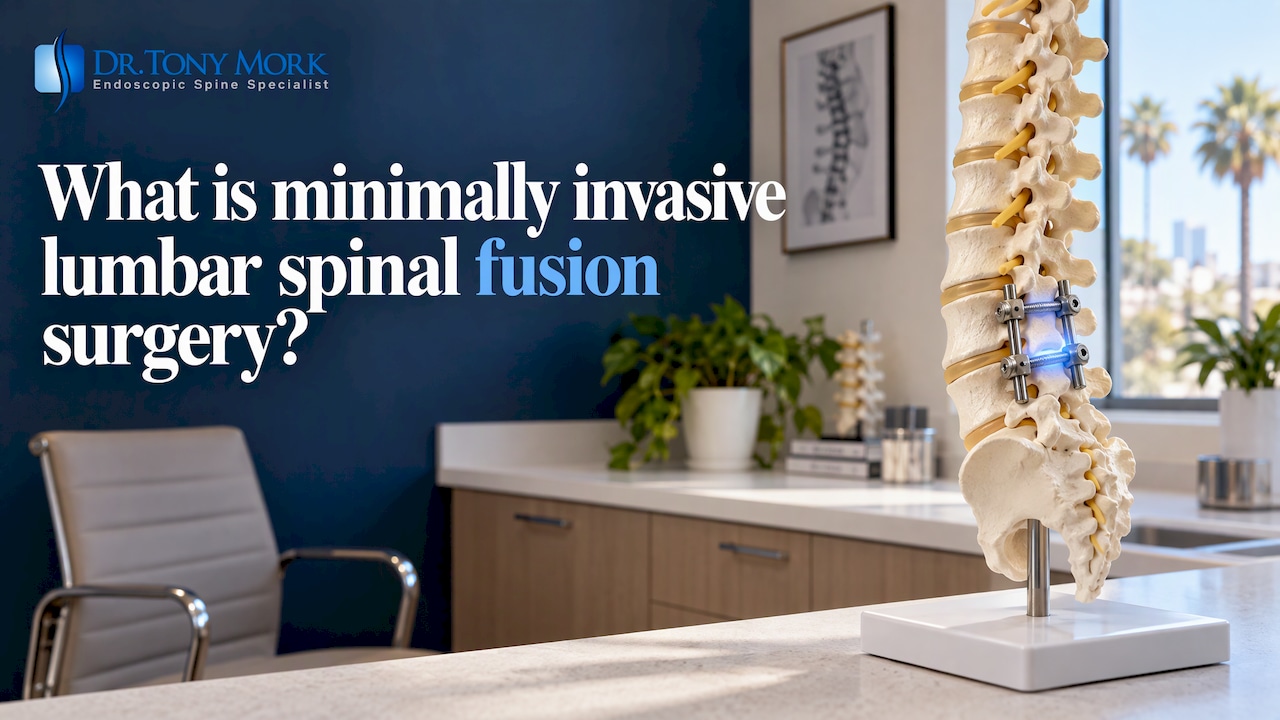
Minimally invasive lumbar spinal fusion is surgery that permanently joins two or more vertebrae (the bones of the spine) in your lower back, using smaller incisions than traditional open fusion. It is still a fusion, and the spine was designed to move, so I treat fusion as a last resort that can still be done later if you need it.
I am Dr. Tony Mork, MD, a board-certified orthopedic surgeon. I have practiced endoscopic spine surgery exclusively since 1998, and I have performed more than 8,000 endoscopic spine procedures. Many of the patients who find me were told fusion was their only option. Often it is worth a closer look at the diagnosis first.
TL;DR
- What it is: Fusion through smaller incisions. The vertebrae are still joined permanently, and hardware (screws and rods) is usually used.
- Who it fits: Specific problems such as spinal instability, a slipped vertebra, or a disc that has failed. An exam and an MRI are needed to know for sure.
- Before surgery: Accurate diagnosis comes first, and conservative care comes before that for many people.
- Another path: Endoscopic spine surgery uses a small incision and a camera. It is outpatient, with no hardware and no fusion.
- Your next step: If you have an MRI, you can send it to my office and I will review it personally.
What does “minimally invasive” mean in spinal fusion?
It means the surgeon disturbs less healthy tissue to reach the problem. Incision length is only part of that. What matters is how much muscle and soft tissue is moved aside or cut.
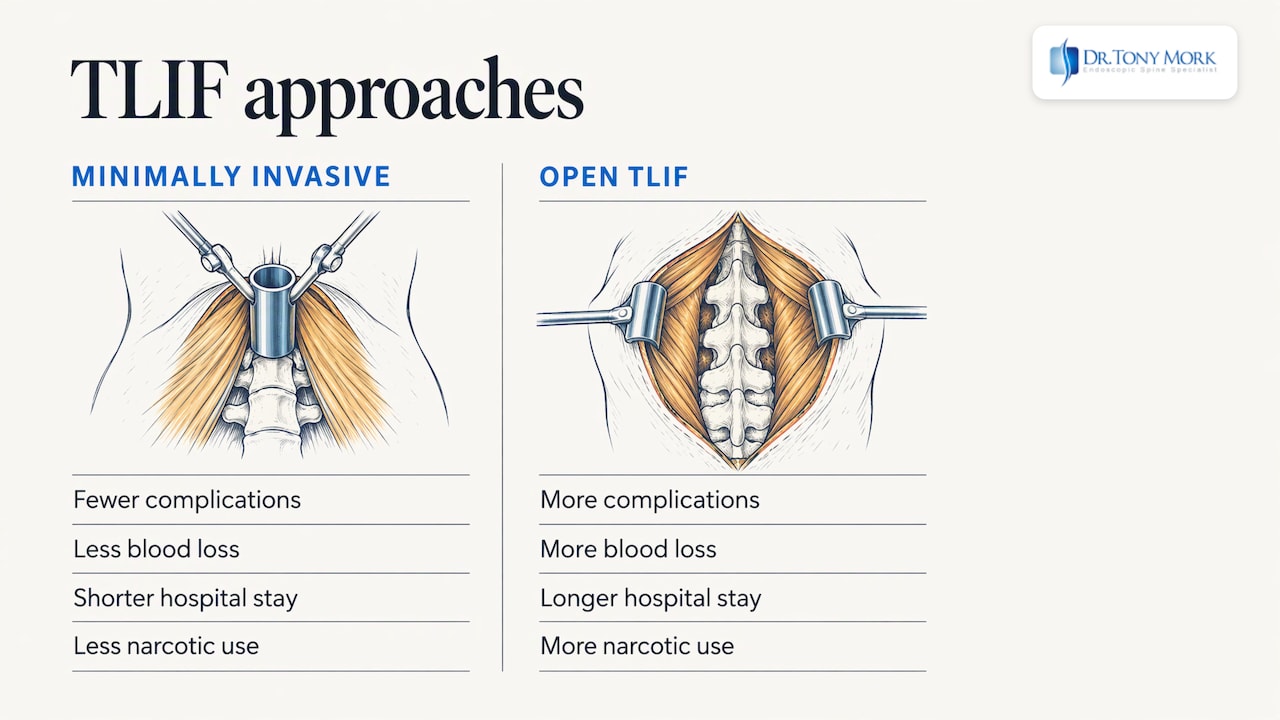
In traditional open surgery, the back muscles are pulled away from the spine along a long incision. In minimally invasive surgery, the surgeon works through narrow tubes placed between muscle fibers. According to a 2020 systematic review of the technique, the goal is the smallest operative footprint that still achieves the surgical goal.
The same review reports that minimally invasive TLIF (transforaminal lumbar interbody fusion) has shown fewer complications, less blood loss, a shorter hospital stay, and less narcotic use than open TLIF, with similar fusion rates and clinical outcomes.
How is a minimally invasive lumbar fusion done?
The most common version is TLIF. The American Academy of Orthopaedic Surgeons (AAOS) describes it on its patient education page. You lie face down. The surgeon approaches the spine slightly from the side and places a retractor (a tool that holds tissue open) on each side. Then:
- Part of the lamina (the roof of the spinal canal) and the damaged disc are removed.
- Bone graft is placed into the empty disc space.
- Screws and rods are added for support while the bone grows together.
Surgery time varies. A 2026 study in Frontiers in Surgery reported an average of 124 minutes of operating time for fluoroscopy-assisted (X-ray guided) MIS-TLIF in 39 patients. Two-level surgery takes longer than one level.
Who is a candidate for minimally invasive fusion?
Fusion is considered for a short list of problems. A peer-reviewed review lists these indications:
- Degenerative disc disease: Severe wear in a disc that has stopped working as a cushion.
- Spondylolisthesis: One vertebra slipping forward over the one below, in lower grades.
- Instability after earlier surgery: Including after a laminectomy (removal of part of a vertebra to relieve pressure).
- Pseudarthrosis: A previous fusion that did not heal.
- Recurrent disc herniation: A disc that keeps pushing out after earlier treatment.
This is a general list. I cannot diagnose you from an article. An exam and an MRI (magnetic resonance imaging) are needed to know for sure.
Do I need a fusion for back pain?
Probably not, and not first. The American Academy of Family Physicians (AAFP) states in its 2024 guidance that chronic low back pain, meaning pain lasting 12 weeks or more, affects about 13% of U.S. adults. It also states that most of these patients will not need surgery.
Conservative care comes first where it fits. That means time, activity changes, physical therapy, medication, and sometimes injections. The AAFP calls non-drug treatment first-line. Many back problems improve with time. Time is on your side.
Surgery is worth discussing when pain keeps you from basics: sitting through a workday, driving, sleeping, putting on your shoes, or lifting a grandchild. Even then, accurate diagnosis comes before surgery. Fusion makes sense only when the pain source is a segment that truly needs to be locked.
Why does the diagnosis matter so much?
Because the right operation depends on the exact source of pain. Back pain can come from a disc, a joint, a pinched nerve, or a narrowed canal. A normal-looking MRI does not always mean there is nothing wrong. An annular tear (a crack in the tough outer wall of a disc) can be easy to miss.
A research paper in PMC reported that patients who met North American Spine Society criteria for lumbar fusion did about three times better than those who did not. The lesson is plain. Matching the operation to the diagnosis matters more than the size of the incision.
If you have seen three or more doctors without an answer, the problem is often the question being asked, not you. My goal is to remove the source of pain, not just manage it.
What are the risks of minimally invasive fusion?
Every surgery carries risk. The AAOS lists these for minimally invasive spine surgery:
- Infection: Antibiotics are given before, during, and often after surgery.
- Bleeding: Some is expected and usually not significant.
- Recurring symptoms: Pain can return.
- Pseudarthrosis: The bone does not fully knit. Smokers are more likely to develop it.
- Nerve damage: Described as very rare.
- Blood clots: Uncommon, but dangerous if one travels to the lungs.
After fusion, the AAOS advises watching for calf swelling or pain, redness or drainage at the wound, and a temperature above 101°F. If your legs feel weak or buckle, call your surgeon right away.
A fusion also changes how the spine moves. Segments next to the fused level carry more load. That is one reason I put fusion last.
What is recovery like after minimally invasive fusion?
Recovery often takes weeks to months, and results vary. According to the AAOS, patients generally go home the same day or in 1 to 2 days, compared with 3 to 5 days after traditional surgery. Pain after the procedure is believed to be lower than after open surgery.
The bone still has to grow together. Moving too soon can prevent that, so fusion recovery is more structured and cautious than recovery from a procedure with no fusion. A brace and physical therapy may be part of the plan.
What is the alternative to fusion?
For many patients with a disc herniation, nerve pinching, or stenosis, the alternative is endoscopic spine surgery. Think of the disc as a radial tire with a soft center. A tear in the wall lets the center bulge out and press on a nerve. The fix is to treat the leak and the pressure, not to weld the wheel to its neighbor.
Endoscopic surgery means a small incision, a camera, outpatient care, no hardware, and no fusion. I also use a laser, but it is one tool, never a cure by itself. “Minimally invasive” again refers to how much healthy tissue is disturbed. You can read more on endoscopic spine surgery and minimally invasive spine surgery. Conditions I treat this way include:
- Herniated disc: Removing the fragment pressing on the nerve, see endoscopic discectomy.
- Spinal stenosis: Widening a narrowed canal (like a narrowing in a waterway), see endoscopic decompression.
- Foraminal stenosis: Opening the passage where a nerve leaves the spine, see foraminal decompression.
There are limits. Endoscopic surgery is not right for every spine. A spine that is truly unstable may still need fusion, and I will tell you so. Fusion can still be done later if needed. Results vary, and I cannot promise a pain-free outcome.
Patients also ask about the thin line between a healthy and a thinning bone. If you are working on bone strength alongside your back care, this guide to spine T-scores explains how scan readings can mislead.
Can my MRI be reviewed before I travel?
Yes. My office offers remote evaluation of your MRI and CT (computed tomography) scans, so you can learn your options before you make a trip. I see patients at my Irvine office, 2102 Business Center Dr #127, Irvine, CA 92612, and at my office in Naples, Florida. Patients also travel from other states. My practice is a concierge practice, which means you have direct access to me and support after surgery. Insurance may cover facility and anesthesia fees, but not the surgeon’s fee.
To start, you can use the MRI evaluation or phone consultation from my site.
What is my view on fusion?
I founded the Endoscopic Spine Academy and co-founded Microspine because I believe most patients deserve a precise diagnosis before anyone talks about fusion.
The spine was designed to move. When a patient comes to me told that fusion is the only answer, I look for the exact source of pain. If I can remove that source through a small incision, with no hardware, I would rather do that. If fusion is truly needed, I say so, and it remains an option later.
I disagree with fusion as a routine first step. Fusion has an important place, but it should be a last resort.
Dr. Tony Mork
FAQ
How long does lumbar fusion surgery take?
It depends on the number of levels. A 2015 cohort study of 252 patients reported an average of about 128 minutes for one level and 182 minutes for two levels. Your surgeon can estimate your own case.
What are signs of nerve problems after fusion?
Leg weakness that makes your legs buckle needs a call to your surgeon right away. New numbness or worsening pain should also be reported. Do not wait for your next appointment.
What is MIS TLIF?
It stands for minimally invasive transforaminal lumbar interbody fusion. The surgeon enters from the side, removes the disc, places bone graft, and adds screws and rods. It is still a fusion.
Can I avoid fusion?
Many patients can, depending on the diagnosis. Conservative care and endoscopic surgery are options to discuss first. An exam and an MRI are needed to know for sure.
If you have an MRI, upload it and I will review it personally and talk with you about your options.
This article is for general education and is not medical advice. Please see a qualified doctor about your symptoms.