
Yes. A pinched or irritated nerve in the lower back can send pain into the groin, the upper inner thigh, or the tailbone area, even when the back itself barely hurts. An exam and an MRI (magnetic resonance imaging, a scan that shows discs and nerves) are needed to know for sure where your pain starts.
I am Dr. Tony Mork, a board-certified orthopedic surgeon. I have practiced endoscopic spine surgery exclusively since 1998, and many of my patients come to me after a normal hip exam and a normal hernia check. If that sounds like you, this page explains why the back is worth a closer look and what your options are.
TL;DR
- Yes, it can happen: Nerves that leave the upper lumbar spine (the lower back) travel through the groin, so a problem in the back can be felt there.
- Diagnosis comes first: Hip, hernia, pelvic and nerve causes need to be sorted out before anyone talks about surgery.
- Conservative care comes first: Time, activity changes, physical therapy, medication and sometimes injections help many people.
- Fusion is a last resort: The spine was designed to move, and a small-incision endoscopic option may be an alternative for some patients.
- Red flags need urgent care: Loss of bladder or bowel control or numbness in the saddle area means going to an emergency room.
Can pain in my lower back really show up in my groin?
Yes. Pain does not always appear where the problem is. This is called referred pain (pain felt in a different place from its source).
Think of the nerves like electrical wiring running from a fuse box. If the problem is at the box, the lights that go out may be in a different room. Nerves leave the spine through small openings and travel to the hip, groin and thigh. Irritation at the opening can be felt along the whole path.
Alberta Health Services, a Canadian public health provider, lists back conditions such as disc herniation and lumbar stenosis as possible sources of groin or thigh pain, because of the nerves that travel through the groin. The World Health Organization notes that low back pain can radiate into other areas of the body, especially the legs.
In daily life, this may look like:
- Sitting: A deep ache in the middle of the low back and groin that builds through a workday or a long drive.
- Getting dressed: Pain in the groin or inner thigh when you bend to put on shoes or socks.
- Sleeping: Discomfort that changes when you roll over or lie on one side.
- Lifting: A sharp pull in the groin when you lift a grandchild or a bag of groceries.
- Golf: Pain in the back and groin on the downswing or when you twist.
What back problems can cause groin pain?
Several structures in the spine can irritate the nerves that supply the groin. These are the ones I see most often.
- Disc herniation: The disc is like a jelly-filled cushion between the vertebrae (the bones of the spine). When the soft center pushes through the outer wall, it can press on a nearby nerve. See my page on endoscopic discectomy for a herniated disc.
- Bulging disc or annular tear: An annular tear is a crack in the tough outer wall of the disc. It can be painful even without a pinched nerve. Learn more in my bulging disc treatment and annular tear assessment pages.
- Foraminal stenosis: The foramen is the opening where a nerve leaves the spine. Stenosis means narrowing, like a waterway that has become too tight. You can read about diagnosing foraminal stenosis.
- Spinal stenosis: Narrowing of the central canal can press on several nerves at once. See endoscopic decompression.
- Facet syndrome: Facet joints are small joints at the back of the spine. When they wear or become inflamed, pain can refer into the buttock and groin.
The American Academy of Family Physicians explains that low back pain can come from the spine itself, from a systemic disease, or from another organ that refers pain to the back. That is why a careful workup matters.
Why was my MRI normal if my back is the problem?
A standard MRI can miss small sources of pain. A disc can have an annular tear or a high intensity zone (HIZ, a bright spot on the MRI that can mark a painful tear) and still look “fine” to a quick read. Some discs hurt without pressing on a nerve at all.
Some patients have also been told their back is not the cause because the herniated disc is on the opposite side from the pain. Nerves do not always follow the pattern a textbook predicts. A second look at your images can help. I explain this in should I get a second opinion on my spine MRI.
When the MRI is unclear, a CT scan (computed tomography, an X-ray based scan) can add detail about bone. Read more in my article on whether a CT scan can find the cause of back pain. Discogenic pain, meaning pain that comes from the disc itself, is covered in how discogenic back pain is treated.
What else can cause groin pain besides my back?
Many things can. This is why accurate diagnosis comes before surgery.
- Hip joint: Hip arthritis or a labral tear (damage to the cartilage rim of the hip socket) often causes deep groin pain.
- Hernia: A bulge or weak spot in the lower abdominal wall.
- Muscle strain: Common in athletes and lifters.
- Nerve entrapment: A nerve in the lower abdomen or groin, such as the ilioinguinal nerve, can become irritated or trapped.
- Urinary or pelvic conditions: Kidney stones, infection or pelvic floor problems.
An exam and an MRI are needed to know for sure. I do not diagnose anyone from a web page, and neither should you. If your hip and hernia checks were normal and you still hurt, the back and its nerves are the next place to look. Your primary care doctor can help rule out the other causes.
When is groin pain with back pain an emergency?
Go to an emergency room right away if you have any of these:
- Bladder or bowel changes: Loss of control, or trouble urinating.
- Saddle numbness: Numbness in the groin, inner thighs or around the genitals.
- Progressive weakness: A leg that is getting weaker.
- Fever, injury or cancer history: New back pain with any of these.
The American Academy of Family Physicians advises prompt evaluation, which may include imaging and a specialist, when these red flags are present. Cauda equina syndrome (severe compression of the bundle of nerves at the base of the spine) is a surgical emergency.
Will it get better without surgery?
Often, yes. Many back problems improve with time. Conservative care comes first, and it should.
According to the American Academy of Family Physicians, most acute low back pain does not need imaging unless there is trauma or a red flag. For acute pain, staying active, using heat and taking an anti-inflammatory medication (NSAID, a nonsteroidal anti-inflammatory drug such as ibuprofen) are first-line options. For chronic pain, the AAFP lists exercise-based care first. Never stop a medication without talking to the doctor who prescribed it.
Here is a reasonable order:
- Time and activity changes: Avoid what flares the pain, but keep moving.
- Physical therapy: Helpful for many people. If it makes your pain worse, tell your therapist and your doctor, because that can be a clue about the source.
- Medication: As directed by your doctor.
- Injections: The AAFP says epidural steroid injections (ESI, steroid medicine placed near the irritated nerve) are not recommended except for short-term relief in radicular pain, meaning pain that travels along a nerve. If your injections helped only briefly, that tells us something useful about where the pain starts.
If your pain has lasted beyond about 8 weeks despite appropriate care, the AAFP says imaging and further evaluation may be reasonable.
Do I need a spinal fusion for groin pain from my back?
Not usually, and not first. Fusion joins two or more vertebrae so they no longer move. The spine was designed to move, so I treat fusion as a last resort. It can still be done later if needed.
The AAFP also says most patients with chronic low back pain do not need surgery. For those who do, my goal is to remove the source of pain, not just manage it. Read about alternatives to lumbar fusion and lumbar radiculopathy treatment from home care to surgery.
What is endoscopic spine surgery?
It is surgery through a small incision with a camera, done as an outpatient procedure, with no hardware and no fusion. A thin tube carries the camera to the problem, and I work through it with small instruments. A laser can be one of those tools. It is never a cure by itself.
“Minimally invasive” refers to how much healthy tissue is disturbed, not only how small the incision is. That is the difference I care about most. My page on how minimal minimally invasive surgery can get explains more.
The pros and cons are real:
- Benefits: Less disturbance of healthy muscle and bone, and many patients go home the same day.
- Recovery: Recovery often takes days to weeks to return to regular activity. Results vary.
- Limits: Not every spine problem can be treated endoscopically. Severe instability or deformity may need a different approach.
My full discussion is in the pros and cons of endoscopic spine surgery and the patient guide.
What if I already had back surgery and still have groin pain?
Pain after surgery has its own possible causes, including scar tissue, a missed source of pain or a level next to a prior fusion. It needs the same careful diagnosis. See treatment for post-laminectomy syndrome.
Can I do anything at home while I wait for answers?
Gentle routines may ease flare-ups for some people. A step-by-step routine for back pain relief at home covers positioning and comfort basics. Do not use home care to delay an exam if your pain is persistent, or if you have any red flag above.
How do I know if my pain starts in my back?
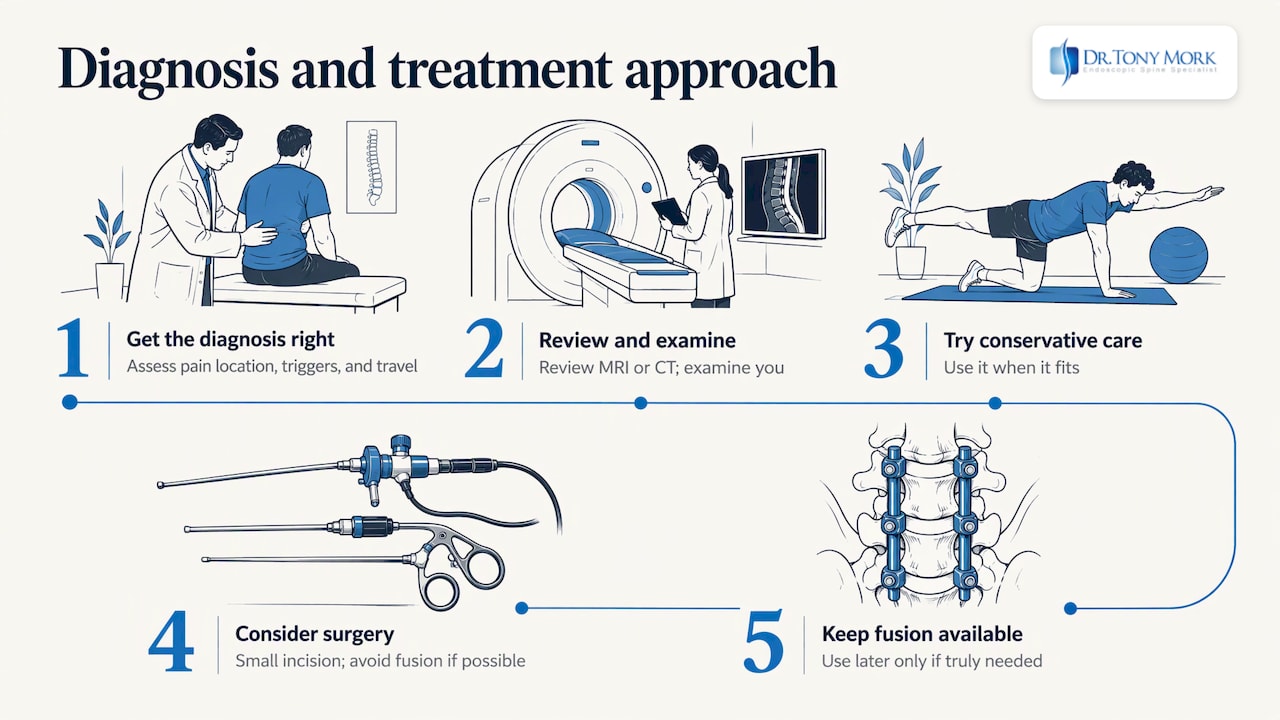
I look at the full picture. I ask where the pain is, what position makes it worse (sitting, driving, bending), and whether it travels. I review your MRI or CT images and examine you. When hip and hernia checks are clear and the pattern fits a spinal nerve, we talk about whether the disc, a facet joint or a narrowed nerve opening is the likely source.
If you cannot travel, my practice offers remote review of MRI and CT scans. You can upload your images and I will look at them personally. My endoscopic spine surgery page explains what the procedure involves.
My view on groin pain that starts in the back
I have seen many people who were told that the groin pain was in their head, or that nothing was wrong because the hip and hernia tests were clear. The spine is a common and overlooked source.
My approach is simple to state. Get the diagnosis right first. Use conservative care when it fits. When surgery is the right step, remove the source of pain through a small incision, without fusion if possible. Fusion stays available later if it is truly needed.
I have performed more than 8,000 endoscopic spine procedures, and I founded the Endoscopic Spine Academy and co-founded Microspine. My concierge practice means you can reach me directly, before and after surgery.
Dr. Tony Mork
Where can I be seen?
My Irvine office is at 2102 Business Center Dr #127, Irvine, CA 92612. I also see patients at my Naples, Florida office. Many patients travel from other states for endoscopic spine surgery. My concierge spine services include direct access to me and support after surgery. Insurance may cover facility and anesthesia fees but not the surgeon’s fees.
If you want a closer look at your options, see my minimally invasive spine surgery page.
FAQ
Can a pinched nerve in my back cause testicular or tailbone pain?
It can. Nerves from the lower spine supply the groin, genital area and tailbone region. Pain there with normal hip and hernia checks is a reason to look at the spine. An exam and an MRI are needed to know for sure.
Can sitting make groin pain from the back worse?
Yes, for many people. Sitting increases pressure inside the lower discs and can narrow the nerve openings. Long drives and desk days are common triggers.
Should I see a doctor for groin pain with back pain?
Yes, if it persists, keeps returning or is getting worse. See a doctor right away for bladder or bowel changes, saddle numbness, leg weakness or fever.
Does groin pain from the back always need surgery?
No. Many back problems improve with time, activity changes, physical therapy and medication. Surgery is considered when a clear source of pain is found and conservative care has not worked.
If you have an MRI, upload it and I will review it personally and talk with you about your options. Time is on your side.
Recommended
- Back Pain Causes
- Exercises That Strengthen Your Lower Back and Prevent Herniated Discs
- Can a CT scan find the cause of my back pain?
This article is for general education and is not medical advice. Please see a qualified doctor about your symptoms.