
If you have been told you need cervical fusion, you usually have other choices. They fall into three groups: structured nonsurgical care, motion-preserving surgery such as cervical disc replacement, and decompression procedures that remove only the tissue pressing on a nerve or the spinal cord. Which one fits depends on what is compressed, how many levels are involved and how long you have already tried conservative care. This guide explains each option, who tends to qualify and what to ask before you decide.
TL;DR
- Most cervical radiculopathy (pinched nerve in the neck) improves without surgery, so a supervised nonsurgical trial often comes first.
- Cervical disc replacement is designed to keep motion at the operated level. Long-term studies show results comparable to fusion, with fewer repeat operations in some comparisons.
- Decompression, including endoscopic approaches, removes the disc or bone pressing on a nerve and does not always require fusing the vertebrae.
- Not everyone qualifies for every option. Deformity, osteoporosis and severe joint degeneration can point toward fusion.
- A second opinion based on your own MRI is the fastest way to learn which options apply to you.
Table of Contents
- Why people look for an alternative to cervical fusion
- Option 1: Nonsurgical treatment done thoroughly
- Option 2: Cervical disc replacement
- Option 3: Decompression without fusion
- Side-by-side: fusion and its alternatives
- Options you will see advertised, and how to think about them
- Can a cervical fusion be reversed?
- What we think: motion and nerve decompression first
- How to decide: a practical checklist
- Get an opinion on your own scans
- FAQ
- Sources
Why people look for an alternative to cervical fusion
Cervical fusion (most often anterior cervical discectomy and fusion, or ACDF) removes a damaged disc and joins the neighboring vertebrae so they heal into one segment. It is a well-established operation. Many patients still want to know whether there is a path that keeps more of the neck’s natural movement, or that avoids fusing at all.
The common reasons are practical:
- Loss of motion. Fusion deliberately limits movement at the treated level.
- Stress on neighboring levels. Motion-preserving surgery was developed partly to reduce the risk of adjacent-segment degeneration and disease, which can follow cervical fusion.
- Uncertainty about whether surgery is needed at all. Neck degeneration is extremely common. The American Academy of Orthopaedic Surgeons notes that more than 85% of people over 60 are affected by cervical spondylosis, and most of them never need an operation.
The same source says surgery for spondylosis is not commonly recommended unless a spinal nerve is pinched, the spinal cord is compressed, or severe neck pain has not responded to nonsurgical treatment. That is the threshold to keep in mind as you read the options below.
Option 1: Nonsurgical treatment done thoroughly
Before any operation, a proper trial of conservative care is the standard step. For a pinched nerve in the neck, Cleveland Clinic lists immobilization, medication, physical therapy and cervical epidural steroid injections as the nonsurgical tools. Medication may include NSAIDs or a short course of oral corticosteroids. A soft collar may be used briefly, typically no more than one to two weeks.
The same page reports that more than 85% of cervical radiculopathy cases resolve within 8 to 12 weeks without specific treatment. That is a strong reason not to rush.
Physical therapy for cervical spondylosis generally runs 6 to 8 weeks, two to three sessions a week. If you tried a few visits and stopped, you have not really tested it. If you completed a full course and your arm pain, numbness or weakness persists, that is useful information for your surgeon.
Two cautions belong here:
- Progressive weakness, clumsy hands, trouble walking or loss of bladder or bowel control can signal spinal cord compression (myelopathy). See a spine surgeon promptly rather than waiting out a therapy course.
- For degenerative cervical myelopathy, a clinical practice guideline suggests that mild cases may be offered either surgery or a supervised trial of structured rehabilitation, while surgery is recommended for moderate to severe cases.
Option 2: Cervical disc replacement
Cervical disc replacement, also called cervical disc arthroplasty or artificial disc replacement (ADR), is the alternative most patients hear about first. The surgeon removes the damaged disc, relieves pressure on the nerve and places an artificial disc designed to preserve motion. For one FDA-approved device, the manufacturer’s labeling describes removing the unhealthy disc and decompressing the nerve root before placing the implant.
What the long-term research shows
The evidence is encouraging but not one-sided:
- A 2021 position statement from the International Society for the Advancement of Spine Surgery says ADR preserves motion while fusion limits it, and that long-term studies reported similar positive outcomes, with lower secondary-surgery rates for ADR in some comparisons.
- In a 10-year follow-up of the BRYAN disc, overall success was 81.3% in the disc replacement group versus 66.3% in the ACDF group.
- In a 7-year study of 209 patients, those who received the ProDisc-C had a lower chance of later surgery than ACDF patients (7% versus 18%).
- A 10-year Swedish follow-up of 143 participants found no difference in patient-reported outcomes between ADR and fusion. In that study, the higher reoperation rate in the ADR group was mainly due to device loosening in 11 female participants.
Surgeons are also still debating the topic. A 2021 JAMA Network Open analysis noted that although randomized trials show potential advantages for arthroplasty, there is no consensus on clinical effectiveness among spine surgeons and adoption varies.
Who may qualify
FDA documents for the M6-C disc describe candidates as skeletally mature patients with intractable degenerative cervical radiculopathy who failed at least six weeks of conservative treatment or have progressive neurological symptoms. The clinical-trial participants were 18 to 75 years old and had not responded to nonsurgical care for at least six weeks.
The labeling lists contraindications that often push a patient back toward fusion:
- Advanced spinal deformity
- Advanced facet-joint degeneration
- Active infection
- Osteoporosis
- Known allergy to the device materials
In plain terms, a disc that is the main problem in an otherwise healthy, well-aligned neck is a better replacement candidate than a neck with extensive arthritis at several levels.
Option 3: Decompression without fusion
Sometimes the problem is not a failed disc that must be replaced. It is a nerve or the spinal cord being squeezed by a piece of disc, a bone spur or a narrowed nerve exit (foraminal stenosis). In those cases, decompression removes the disc or bony material compressing the structure. The FDA labeling above describes decompression as removing disc or bone that presses on the spinal cord or nerves.
Common forms include:
- Posterior foraminotomy. The surgeon enlarges the opening where a nerve root exits, working from the back of the neck, so the disc and vertebrae stay in place.
- Discectomy without fusion. Only the offending disc fragment is removed.
- Endoscopic decompression. The same goals are pursued through a very small incision with a camera and narrow instruments, which means less disturbance of surrounding muscle and bone.
The key question is whether removing the pressure leaves the neck stable enough to avoid fusion. A surgeon decides this from your imaging, your alignment and how much bone or joint must be removed. You can read more about how this applies to nerve-exit narrowing in our guide to cervical foraminal stenosis treatments.
Side-by-side: fusion and its alternatives
| Cervical fusion (ACDF) | Disc replacement | Decompression without fusion | |
|---|---|---|---|
| Main goal | Remove disc, join vertebrae | Remove disc, preserve motion | Remove tissue pressing on nerve or cord |
| Motion at treated level | Limited by design | Designed to be preserved | Natural motion left in place |
| Best suited to | Instability, deformity, multilevel disease | Single disc problem, healthy joints and bone | Nerve compression from disc fragment or narrowed exit |
| Common exclusions | Few | Deformity, osteoporosis, advanced facet arthritis | Instability, large bone removal needed |
| Evidence base | Longest track record | 7 to 10 year trials | Varies by technique and condition |
Use the table to frame questions, not to self-diagnose. Two patients with the same MRI wording can need different operations.
Options you will see advertised, and how to think about them
Some patients arrive at fusion decisions after seeing regenerative injections, dynamic stabilization devices or chiropractic care promoted as replacements. Epidural steroid injections and physical therapy have a place in nonsurgical care, as described above. For anything marketed as an alternative to surgery, ask three things: what condition it was studied in, how long patients were followed, and whether it addresses the structure that is actually compressing your nerve. If a nerve or the spinal cord is compressed, injections cannot remove the compression. They can only calm inflammation around it.
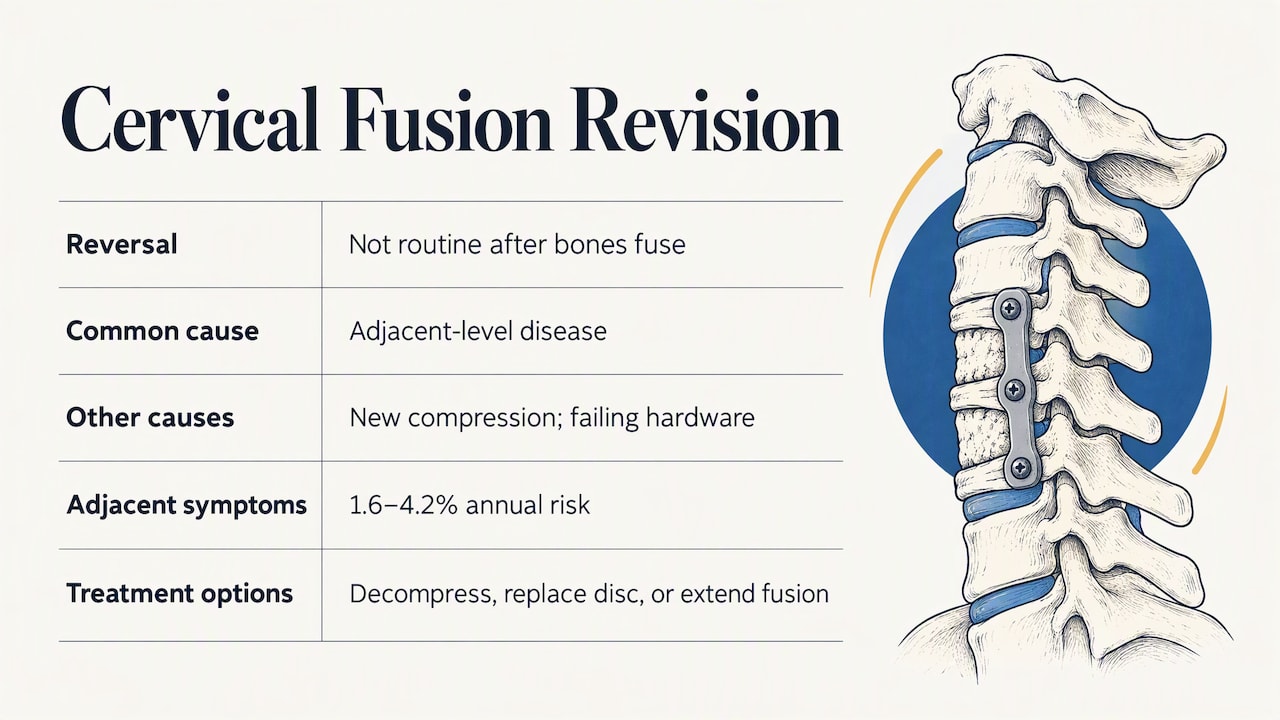
Can a cervical fusion be reversed?
Not in a simple way. Once vertebrae have fused, the bone has healed into a single unit, and reversal is not a routine operation. When symptoms continue or return, surgeons usually treat the cause instead: a new compression, a problem at a neighboring level, or hardware that is failing.
New problems at adjacent levels are the most common reason. A study of revision surgery for adjacent segment disease cites earlier research putting the cumulative risk of new symptoms at 1.6% to 4.2% per year after cervical fusion. Treatment options then include decompression at the new level, disc replacement at a suitable adjacent level, or extending the fusion, depending on imaging. This is one reason many patients want to explore every option before a first fusion.
What we think: motion and nerve decompression first
Here is our perspective at Dr. Mork’s practice. We have performed more than 8,000 spine surgeries, and the pattern we see is that patients are often told fusion is the only answer after one imaging study and one conversation. The better question is what exactly is causing your symptoms.
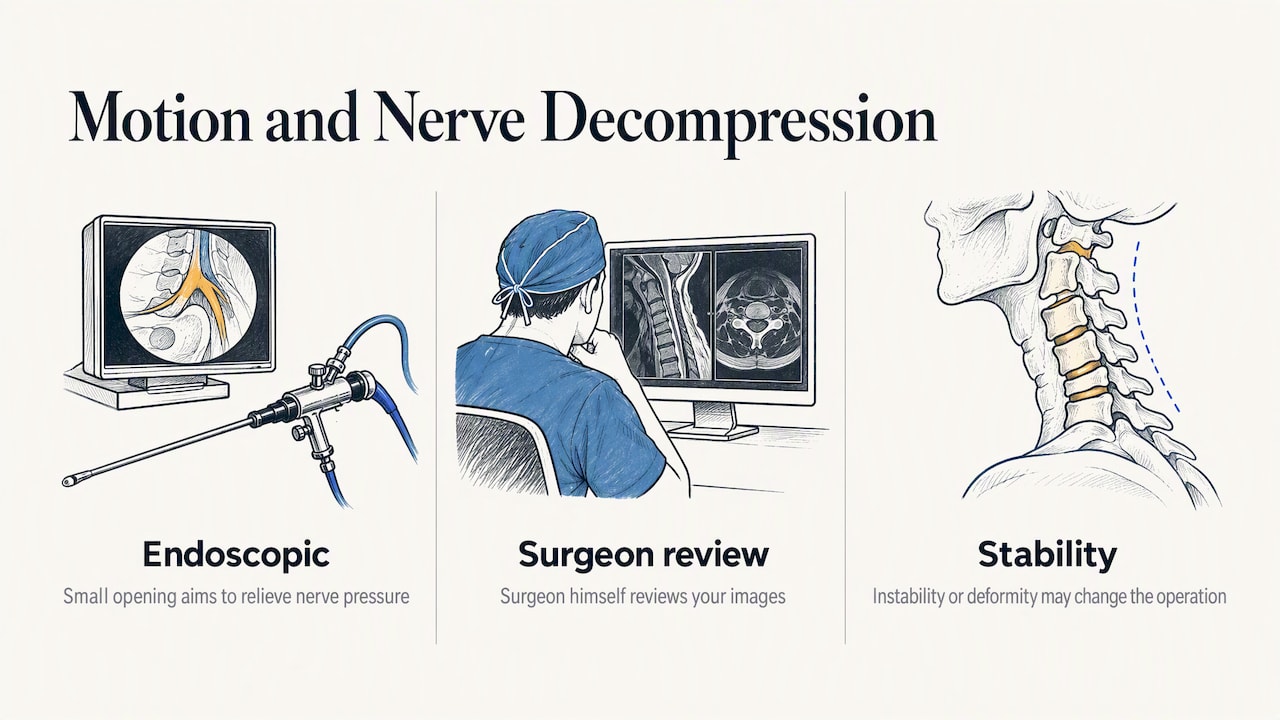
Our approach is built around endoscopic techniques designed to relieve pressure on a nerve through a small opening, with the aim of avoiding fusion and getting you back to daily activities sooner. For many nerve-compression problems in the spine, decompressing the nerve is the point of the operation, and fusing is an addition that may not be necessary. When you work with us, your images are reviewed by the surgeon himself, not a screening team, and you have direct access to him before and after surgery.
We also want you to know where our approach fits. If your neck has significant instability or deformity, an honest evaluation will say so and discuss the right operation. Our job is to match the procedure to the problem, and to make sure fusion is not recommended simply because it was the default. You can read our broader reasoning on why to consider other options than spinal fusion, and how our endoscopic procedures work.
— Eric
How to decide: a practical checklist
- Confirm the diagnosis. Ask which structure is compressed (a nerve root, the cord or neither), at which level, and whether your symptoms match the imaging. Sometimes the pain generator is not where the MRI looks worst. Our guide to diagnosing foraminal stenosis shows how that process works.
- Document your conservative care. Note dates, therapy duration, medications and injections. Six or more weeks of real treatment is a typical threshold for surgical candidacy.
- Ask about all three paths. Request an explanation of why fusion, replacement or decompression is or is not appropriate for you.
- Ask about reoperation. How often does your surgeon see repeat surgery with each approach, and for what reasons?
- Check your bone health and alignment. Osteoporosis and deformity change which options are open.
- Get a second opinion with your own imaging. Send the actual MRI or CT, not just the report.
- Understand recovery and costs. Ask about activity limits, work return and what insurance does and does not cover.
On recovery, one point is worth knowing if you do have surgery: AAOS and the American Society of Anesthesiologists advise that after major procedures such as fusion, opioids should be stopped within two weeks if possible, and within one month. Ask your surgeon for a written pain plan before the operation.
Get an opinion on your own scans
If you have been told you need cervical fusion and want to know whether a non-fusion path could work, we can review your imaging remotely. Our MRI evaluation is $100, and a one-on-one phone consultation with Dr. Mork is $200. Surgery is a direct fee-for-service procedure with payment required before the operation. Insurance may cover facility and anesthesia fees, but not the surgeon’s fee. Start at our concierge spine services page, or read about our endoscopic spine surgery.

For nerve-exit narrowing in particular, see our endoscopic foraminal decompression page.
FAQ
Is cervical disc replacement better than fusion?
Neither is better for every patient. Disc replacement is designed to keep motion, and long-term studies report similar outcomes to fusion, with fewer repeat surgeries in some comparisons. It requires healthy bone and joints and a suitable disc problem, so fusion remains the right choice for some necks.
Can I have neck surgery without fusion?
Yes, in many cases. Disc replacement and decompression procedures such as foraminotomy or discectomy without fusion are options when the neck is stable enough after the compressing tissue is removed. Your imaging and alignment determine whether you qualify.
How long should I try nonsurgical treatment first?
Physical therapy programs for neck arthritis generally run 6 to 8 weeks, and many pinched-nerve cases improve within 8 to 12 weeks. Disc replacement criteria also typically require at least six weeks of failed conservative care. Progressive weakness or trouble walking is a reason to see a surgeon sooner.
Can a cervical fusion be reversed?
Not as a routine procedure, because the vertebrae heal into one unit. If symptoms return, surgeons treat the cause, such as a new compression at a neighboring level or failing hardware, using decompression, disc replacement or extended fusion as appropriate.
Sources
- Cervical Spondylosis (Arthritis of the Neck), OrthoInfo (AAOS)
- Cervical Radiculopathy (Pinched Nerve in Neck), Cleveland Clinic
- Clinical Practice Guideline for the Management of Degenerative Cervical Myelopathy
- M6-C labeling, FDA
- M6-C Summary of Safety and Effectiveness Data, FDA
- 2021 Position Statement, International Society for the Advancement of Spine Surgery
- Ten-year outcomes of cervical disc replacement with the BRYAN disc
- ProDisc-C versus ACDF, 7-year study
- Artificial disc replacement and adjacent-segment pathology, 10-year follow-up
- The Ongoing Debate of Arthroplasty or Fusion for Cervical Spine, JAMA Network Open
- Revision surgery for adjacent segment disease after anterior cervical spine surgery
- Getting Ready for Surgery: Safe and Effective Pain Relief, AAOS and ASA